Gun control begins on deck

While assigned to a naval ship, from the early 1990s till the late in the decade,  one of my additional duties was as a watchstander .   I was part of the Quarterdeck watch which controls movement of personnel and material on and off ship while in port.    The Quarterdeck watch is made up of an Officer of the Deck (OOD),  a Petty Officer of the Watch (POOW), and a Messenger of the Watch (MOOW), under the general supervision of a Duty Section Leader and a Command Duty Officer.  We all are charged with maintaining the safety and security of the ship – or station (Installations also maintain the same structure) while the vessel is in port.

To be qualified to stand a watch on  the Quarterdeck,  each person has to complete training requirements including firearms training.   This is normally managed by a Petty Officer from the Armory,  a Gunners Mate or Master-At-Arms.   On this particular day, were at sea,  and in calm weather.     It was a time to renew my  qualifications at a “range” set up on the fantail of the ship.  We would shoot at targets in the direction of the open sea.

EUCOM Image
image courtesy US NAVY EUCOM, 7 JUL 2011

This was a time for refresher lessons on firearms safety.  Handling of pistol, rifle or shotgun,  hot weapons,  jammed rounds and so forth.   Occasionally we received instruction in prayer.  Prayer?   On one memorable occasion,  a young Sailor, we thereafter called “Barney Fife”, was on the line with four of us,  and the Range Master standing behind and to the left of our group.   At the command to “Commence Firing”, after the first or second trigger pull, there was a “Zing!”, followed by an immediate   “CEASE FIRING!!!” and “UNLOAD!”  or something to that effect.  One of our group had somehow discharged his weapon such that a slug ricocheted off the deck dangerously close to the Range Master.

Billy.   This was the same young Sailor that one of the deck seaman with sound-powered phone ( for internal ship communications) had fooled into waiting for a shore-to -ship phone call  while they both were on a sea detail.  He was a good-hearted but slow-witted guy.

Thereafter, Seaman Jones (not his real name)  was permitted to stand the Quarterdeck watch only as Messenger – and was not allowed to touch a weapon.   We were assigned to the same duty rotation, and as I was generally the OOD watchstander,   I would allow him only to stand downrange of me.   While the Gunners Mate may have pronounced a saltier blessing in our young Sailor’s direction,   I think we all were generally very thankful to the Almighty that day!

mammalian diving reflex

When I was very young I was taught to swim, and recall that I was quite fond of holding my breath and ducking underwater and pushing off to see how far I could swim before I had to come up for air.   My father had been a great swimmer my mother tells me, but when he was still in his twenties,  illness took away his athleticism.  With his DNA, I enjoyed being in the water: swimming pools, rivers, ponds, and the ocean.  With my mother’s DNA (she grew up by the Irish Sea), cold water was not preferred but also not dreadful for me.

As a pre-teen I took a Red Cross Life-Saving certification class at the community pool near our apartment building.  I had always been a good swimmer and athletic, but the certification test proved to be my brush with drowning.   The backup instructor was a huge Marine-looking man who jumped into the pool and pointed at me.    I swam toward him as trained and he started to thrash about.   Then he seized hold of me, and climbing up my shoulders, forced me under the water.   That simulation was all too-real.   Whether fear of death or anger at embarrassment,  as I started to choke inhaling pool-water, I managed to strike him as hard as I possibly could.   They awarded me the Life Saving certificate.  I don’t think the instructor wanted to advertise that a lanky kid had overpowered him.    I have told the story previously how, on a beach in Cape Cod,  my mother and I were walking along a tidal sand bar with the tide going out.  I ran ahead into a channel that appeared to be no more than knee-depth.  It wasn’t and I lost my footing in the swifty oceanward water and was washed about a quarter-mile into the Bay.   I was rescued by a couple in a power boat who were near enough to see my mother’s frantic waving and my bobbing.   In the Navy at seventeen,  it was not water that got the better of me but a failure to properly secure my gas mask in the tear gas training chamber.  Lord!  I was crying, spewing and hacking with stuff running out of me long before we all had to remove the masks and sing “Anchors Aweigh” for our boot camp instructors!    Years later, after my first enlistment ended and I was a student at the University of Arizona,  I took scuba diving lessons, certified and spent several weekends in successive summers, in the Sea of Cortez.  During one of these, I was a now, more-experienced diver paired up with a newly-qualified teen (ten years my junior).  “Jacques Cousteau” did not heed the diving limit so we found ourselves about a hundred feet instead of the sixty-foot maximum set by our dive master.    Pointing him to the surface, we were several hundred yards from the dive boat and had a challenging swim to get back to the boat.

In all the scenarios that we undertook during my second enlistment in the Navy and eight years of sea duty,  we performed a lot of dry simulations of flooding casualties to the ship.  We had hands-on training ashore for firefighting, and we had both well-lit, and blackout compartment simulations on entering, exiting, and securing compartments.  As part of the training for the Enlisted Surface Warfare qualification, I had a familiarity as well as a number of hours monitoring and performing skills that might save my life or my shipmates someday.

030126-N-1810F-002
USS John S. McCain DDG-56,  By Photographer’s Mate 3rd Class Todd Frantom – 030126-N-1810F-002 from http://www.news.navy.mil/view_single.asp?id=4306, Public Domain,  via Wikipedia
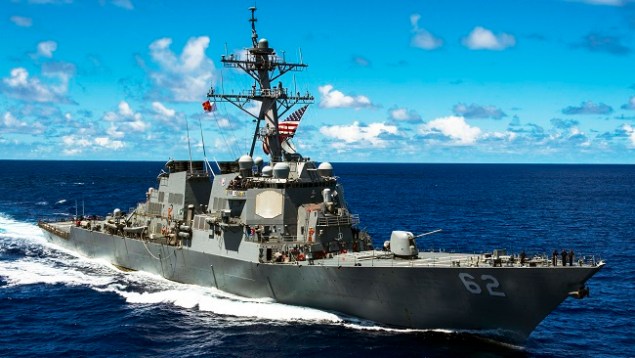
FILE: USS Fitzgerald
USS Fitzgerald, DDG-62

I have no idea what has caused shipmates on two Navy combatant ships,   the USS John S. McCain, and the USS Fitzgerald, to collide with merchant ships this summer, but the intense bravery and training of the men and women who saved their ships has not been told in the questioning by observers on how that could possibly happen in the first place.  The facts will certainly be collected, studied and whether training or terrorism-related, the truth will be known.  It is the response of the crew to a potentially fatal breach of the hull that should be studied equally and used to train subsequent generations.  There were definitely those who, knowing they could possibly die, chose to try to save their shipmates in the flooded compartments instead.

Numerous injuries and the deaths of at perhaps seventeen Sailors at sea are horrible.  The mere seconds between personnel sleeping, eating breakfast, taking pressure readings, monitoring electrical panels — and the aftermath of a collision: the crushing metal, screaming men, pitch darkness, and flooding seawater, are mind-numbing for those who have not been in peril.   We should all pause and pray for those Sailors and their families.   The loss of life in combat, in training accidents, in freak-occurrences on routine days, or even the acts of a madman or terrorists are never acceptable, but the mental preparation as members of the military one might accept the possible call to put yourself in harm’s way to save your fellow service members.


where are the peacemakers?

Blessed are the peacemakers, for they will be called children of God.    (NIV) Matthew 5:9

As a younger ( admittedly, I was thirty-one years old) Sailor, I had brushes with questionable people and groups.  In Pensacola, Florida since I was trained in the use of various firearms and owned a few different weapons,  I had on occasion gone to a shooting range in the rural red-clay part of Escambia county.  One Saturday, I came home  to a message on my answering machine inviting me to join the Klan!  I never responded. It wasn’t something you mocked in person.  I presumed they got my home phone (this was long before cell phones) from the sign-in sheet at the range.   On one occasion,  when a black community group – I’m assuming a church group – would picnic in a local park,  I would notice a couple of large pickup trucks with very ‘white’ occupants  would cruise by slowly.

Those who make peaceful revolution impossible will make violent revolution inevitable. John F. Kennedy

With the whole country worked up into a frenzy over Trump, cultural identity, destruction of historical places, names and monuments, and social media,  I have to confess I have never been ashamed of my race, ethnicity, education, religion, gender, sexuality nor veteran status.   In the last forty years, I have been a card-carrying member of several national organizations: the Navy,  the Veterans of Foreign Wars (VFW),  Fleet Reserve Association (FRA),  National Cryptologic Veterans Association (NCVA), Tin Can Sailors, the Navy Memorial Association, and  the American Legion.

There is no grievance that is a fit object of redress by mob law.   Abraham Lincoln

I can only speak specifically to my experience over forty years in the military and industry, that the least tolerant of different opinions, least skilled in critical thinking, and least appreciative of the benefits and blessings of the United States, are generally the ones raised and taught by non-veterans.  I served with and was mentored by some of the most professional, inspiring, and capable leaders, female and male,  black, hispanic, asian, and white.  I would march into hell itself with these role models leading me.  When there needs to be leadership, from the local school board, up to and including the White House, the military-trained leader needs to step up.

Men make history and not the other way around. In periods where there is no leadership, society stands still. Progress occurs when courageous, skillful leaders seize the opportunity to change things for the better. Harry S Truman

***  5, U.S.C. 3331 codified in 1868, that all Federal employees take an oath to work within the bounds of the Constitution, to support the government and not to circumvent it.  It was part of the healing process to re-unite the defeated Confederacy.   Part of the oath states support for the Constitution and to oppose all enemies, “foreign and domestic”.