Ask the Chief: balloon hullabaloo

A Chinese high altitude balloon carrying equipment has been carried along in the atmosphere over the United States this past week causing all sorts of ruckus. Their government has responded to United States that it was accidental, and not intentional, violation of our national sovereignty. While the balloon has maneuvering capability and seems to possess a sophisticated payload, the Chinese government claim, that it is an off-course weather balloon, is laughable. It would have been more credible had they claimed it was high altitude survey of their investments in the United States (the Chinese have invested some $200 Billion in the past quarter-century in US businesses and real estate). Though the U.S. Defense Department says the balloon has not ventured over sensitive military installations, and the Government has not ordered it to be shot down, one wonders whom is leading who on. At a time when the Chinese government has trillions of dollars at their disposal, building aircraft carriers, orbiting space platforms, and conducts espionage via HUMINT (spying on government officials, theft of intellectual property and technology by foreign agents) and COMINT (intercepting radio transmissions and hacking into computer networks), this balloon seems to be very low tech espionage for an adversary.

To gain military or economic advantage, nations have engaged in surveillance or intelligence gathering of their rivals for millennia. With the invention of radio communications, ELINT (electronic intelligence) grew exponentially as each nation devised more sophisticated means to mask their operations. With the satellite era, FISINT (foreign signal intelligence) was developed to intercept and analyze telemetry, determining a potential adversary’s capabilities and intentions. All of these have prompted increasingly sophisticated means of securing them from observers.

Determined adversaries view the long game to achieve their objectives. Years before the Second World War, Imperial Japan was sizing up the military capabilities of the United States to thwart their territorial ambitions. The US was then also decrypting their communications, which facilitated the Allies in reversing their early military successes and shortened the war in the Pacific. Since the end of World War II, the Cold War competition between two nuclear-armed adversaries seemed only to conclude when the economic cost to the Soviet Union became unsupportable. At the same time, China has also developed nuclear weapons, and provided enormous support to North Korea and North Vietnam militarily and economically, in two conflicts with the United States. In negotiations beginning with the Nixon Administration in the early 1970s, the economic benefit of a global market open to China has created their global power.

China is a different economic competitor and adversary. More students in China pursue engineering and science training than in the US or in Europe. International corporations with offices in the PRC have nationals working around the globe. With wealth from international consumers, the PRC has provided foreign aid to build (Chinese) militarily and politically-useful seaports, industrial capacity, and resource development around the globe. A balloon floating over the United States might be calculated to test our response, as a metric to China’s long-term foreign policy objectives. Two years of a global pandemic that originated in the PRC due to a failure at a government virology lab, and subsequent obfuscation by their government and officials in foreign nations (with ties to the PRC), lend themselves to being tools of future conflict. Another balloon carrying a biological agent does not seem farfetched.

The PRC has conducted increasingly bold military maneuvers near Taiwan, and is likely monitoring regional powers’ response to its client, North Korea’s, missile tests. However preoccupied the United States is with domestic problem, overt military action against Taiwan in the coming year may be a last option in their Party chambers. Through a century of international agreements, should an adversary attack a treaty partner (Taiwan), the United States will enter the fray. A surveillance balloon over the United States might be a metric to gauge whether the United States populace would be prepared to support that.

After this was published, it appears that the United States did shoot down the balloon as it crossed over into the Atlantic airspace. -February 4,2023. We know it had no civilian-use payload, as it would otherwise have been launched from a Walmart or an Amazon facility – the route most Chinese products go through.
A veteran and an entrepreneur

A beautiful afternoon in San Diego seemed like a nice opportunity to enjoy a cigar and watch birds from my front patio. These are some of the perks of being self- employed.

A young guy – anyone appearing under 45 is looking young – approached me with a flyer advertising his real estate business. We got to talking about cigars, work, dogs, and the benefits of being self-employed. He, too, is a Navy veteran who worked in electronics engineering, deciding there was a better way to earn a living in San Diego. He started buying and fixing up houses and then went the additional step of becoming a realtor.

As a video interview via Facebook, with actor Morgan Freeman, also a veteran, affirmed, we limit ourselves and make excuses. He absolutely confirmed the American Dream is possible if one is willing to put in the work.

on safari liberty

It does not take much to get old Salts, or two military veterans chatting like old friends. As a perk of his new job at the San DIego Zoo and Wild Animal Park, our son and his co-workers invited parents to go on a “safari” with them yesterday. Seeing giraffes, buffalo, zebras and gazelles in a more natural environment of several hundred acres, from the inside, was awesome.

In the course of getting to know our fellow travelers, I met Dave whom I instantly recognized shared a Navy connection with me. Though a submariner, a “bubblehead”, his quip “I could tell you what I did but I’d have to kill you,” is humorous code for those of us who performed duties that are still governed by national security regulations. As “spooks”, intelligence and cryptologist specialties, we just shared some laughs about those times over lunch after the tour.

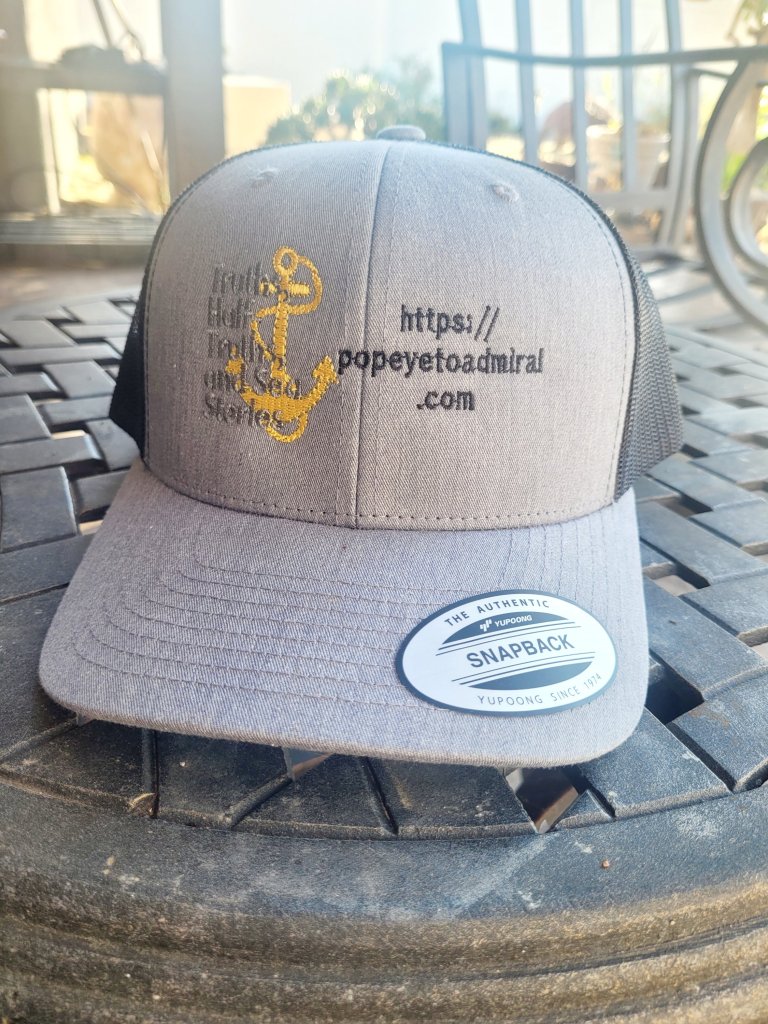
Spread the word on a Ballcap

New item

For more than 25 years, I wore a command ballcap as a working uniform item with dungarees and BDUs. And kept the caps as mementos long after retiring. I hardly go anywhere without wearing one. And they always start a conversation with another veteran.

Do you have a favorite that you wear still? A company in the Carolinas makes embroidered shirts for my employees, and last month, I contracted them to create these to spread the word about my blog dedicated to veterans and families of vets.

Building boats in the desert and the Rillito river fleet

Long before the “sand Navy” was an actual thing – those Navy servicemembers who did a tour in Afghanistan or Iraq during the war- I remember a man who was building a boat in the Arizona desert in the 1980s. While the region is still subject to monsoon flooding (late summer thundershowers that over centuries carved riverbeds flowing west and north from Tucson and elsewhere), I think the builder was overly optimistic. Until I saw what I presume was the same boat launched from the bay in San Diego some twenty years ago. There are other latter-day Noahs still building boats in a parched land. Yet, owning a boat seems to be a short-lived experience for most would-be mariners. While there are many sailing and power boats moored in marina slips all along the San Diego bays, I have seen many hundreds high and dry in storage yards far from the sea. And I live the experience through others. One of my friends, a Navy veteran, invited me out on his boat. Though I enjoyed the experience, I have not had the urge to buy one myself. It would also be another frequent chore to master; between financial and maintenance needs of boats, or cars, or homes, there are rare times to enjoy one. Perhaps, it is why I remember movies where a boat owner was spending an afternoon drinking beer, in his boat while it was stored in his driveway. But having a boat sitting in my driveway in El Cajon most of the year would remind me of one of my running jokes from long ago.

What still causes me to chuckle forty years later is my years spent at the University of Arizona when I would frequently tease a former submariner and fellow student about his participation in the “Rillito River fleet”. The Rillito is, and has been for most of the last several decades, dry but for the previously mentioned “monsoons”. Also, it was the closest non-body of water near both of our homes during that period. That he was a drilling Navy Reservist at the center located on the Davis Monthan Air Force Base at the southern end of Tucson, was amusing to me then. However, the “bubblehead” may have had the last laugh, as I too, became a Reservist there. Within less than I year, I submitted a request to return to Active Duty and subsequently spent the next twenty-three years on ships, and shore sites, from Middle East desert to tropical jungle. From performing observation and interdiction of narco-traffickers in Latin American waters, seizing smuggler’s vessels during a Haitian revolution, supporting Allied efforts in the Serbian – Croatian war, supporting no-fly zones over Kurdish Iraq, I fulfilled my promise to get back out of Arizona and go to sea.

These days I do not make light of any veteran’s membership in the “sand Navy”. They have seen and done some stuff. Whether Reservist or Active Duty Sailor, female or male, if they would have me, I would be willing to crew with them even in the dry washes of southern Arizona.

Veteran stories: a soldiers service to God and humanity

The Nuremberg trials concluded 75 years ago, obtaining convictions for Nazi officials, commanders and death camp overseers, those who orchestrated and committed genocide in World War II. World War II veteran Ben Ferencz prosecuted 22 Nazi death squad leaders for their role in murdering a million Jews. During his life he helped create the International Criminal Court in the Hague, and secure compensation for the survivors and families of Holocaust victims. At nearly 103, he is still dedicated to making the world better. Read his fascinating story, published by NBCNews January 15, 2023, here.

Putting your heart where your crow used to be

Anybody who wears their feelings on their sleeve and has a harder, crusty shell – like I do – is definitely protecting an inner sensitivity.

Fred Durst, rapper, actor, musician (Limp Bizkit)

It has been more than twenty years since I was a crewman aboard a Navy ship putting to sea. With nearly eight and half years of sea time, all but several months of which was continually away from homeport, I relished having that connection to loved ones that the mail might bring. Where an actual package might take a month to be delivered, letters normally took half that time. And when email became possible, it seemed like those were almost instantaneous messages and response. Even during a busy OPTEMPO, Sailors need that connection to be reminded that what they are doing is important and that people back home have them in mind. We used to call articles shipped from home CARE packages. Moms or wives, or girlfriends (and now husbands, boyfriends and family) sent letters, cookies, magazines, and other mementos to their loved one afloat halfway around the world.

As former shipmates know, deployments and remote duty assignments can negatively influence marriages, relationships and personal conduct. Home life as a single parent is difficult without preplanning and a support network; many young marriages are tested by months of separation, and relocation every few years to different states or even countries. Sometimes poor decisions at home, or while on deployment causes emotional and financial distress. Away from one’s family or church, personal accountability is challenged. Working and living 24 hours a day among those who may believe playing “hard” is as important as working “hard”, personal accountability is tested (“poured into” one’s rack after drinking all day with your Liberty buddies, is overlooked once or twice by your leadership, but can be career-limiting as well as unhealthy). It is for that reason that connection with one of those families or young servicemembers, having walked myself in those boondockers, is so important to me.

The idea to continuing to serve our active duty men and women while they are away from home is not new. Legion and VFW halls, and USOs have done that for a century. But what eats at me is what am I doing to help encourage others? It is fairly easy to be someone who says they support such n such. And if someone says they are a supporter, do they provide some form of material support? A donor to a cause is needed, but asks little of that person. Putting additional “skin in the game”, is the one who participates in some activity, whether writing a letter, making a phone call, or taking a CARE package to the post office and mailing it. And then there is the one who is spurred to coordinate these efforts, obtaining the names of those service members your group or organization wants to help. Like the Chief, a job needs doing, and it is the Chief who sees it through. Sometimes your sweat, tears, and time makes it seem little is being accomplished. And yet there are those who will remember how there were people who helped make the separation – deployment – bearable. Being a Chief looking after the well-being of ‘your’ people never changes whether on Active Duty or retired for more than a decade. For the last couple decades, it is the members of my church family, neighbors, friends and former co-workers I have kept in my heart. Wearing my heart on my sleeve, though I no longer have khakis or dress uniform is still to help those serving today.

Ask the Chief: Mop-N-Glo memories

I do not recall Sailors or Marines scrubbing, polishing or sweeping (on hands and knees) featured in recruiting or Hollywood military movies. But cleaning living quarters with keen eye to removing specks of dust or a random human hair helped turned generations of civilians into military personnel. Being a just-promoted Navy seaman (or fireman or airman) apprentice (E-2) or seaman (E-3) attending a Navy “Class A” fundamentals school, the officer and enlisted managers of the schools and the barracks ran them as an extension of recruit training. These school managers were fastidious in weekly inspections of barracks rooms and our uniforms; we grumbled among ourselves to prefer being sent straight to the “Fleet”.


“A School” was just as much about learning Navy “life hacks” as it was about acquiring one’s trade fundamentals. And acquiring a perspective how to work “smarter, instead of harder”. After the first or second inspection, we would seek out the ‘skinny’ to obtain best result with the minimum output of effort. For dress uniform inspections, we learned of a local shop that specialized in neckerchief rolling, or ribbon-mounting (having only one, a National Defense ribbon as a recent enlistee, the shop catered primarily to senior military enlisted and officers). Though we had some who proudly shined their leather shoes to perfection, most of us purchased Corframs, patent-leather shoes as soon as we could.

It was some of our “Fleet returnees”, sailors and Marines returning for formal training, who gave us techniques to dazzle the inspectors. We learned quickly. Knowing that even a “spotless” room might receive an arbitrary review for “uneven” sheen using the Navy-standard floor wax and electric floor buffer, the secret these “salty” E-4s and E-5s passed us, involved the use of an acrylic liquid wax like Mop-N-Glo. Both techniques required ‘elbow grease’ and an absolutely clean, cleanser-free, surface. But the latter was applied with sponges. As the acrylic would be as easily marred by shoe scuffs, we all agreed to walk in our socks once inside the doorway.

Sometimes we might make two consecutive inspections before having to deep clean and reapply acrylic. As we learned later, many of the school staff would be more diligent when inspecting a barracks room that had a “Fleet returnee” in it. These were the first of many ‘life hacks’ I would acquire as a result of military experiences. Though I have not used a buffer nor Mop-N-Glo in 30 years, memories return when I visit a home where the resident has a sign requesting shoes to be left at the doorway. And if I have an appointment at an office building or military base, the sheen on the floor triggers silent appreciation for the “buffer technician”.

Ask the Chief: honoring the Flag

Everywhere I go, I meet a veteran with a story that teaches me something about us as Americans. Some I meet are veterans of WWII and Korea, and some are quite a bit younger as veterans of combat tours in Afghanistan or Iraq. Others recall some detestable conduct they experienced from fellow Americans – incidents of racism, bigotry, or suspicion- but joined the military because of the promise that America meant to them. Some gave up promising careers to go defend America after September 11th. And quite a few I meet are immigrants who were willing to give up everything including their lives, to join the military, fight for the United States and earn citizenship.

Do you know the meaning of each fold of a properly folded American flag?

-George x, veteran and filmmaker

In a little motel office not far outside Yosemite National Park, my wife and I met the “staff”, George, who today was the snow shoveler, registration clerk and information concierge. We chatted this evening when we went looking for hot water to make cocoa, and he was very proud to share with us a story and a video about the American Flag. As a foreign-born American soldier, he earned citizenship through his wartime service. As a film student not long after his enlistment ended, a conversation with a Vietnam veteran sparked the momentum to make a documentary on the meaning of the Flag. With the participation of several notable Hollywood actors and military veterans, he produced the film directed by John Duffy. George gave us a DVD copy of “The Flag” which he promised “gives something to watch when the TV reception here is not good”.

Even as a retired Navy Senior Chief, I couldn’t immediately recall what the 13 individual folds of the flag I lowered and folded 3 decades ago meant, when it was my duty to execute with precision at Evening Colors. But the United States ensign has meant a great deal to me and my family for generations. Like one of the scenes in the film recreated what spurred a Vietnam vet’s interest in getting this film made. The idea that Americans would think it appropriate to burn an American flag, for whatever protest they have with our Government’s bureaucrats and elected officials, still wells up the same response from veterans. Like me, it might be fury at the disrespect shown veterans who have defended the principles, people, and homeland of the United States; and disappointment that people, never having suffered what most of the world has endured, trash symbols that give them more freedoms and choices than most.

  • First Fold: A Symbol of Life
  • Second Fold: Symbol of our belief in eternal life
  • Third: made in honor and remembrance of the veteran departing our ranks, and who gave a portion of his or her life for the defense of our country to attain peace throughout the world
  • Fourth: represents our weaker nature; as American citizens trusting in God, it is Him we turn to in times of peace, as well as in times of war, for His divine guidance
  • Fifth:  tribute to our country. In the words of Stephen Decatur, “Our country, in dealing with other countries, may she always be right, but it is still our country, right or wrong.”
  • Sixth: is for where our hearts lie. It is with our heart that we pledge allegiance to the flag of the United States of America, and to the republic for which it stands, one nation under God, indivisible, with liberty and justice for all.
  • Seventh: is a tribute to our Armed Forces for it is through the armed forces that we protect our country and our flag against all enemies, whether they be found within or without the boundaries of our republic.
  • Eighth: is a tribute to the one who entered into the valley of the shadow of death, that we might see the light of day, and to honor our mother, for whom it flies on Mother’s Day.
  • Ninth:  a tribute to womanhood. It has been through their faith, love, loyalty and devotion that has molded the character of the men and women who have made this country great.
  • Tenth: a tribute to father, who has also given his sons and daughters for the defense of our country since he or she was first born.
  • Eleventh: represents the lower portion of the seal of King David and King Solomon and glorifies God of Abraham (honored by Jew or Muslim)
  • Twelfth: represents an emblem of eternity and glorifies God the Father, the Son and Holy Ghost.
  • Thirteenth: when the flag is completely folded, the stars are uppermost, reminding us of our national motto, “In God We Trust.”

Ed: This list is explained in the documentary, and this same description is given on military.com; some websites, including government sites, incorrectly attribute the folds to represent the original 13 colonies.

Ask the Chief: toxic exposure

Veterans and their families must take the initiative to obtain healthcare we are due as a result of military service. Veterans must recognize that any large bureaucracy moves slowly as a result of myriad policies, procedures, and claimants seeking redress. But recognition of one’s “adversary” does not mean avoiding redress of wrongs. As history taught, determined veterans and others exposed to ionizing radiation associated with nuclear weapons used against Hiroshima and Nagasaki, as well as the Nevada desert and Pacific atoll ranges, were determined to obtain treatment from the Government. Similarly, civilians, shipyard workers and veterans’ exposure to asbestos insulation dust caused lung damage and incidents of cancer; public pressure resulted in nationwide asbestos removal and medical treatment for the afflicted. Certain cleaning solvents (e.g., trichloroethylene up through the 1970s) and repeated exposure for decades to PCBs – Polychlorinated biphenyl – used as insulating and coolant agents, sickened people and forced cleanup and care for those affected. Toxics leached into drinking water within military installations, exemplified by the Camp Lejeune Marine Base and elsewhere originating decades ago have become legal issues. Recently, the Government was forced to assume responsibility for troops exposed to toxics from Burn pits, disposal of trash and sewage with ignited diesel fuel – at camps during the wars in Iraq and Afghanistan. Among veterans who were deployed to the Mid-East since the Gulf War in 1991, a number have maladies that resist determining a cause. Since the 1990s, medical professionals have identified about a third of Gulf War veterans suffering problems grouped as Gulf War Syndrome.

Recent data studied by the U.S. Census Bureau (2018) indicates that living veterans number about 7 percent of the U.S. population. While servicemembers might risk injury and death from combat, many faced hazards from the conditions they worked within while working and living with toxic substances. These substances may contribute or aggravate, even decades later, health conditions. While it seems logical that these should be diagnosed and treated as the responsibility of the Government, it is an unfortunate necessity to apply political pressure and bring public scrutiny when an illness is as a result of military service. In the modern era, many voices clamor for Government services. Veterans who do not clamor louder that other constituents may not get heard.

civilizations, past and present owe sailors a debt

As a Christmas gift, one of our sons gave me a book, The Sea & Civilization: a Maritime History of the World, (2013) by Lincoln Paine. I have always been interested in history, and yet I never had a concise history describing the rise of civilizations around the globe. From Lincoln Paine’s Introduction and into the first chapter, Sailors have played a major role in enabling the rise of cultures across Oceania (across the Pacific Ocean), North and South America, and the Caribbean islands, and elsewhere. For most of us, the history we were taught, particularly in North America and western Europe, focused solely on how Europeans explored the world, encountering mostly primitive peoples. In recent decades, new research into those explorers who chronicled their voyages, and new archaeological discoveries reveal that people thousands of years earlier than either Greeks or western Europeans had fairly advanced maritime cultures, navigated great distances and established wide trade networks. I will repost with observations of what was learned that challenges my previous notions in maritime history.

Perhaps as my readers encounter well written and thoughtful books of interest to the Maritime-minded, you will take the opportunity to share these with me and others. I hope to develop a reading list early this year on maritime history, leadership, storytelling, boatbuilding, science, and biographies of some notable men and women who have dared to put to sea and returned victorious.

Ask the Chief: no one is coming

On social media, a former Green Beret, Scott Mann, succinctly describes veterans’ loss of confidence in the United States Government after the debacle which allowed the Taliban fighters who sheltered the 9/11 terrorist network to retake the country of Afghanistan. If the aim of the United States was to punish an ideology that murdered thousands in the United States, and to convince that ideology’s adherents to abandon those efforts, the cost in lives, injury, emotional and physical suffering over twenty years failed. Changing a fourteen hundred year old culture of Islamic traditions, tribalism, misogyny, and history of repelling foreign invasion by military occupation, electrification, and educating young women was unlikely to be permanent in one generation. It was the same lesson the Soviets learned and the British before them. The lessons that America’s hasty exit left in the minds of adversaries and allies, is that the United States can be defeated when drawn into a long, bloody conflict with facile understanding of its adversaries. It is the historical view that politics at home shifts America’s commitment. With such an eventual outcome, it emboldens her adversaries, economic and military, to convince nations with strategic geopolitical importance to partner with them. While nations like Russia rattle sabers (nuclear weapons, natural gas supplies) against Europe, annex the Crimea region and invade the Ukraine (which has proven to be Putin’s equally bloody miscalculation), Iran continues to develop weapons and relations with regimes that do not favor the US nor its allies; North Korea continues development of nuclear-capable missiles; and China builds bases, militarily-useful seaports and industrial capability globally. It also flexes naval power to remind the United States that it plans to eventually retake Taiwan. The seeds of future conflict with the United States, to support alliances or to defend trading partners, is being sown all the time. Meanwhile the United States military has experienced an internal conflict shifting resources and capabilities to align with societal change in identity- gender, attitudes ( regard for authority, character, politics). Accidents, expensive but short-lived weapon systems, and ethically-challenged members in the officer and enlisted ranks (bribery, sexual abuse, and “loss of confidence” in those chosen to command) reflect deficiencies in training, design, threat analysis, and personnel selection.