Ask the Chief: barter economy

Ask any Navy veteran about the barter economy, and most of us have engaged in it. We knew it as “comshaw”, which was anything we obtained outside of official channels, generally by bartering items we may have more abundantly, or obtained as something we might use to trade with another division, department, station or military branch for an item we needed. I experienced this firsthand when I was authorized by my department to shop at the DOD/ GSA store at the shipyard for items we needed before deploying. A fellow Petty Officer on a ship across the pier needed an item we were authorized to purchase, but his shopping manifest did not authorize it. We managed to do a little third party transfers with other shoppers to trade up to what he needed. And it came with a guarantee to provide me with something when needed in return. Sometimes, a supply Petty Officer must use forward thinking to anticipate what is a good trade and whom to count on to return a favor.

What brings this to mind many years later is the current state of our economy. It seems that just about everything that homeowners and entrepreneurs may find necessary (or effective) is either prohibited by the State, too costly, or comes with excessive taxes, permits or other fees. A solvent for a barbecue grill, legal in many states, was returned to the shipper, and my purchase rescinded (Amazon). Or another example, a preservative that is effective for concrete in extreme environments is not legal here; however, a less-effective preservative with many of the same “aerosols”, is legal, but requires double or triple applications during the same multi-year effectiveness of the former single application. Sometimes it is just a little difficult to obtain something – the toilet paper or meat and egg supply issues in recent years come to mind- while others may have a sufficiency. Perhaps they might be willing to trade these for another item or service of value? It was not all that long ago that I read about a champion of barter, who had started with an older but valuable item (I think it was a musical instrument) and successively traded up to obtain real estate.

Many years ago, our accommodations in the seaside Mexican town where my buddies and I went scuba diving were paid for with equipment and other goods from the United States that then were difficult to obtain in Mexico. Today, as the cost of maintenance and repair for household or mechanical items escalate, and the government continues to find additional ways to collect sales and income taxes from the middle class, I wonder whether a barter system that circumvents cash and credit transactions will become more popular.

Comshaw may be the way of the future.

Ask the Chief: an entrepreneur’s approach to social media

As my wife and ISIC (Immediate Superior In Command), reminds me, opining, responding to, or worse, instigating a diatribe via social media is bad for business. In the last century, word of mouth, newspaper, radio and television advertising, storefronts and mail order were means to get products and services to consumers. Developing repeat business from clients was more easily obtained and was often a local market. It is almost exclusively through social media or websites that consumers are aware of an entrepreneur’s product or service today. Social media giants such as Facebook, Twitter, Meta (Google), Tik-Tok or distributors such as Amazon are the primary means to advertise an entrepreneur’s wares. Inciting negative publicity can diminish a product or service’s availability on these platforms. (These companies also depend on consumers to regularly return to their platforms for profitability.)

As a result, when an inflammatory post, or even something innocuous that may appeal to an entrepreneur’s morals and personal beliefs, social media can quickly become a murky pool in which the original intent or comment is lost. As we have seen frequently, companies such as Facebook or Twitter can limit exposure for certain content. It might be a battle of wills with one claiming censorship and the other inflammatory rhetoric, but small businesses cannot afford loss of market share. This is the unfortunate reality today that we be friendly toward all.

Legal tender has no morals.

Ask the Chief: balloon hullabaloo

A Chinese high altitude balloon carrying equipment has been carried along in the atmosphere over the United States this past week causing all sorts of ruckus. Their government has responded to United States that it was accidental, and not intentional, violation of our national sovereignty. While the balloon has maneuvering capability and seems to possess a sophisticated payload, the Chinese government claim, that it is an off-course weather balloon, is laughable. It would have been more credible had they claimed it was high altitude survey of their investments in the United States (the Chinese have invested some $200 Billion in the past quarter-century in US businesses and real estate). Though the U.S. Defense Department says the balloon has not ventured over sensitive military installations, and the Government has not ordered it to be shot down, one wonders whom is leading who on. At a time when the Chinese government has trillions of dollars at their disposal, building aircraft carriers, orbiting space platforms, and conducts espionage via HUMINT (spying on government officials, theft of intellectual property and technology by foreign agents) and COMINT (intercepting radio transmissions and hacking into computer networks), this balloon seems to be very low tech espionage for an adversary.

To gain military or economic advantage, nations have engaged in surveillance or intelligence gathering of their rivals for millennia. With the invention of radio communications, ELINT (electronic intelligence) grew exponentially as each nation devised more sophisticated means to mask their operations. With the satellite era, FISINT (foreign signal intelligence) was developed to intercept and analyze telemetry, determining a potential adversary’s capabilities and intentions. All of these have prompted increasingly sophisticated means of securing them from observers.

Determined adversaries view the long game to achieve their objectives. Years before the Second World War, Imperial Japan was sizing up the military capabilities of the United States to thwart their territorial ambitions. The US was then also decrypting their communications, which facilitated the Allies in reversing their early military successes and shortened the war in the Pacific. Since the end of World War II, the Cold War competition between two nuclear-armed adversaries seemed only to conclude when the economic cost to the Soviet Union became unsupportable. At the same time, China has also developed nuclear weapons, and provided enormous support to North Korea and North Vietnam militarily and economically, in two conflicts with the United States. In negotiations beginning with the Nixon Administration in the early 1970s, the economic benefit of a global market open to China has created their global power.

China is a different economic competitor and adversary. More students in China pursue engineering and science training than in the US or in Europe. International corporations with offices in the PRC have nationals working around the globe. With wealth from international consumers, the PRC has provided foreign aid to build (Chinese) militarily and politically-useful seaports, industrial capacity, and resource development around the globe. A balloon floating over the United States might be calculated to test our response, as a metric to China’s long-term foreign policy objectives. Two years of a global pandemic that originated in the PRC due to a failure at a government virology lab, and subsequent obfuscation by their government and officials in foreign nations (with ties to the PRC), lend themselves to being tools of future conflict. Another balloon carrying a biological agent does not seem farfetched.

The PRC has conducted increasingly bold military maneuvers near Taiwan, and is likely monitoring regional powers’ response to its client, North Korea’s, missile tests. However preoccupied the United States is with domestic problem, overt military action against Taiwan in the coming year may be a last option in their Party chambers. Through a century of international agreements, should an adversary attack a treaty partner (Taiwan), the United States will enter the fray. A surveillance balloon over the United States might be a metric to gauge whether the United States populace would be prepared to support that.

After this was published, it appears that the United States did shoot down the balloon as it crossed over into the Atlantic airspace. -February 4,2023. We know it had no civilian-use payload, as it would otherwise have been launched from a Walmart or an Amazon facility – the route most Chinese products go through.

A veteran and an entrepreneur

A beautiful afternoon in San Diego seemed like a nice opportunity to enjoy a cigar and watch birds from my front patio. These are some of the perks of being self- employed.

A young guy – anyone appearing under 45 is looking young – approached me with a flyer advertising his real estate business. We got to talking about cigars, work, dogs, and the benefits of being self-employed. He, too, is a Navy veteran who worked in electronics engineering, deciding there was a better way to earn a living in San Diego. He started buying and fixing up houses and then went the additional step of becoming a realtor.

As a video interview via Facebook, with actor Morgan Freeman, also a veteran, affirmed, we limit ourselves and make excuses. He absolutely confirmed the American Dream is possible if one is willing to put in the work.

on safari liberty

It does not take much to get old Salts, or two military veterans chatting like old friends. As a perk of his new job at the San DIego Zoo and Wild Animal Park, our son and his co-workers invited parents to go on a “safari” with them yesterday. Seeing giraffes, buffalo, zebras and gazelles in a more natural environment of several hundred acres, from the inside, was awesome.

In the course of getting to know our fellow travelers, I met Dave whom I instantly recognized shared a Navy connection with me. Though a submariner, a “bubblehead”, his quip “I could tell you what I did but I’d have to kill you,” is humorous code for those of us who performed duties that are still governed by national security regulations. As “spooks”, intelligence and cryptologist specialties, we just shared some laughs about those times over lunch after the tour.

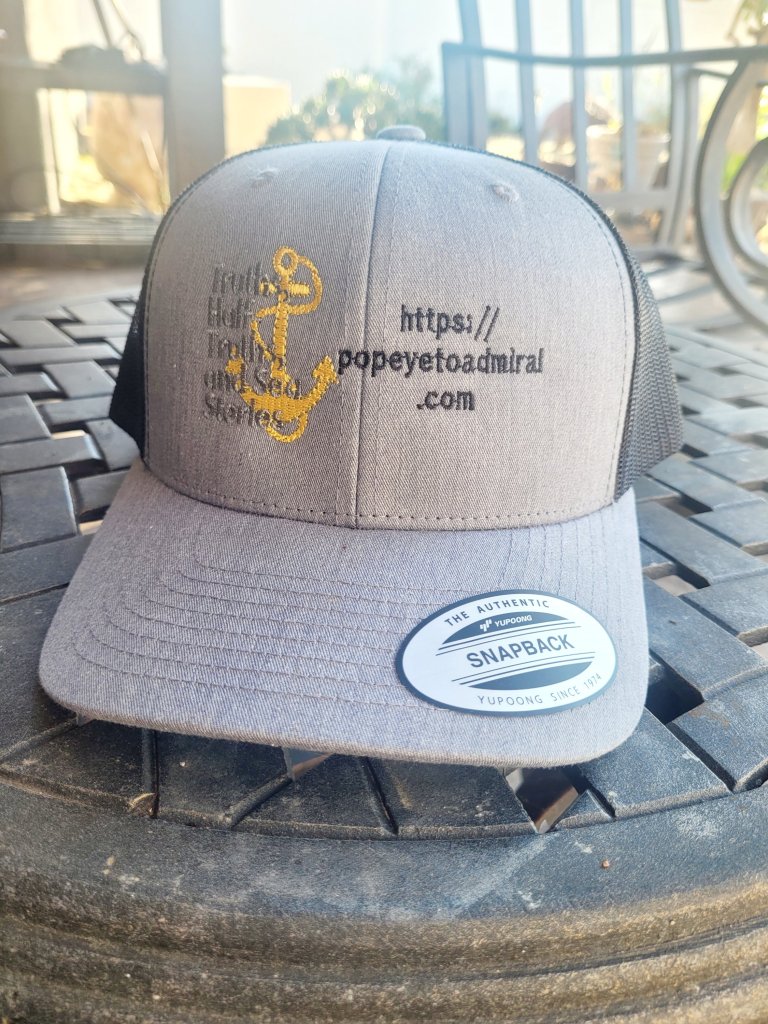
Spread the word on a Ballcap

New item

For more than 25 years, I wore a command ballcap as a working uniform item with dungarees and BDUs. And kept the caps as mementos long after retiring. I hardly go anywhere without wearing one. And they always start a conversation with another veteran.

Do you have a favorite that you wear still? A company in the Carolinas makes embroidered shirts for my employees, and last month, I contracted them to create these to spread the word about my blog dedicated to veterans and families of vets.