Reading Linda’s (mainepaperpusher‘s Everyone Else Has the Best Titles) recent blog post of everything she has collected over the years, I have not -so-fond memories of the random hobbies and collections I had up until I joined the Navy at 18. Fortuitously, I had Navy training at an age before I had my own home and a place to fill with random things. As any Sailor can attest, there was a time that a green canvas seabag contained everything that we would need for the foreseeable future. it had straps affixed to it so we carried it when we moved. And it weighed a ton. We were not provided wheeled luggage nor a handcart. One bag is what we were allotted.
Amazing things, seabags. Going back forty years – I imagine today there are focus groups and management training ( a result of a decade of liberal tinkering with a military) that have minimized how much a Sailor actually has to carry. I recall as young recruits you were alternately told to get “your shit in one sock”. or that “your mama” or “your girlfriend” was “not issued to you in your seabag” so you had better “suck it up!” Getting excrement in one sock always makes me laugh. But then I have encountered more than I can count on two hands, people who couldn’t get their “shit” together. Period. But for those curious souls, here’s a recent official listing of a Navy seabag’s contents:
Male: ( item, quantity)
All-Weather Coat, Blue 1
Bag, Duffel 1
Belt, Web, Black, W/Silver Clip 2
Belt, Web, White, W/Silver Clip 3
Buckle, Silver 2
Cap, Ball 2
Cap, Knit 1
Coveralls (Navy), Blue 2
Gloves, Leather, Black 1 pr.
Group Rate Mark, Black 3
Group Rate Mark, White 4
Hat, White 3
Jacket, Blue Working 1
Jumper, Blue Dress 1
Jumper, White Dress 2
Neckerchief 1
Necktie, Black 1
Peacoat 1
Shirt, Winter Blue 2
Shirt, Navy Working Uniform 4
Shirt, White Short Sleeve 2
Shoes, Dress Black 1 pr.
Shoes, Safety Chukka 1 pr.
Sock, Cotton/Nylon, Black 6 pr.
Sweater, Pullover Jersey 1
Towel, Bath 4
Trouser, Broadfall, Blue 1 pr.
Trousers, Poly/Wool, Dress Blue 2 pr.
Trousers, Navy Working Uniform 4 pr.
Trousers, White 2 pr.
Trousers, White Jumper (CNT) 2 pr.
Undershirts, White 8
Undershirts, Blue 8
Undershorts, White 8
Yellow PT Shirt 2
Blue PT Shorts 2
Gym Shoes 1 pr.
That seabag held everything the Navy required you to have. And “properly stowed”, it all would fit aboard ship in your “coffin locker”, the small storage that made up part of your rack. Of course, as we got more seasoned, traveled to different ports, gained some rank and privileges, we tended to stuff various equipment cabinets, voids, lockers of Sailors on leave, and our workspaces — especially if darkened – with our crap: counterfeit perfumes from the Middle East, persian rugs, leather goods, soapstone chess sets, inlaid mother of pearl wood, carvings and so on. Sometimes we replaced – that is, shipped home, a lot of the stuff that we weren’t wearing, so we could stow the other stuff. And every so often, one of the senior officers would pull a “uniform inspection” particularly if more than a few Sailors didn’t have the “prescribed Uniform of the Day” but did have several hammocks, knockoff women’s purses, a few brass knuckles, or a hookah stuffed in his coffin locker.
I learned that if I couldn’t carry it, I didn’t need it. And everytime I transferred from one ship to another, if it didn’t fit in my car, I probably didn’t need it. Boxes and boxes of books were donated to the local library (loading dock) when I left that town.
A decade later, I still have several complete uniforms, with ribbons and name tags hanging in the back of my closet. I’m still too fat to wear them on the prescribed annual holidays. My soldier son can have my foreign trinkets. But he will have a sufficient number of socks stuffed already. And I imagine that my younger sons won’t have a lot of stuff to go through when I’m gone.
Maybe they’ll find my old seabag. And try to figure out how, since it is clearly impossible, why the old Chief always said you were never issued “a wife in your seabag”.
The most expensive hobby a rich man could have is a boat, and the second most expensive hobby he could have is a very old house.
– Barbara Corcoran
Hobbies for the rich and powerful, are several orders of magnitude above what I or my co-workers can afford to enjoy. I take a week-long cruise with six thousand fellow passengers to the Caribbean. A billionaire rents an island and charters guests to it. A friend leases a quaint home in an Italian town using AirBnB; an executive I know rents a villa in Florence for a month and brings his entire family. My neighbor owns a new boat – I assume it is the property of the son, a Navy Sailor. Nobody will confuse him for a wealthy man. While not a hobby, the expansion of electric vehicle ownership also reveals a little disparity. Teslas and a couple BMW electric vehicles share the charging aisles with a couple Fiats and one Ford.
I am always stunned by the embrace socialism has among American and European elitists, academics and revolutionaries. From my study of history, the socialists disdained hobbies that symbolized exclusivity, gentility or were impractical for the general welfare, and were very careful about outside influence on their constituency. Of course, those were the very things the elites afforded themselves.
New York Times, 10/15/16
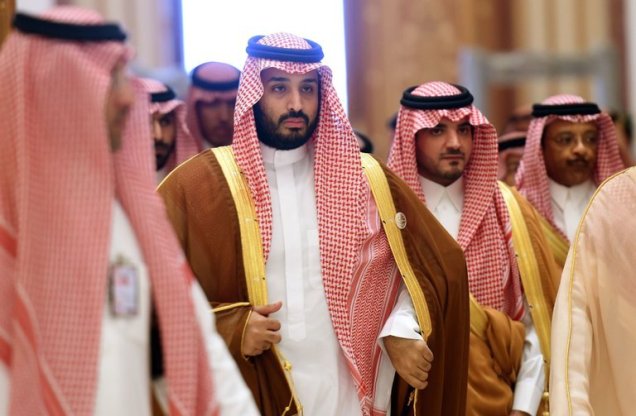
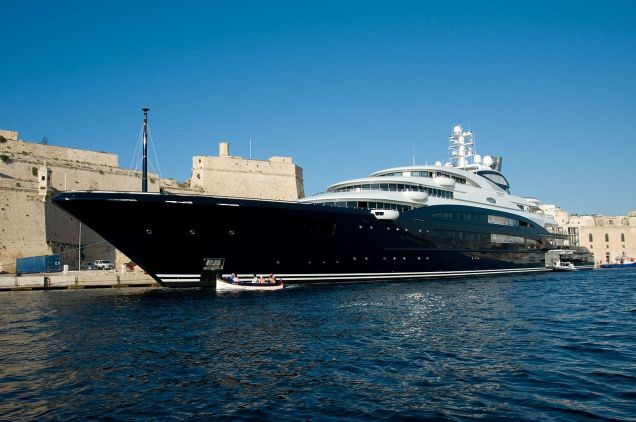
The same media that sympathetically portrayed changes coming to one of the most wealthy, but politically and socially, medieval countries, has been understandably confused. I heard a story today that a thirty -something Saudi prince, Mohammed bin Salman, a powerful deputy in the royal family was seeming disingenuous about starting an austerity reform campaign in his country. Apparently, the New York Times only recently learned that this refreshing new leader was the buyer, a couple years ago, of the most expensive estate in France, the Chateau Louis XIV, a Leonardo Da Vinci painting and a half-BILLION-Euro yacht. An austerity measure of almost a billion and a half dollars.
By Ngw2009 at English Wikipedia -**
You have to marvel at his hobbies though. And their upkeep. I found an article that says he ran his new yacht aground in the Red Sea a month or two ago. The prince may need to get a skipper for his boating hobby.
To bring Saudi Arabia into the 21st Century, the Prince may need his expensive hobbies. A Millennial with a vision for his people. And from his estate in France, if he gets too un-sheikh like, he can let the people eat cake. In the interim, if his news media gets a little too nasty, he probably has an executioner with scimitar on speed-dial.
Google Maps gave me driving directions around the worst of my evening commute tonight that inspired this blog post. While I have made prior references to driving through San Diego at rush hour, it is pointless to meander along that sordid topic – it is only going to get worse and not better. However, I can use the time to make some observations about some of my fellow Southern Californians.
Driving through an obviously middle class neighborhood in suburban San Diego this late afternoon, two weeks prior to the Christmas holiday, I was intrigued that no more than perhaps one in forty homes displayed Christmas decorations or lights of any kind. This was not a section of the city that appeared bound by any homeowners association prohibition, nor a singularly Muslim area or commune of Ascetic monks, It was a single-family style, $600, 000-average price neighborhood (for California, a little more than the median price for 2017.)
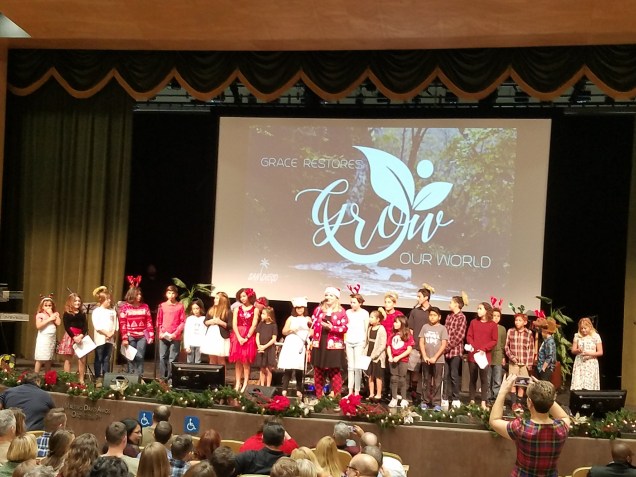
I am not denigrating anyone for NOT displaying Christmas decorations, and I in no way attribute Santa Claus, decorated trees, inflatable Minion or Harley-riding Santa Claus to the Birth of Jesus. But I find it very “unusual”. For a nation that spends a lot on holiday cheer regardless of their spiritual aspirations, (a retail survey calculated that Americans spent $3.2 Billion on decorations, lights, trees and so forth in 2015) I found it unusual. In neighborhoods that become a festive attraction for the surrounding communities, band saws in garages start going in September, and decorations start being put up on the Black Friday shopping day. I thought I would look up the relationship between decorations and personality. One article was particularly interesting in perceptions. An experiment was conducted on observers perceptions using pictures of groups of more socially-engaged neighbors, not socially-engaged (keep-to-themselves sort), each with decorated and not-decorated homes. People who were generally unable to distinguish between social traits for decorated homes, could generally determine the level of social interaction of people with non-decorated homes. People can tell what you are like by the stuff in your environment.
Next post, I may discuss why some late-middle-age men like to tootle around town in a fire-engine red, convertible Porsche Carrera, and why some young people driving Civics, or BMW 3-series, or a 3-cylinder Prius, feel the need to be the most ignorant drivers on the road.
Many people, myself included, refused for a couple decades to acknowledge that people could really affect the weather. My religious beliefs hold that God is in control of all things, yet God did put Adam as steward of the planet. Whatever your belief, in my lifetime, I have witnessed barely breathable polluted air over Southern California, rainy years, drought years, colder and milder winters, hotter and milder summers. Hurricanes. Tornados. Floods. Climate change is the topic that every schoolboy in the industrialized countries of the world has had stamped into their consciences in recent decades. Everyone from politicians in California to European “Green” parties demand humanity stop using resources that are “proven” to destabilize our climate and pollute the planet. For the last twenty years, politicians debate and people divide into camps. But does anyone really know a solution?
“something must be done”
There have, as yet, been no realistic nor popular solutions proposed nor any process enacted. One nation refuses to hinder their industrialization by employing technologies they cannot yet afford to mitigate pollution. Other nations have no solid infrastructure to enact regulation. In the First World, taxation is the first response to climate change, but hinders any real discussion or experiments at solutions that are not “lobbyist”-championed projects. (Several of these have all-but-embezzled millions of tax dollars.) For those of us who work many miles from our homes, lack of public transportation to get there is at odds with the government actions to dissuade personal vehicle use. (Population in most cities outside California is many factors more dense so personal vehicles are less efficient than mass transit.)
climate impacts humans
Geologically, human existence has been a blip on the clock. It is still unclear whether volcanism, sun spot activity, and tectonic forces are responsible for the oscillations in weather over millions of years. Weather changes created Ice Ages and in-between glacial periods caused sea level change. Drought, lasting decades and even centuries, put pressure on feeding ancient populations and caused ancient civilizations to decline.
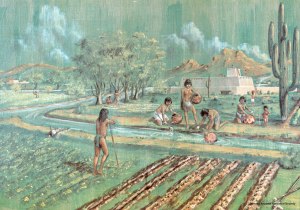
Two in the Americas, Hohokam and Anasazi civilizations were very advanced, yet may have faded – centuries before European visitors – due to extended periods of drought.
A volcanic eruption of Santorini in the Mediterranean was a primary factor the successful Minoan civilization faded around 1500 BCE. From the Bible and other texts, years of record crops followed by drought and famine in the Middle East occurred. Yet history teaches us that human beings in sufficient numbers can alter the environment as well. The millennia that Middle Eastern, Egyptian, Roman and Greek people cut the “cedars of Lebanon” for ship timbers and structures has all but eliminated them. .
In northern Michigan 7000 years ago ancient ancient people mined copper; tailings and debris left behind tell the stories before 19th Century mining began there. But the growth of the world population and the demand for resources have caused more debilitating changes in many aspects on the planet. In more recent times, denser populations along the coasts – the heavy industrialization using coal, oil and natural gas for energy first in the Americas and Europe, then Asia and Africa have had unrestrained and inefficient (heavily polluting) consequences. After several decades, each region in turn developed a conscience about limiting “acid rain” and early deaths from lung diseases and cancers. Before government management in the Americas, clear-cutting forests and mining were damaging what we later preserved through government intervention. This is still rampant in Brazil and the Amazon Basin.
Amazon deforestation
Strip mining that ruins the land and the chemicals used to extract metal poison groundwater in many developing economies. Of course, the topic that give California Jerry Brown the largest headache, is burning hydrocarbon fuels for energy,- releasing billions of tons of chemicals that were deposited over millions of years within the last century or two.
it’s elemental
Fire
Less than two months ago, the Sonoma region of California became an inferno.
Ventura, Los Angeles county, December 2017
This week, another tragic environmental calamity is occurring not only a couple of hours north of me in northern Los Angeles but forty miles north of my home, the Lilac fire, in the hills at the edge of San Diego County. Wind-propelled wildfires have consumed the lives, property, and dreams of hundreds of residents, displaced thousands more. and killed dozens of stabled horses in the last days. Ten years ago, my third of the county was being turned to charcoal by wildfire. Coordinated effort of thousands of firefighters, military and civilians have managed to keep human casualties few while battling the environment.
Perhaps the Government and the governed can put down their acrimony long enough to work through “defensible space” in residential areas. Tangible efforts such as clearing wider swaths of highways near open country might prevent vehicle-caused brush fires. Remove diseased and non-native species of trees and plants, many of which are very flammable, by dedicated planned cutting and clearing. Allow natural clearing through regular controlled burning.
Earth
Mexico 2017
Living at the tectonic boundaries of continents, Asia-Pacific and western North, Central and Latin American residents, earthquakes, and the infrequent volcanic eruption destroy property, kill people living in un-reinforced structures, and wreak havoc. The residents of central Asia suffer a major quake every dozen years of so. A decade or more ago, a major earthquake severely damaged eastern Japan, and one previously induced tsunamis from Thailand to India. Volcanic eruptions occur over a geologic timescale, so it is often ignored by people from Indonesia, to Naples, Italy, to some Caribbean island residents who live on their slopes.
For those who live at tectonic boundaries, nations can provide technical expertise with construction, but it will be up to the affected nations to employ these methods and materials. While many nations do not have infrastructure, others have corrupt or ineffective leadership in their economies.
Water
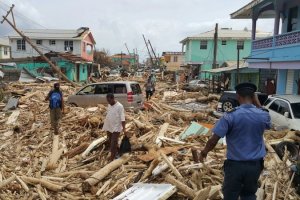
aftermath of Maria, Puerto Rico
Hurricanes or cyclones or typhoons, and tornadoes are either more damaging now – or are more reported in the twenty-four hour news cycle. El Nino or La Nina cyclic ocean heating or cooling contribute to heavy growth of fuel for fires in wet years in the western US, then in dry years contribute to tinder-dry fire conditions; hot winds blowing toward the Caribbean from western Africa mix to become tropical depressions and then storms that churn into the Caribbean, the Gulf of Mexico or Eastern seaboard. For this hemisphere, it is a roulette wheel every June through September where storms will make landfall. Hurricanes in 2017 have ruined large swaths of the Caribbean, and flooded southeastern Texas. For other hemispheres, cyclones or typhoons have often killed many and displaced thousands in the Philippines, and coastal Indian Ocean countries.
Nature has a way of mitigating hurricanes through dense miles of mangrove swamps; humans building in flood-prone regions, building over land that would absorb or deflect flooding has had devastating effects. Home owners who have properties along the beaches where hurricanes have come ashore frequently make a choice to live there, yet the debris that piles up and down the coastline is environmentally damaging and take a long time to remove. With storms such as that which struck New York in winter, or Houston, or Puerto Rico and the eastern Caribbean this year, there may be more frequent and stronger storms in future years. Sea walls, restored wetland, stronger levees, stockpiled supplies and more durable materials are some of the things that people can demand.
Wind
Texas, (courtesy CNN)
From westerly ” Santa Ana” winds out of the deserts of California that dry out vegetation in the forests and hills every Fall (and sometimes Spring through Fall), to the tornadoes that develop in the Central and Eastern United States when cold air masses clash with the warm moist air from the Gulf of Mexico, to hurricanes, wind is a major force to be reckoned with. As part of the whole climate debate, people want to use wind to generate power yet curse it when it accelerates fires, lift roofs off schools, blow down trees or sink ships at sea. As a natural force, wind is not going to be stopped by human will. However, more intelligent design for buildings may mitigate storm damage.
I am so exhausted listening to everyone blame climate change for the problems in the world. It is not the weather “why” I care about. It’s how the world population – as a whole – intends to alter in meaningful ways the slide to more unstable and unpredicable future. As long as there is President Obama-style unilateral initiatives or Congressional “legislation” or California bureaucratic fiats without real adoption in the new industrializing regions of the world – there is no leadership. However social media page “Likes”, group-think, hysteria and the resulting inaction is a poor gift for future generations.
I think Walt Disney had something to do with my life choices. My earliest Disneyland visit was more than 50 years ago. My latest was yesterday, and nearly 18 years since I last visited. Long ago, I enjoying the rafting rides, the submarine adventure, exploring the future and the past. As I grew older, I studied more about the science behind the animated figures and attractions. I found myself yesterday in awe, and then wondering about the maintenance and the mechanics of these animated attractions.
As a kid, I was fascinated by the steamboat in Frontierland; perhaps that is why in school when we read Mark Twain, I had something to relate it to. (There were no paddle wheel steamers I saw where I grew up). Frontierland and steamboats still hold some interest, but there is so much more enjoyment when you go with someone with little kids.
don’t think these young’uns are Groot fans?
Before Star Wars, kids my age grew up with NASA , and sci-fi television like Lost In Space, the cartoon Jetsons, and Voyage to the Bottom of the Sea. In the 1960s and early 1970s, there was a very cool view of approaching new Millennium. Once we all got here, it had been somewhat close but also “quaint” sci-fi. Now Tomorrowland has a very 3D action/ Star Wars feel.
Of course, every Sailor has a little pirate in them so Pirates of The Caribbean was a must-do. Now though it has a very Cap’n Jack Sparrow/ POTC movie tie-in. But it was the original inspiration for multi-billion dollar franchise for Disney, so I guess it had to be somewhat updated. But perhaps, I need to do a little plundering before I go off adventuring again. We bought the year Pass for both parks when I last visited. I think my stash of gold, rubies, and the lot was traded away for 12 monthly payments.
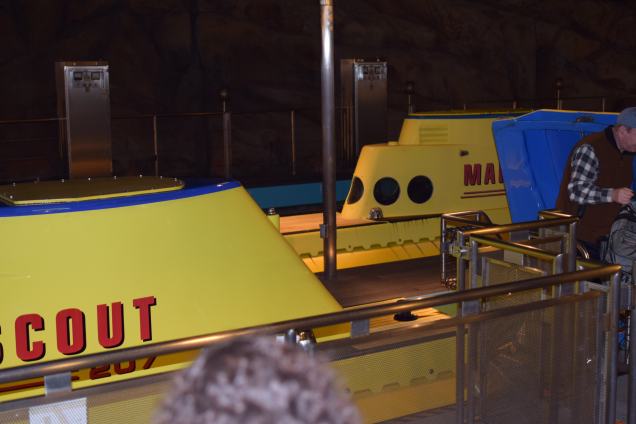
Now that is piracy, but if Capt’n Jack Sparrow trades you a year’s worth of Yellow Submarines, Mater Tow-rides (California Adventure), and a pirate adventure it is fine. And while walking seven or eight miles just inside the parks, as well as places for grog, chow, fireworks, and music spectacles, I have entertainment AND exercise. Maybe if the sea dog’s wife continues to prod me, I can resist the impulse to buy a little Mickey swag. Resist at least until grandchildren accompany us.
I am a happily married man and yet I have a mistress. No, not that kind. The Sea.
The sea, once it casts its spell, holds one in its net of wonder forever.
– Jacques Yves Cousteau, ( http://www.brainyquote.com)
The sea used to call to me as a child. I read stories about life at sea. I was fascinated by Jacques Cousteau’s shows exploring the sea. As a youth, my family would frequently make the short drive to Half Moon Bay from Belmont, California. After body surfing and boogie-boarding in the cold ocean surf we would warm up by a bonfire on the beach. Moved by my mother to to the Atlantic coast as a young teen, I would swim and take a sailboat or rowboat out in the waters off Cape Cod, Massachusetts. Though swept out to sea once by a rip current, I responded by learning to snorkel and scuba dive.
There is a witchery in the sea, its songs and stories, and in the mere sight of a ship, and the sailor’s dress, especially to a young mind, which has done more to man navies, and fill merchantmen, than all the pressgangs of Europe. -Richard Henry Dana, Two Years Before the Mast
I was a captive, not unwilling, during eight years assigned to Navy ships. Then, I spurned my love-interest. I retired from the Navy. As I dallied with camping, hiking, and cycling, the sea called me back to her. It was a recent cruise to the Caribbean that has me spellbound again. I am not too old to don a wetsuit, or rent a boat, or take another cruise, all the while listening to Jimmy Buffett on the radio.
“The most futile and disastrous day seems well spent when it is reviewed through the blue, fragrant smoke of a Havana Cigar”. Evelyn Waugh
“Tobacco is the plant that converts thoughts into dreams”. Victor Hugo
“If smoking cigars is not permitted in heaven, I won’t go”. Mark Twain
NOTE: the following may lead some to engage in foolish behavior, potential pregnancies, fondness for dens of iniquity, and loose talk. Forge ahead if you enjoy the company of Sailors, and such things.
Writers, thinkers, curmudgeons, and satirists enjoyed a fine cigar. Actors, artists, and politicians also, but it seems the powerful’s lesser vices these days involved tobacco. Only in America, in 2017, can we have a state, California, that now frowns on the cigarette, pipe and cigar smoker, but promotes the consumption of marijuana.
What should an old curmudgeon, retired Chief, and blogger do? Relax. With a glass of Johnny Walker Black over ice, and a Jamaican -label Montecalvo cigar, purchased on my recent cruise in the Caribbean. As another post-Thanksgiving day wanes, it was an accomplished day: some writing, dogs groomed, yard trimmed, and exercise. First a hike this morning and then a former pile of stones now have taken the shape I envisioned three weeks earlier. Christmas yard ornaments are laid out. Where a stress-filled work-day can be a disaster repaired with a good cigar, it has been a remarkably good day.
“Religion and politics are nothing but a stinking by-product of man’s gargantuan greed for power. The two evils go hand-in-hand; if politics is the rich man, religion is his unchaste mistress, both having a discreet love-hate relationship. Terrorism only happens to be their spoiled rotten love child whom they can neither extol nor disown.”
-The Little Mermaid, MMXVII
I thought this brave post was worth retelling, particularly since I am both a disciple of Jesus and someone who studied political science at the university. Whenever people discuss either religion or politics, some duck behind solid objects, some have their own horror stories to tell, and still others mount a defense of the particular hill on which they are encamped.
Sadly, this is what both topics have come to – a cauldron that no good can come from for a majority of people who disavow politics and religion. Yet it is exactly the human element that spoils everything. I have never met one unflawed human being: never made a mistake, never been critical, never damaged (emotionally or physically) another animate being nor misused a kindness shown them. Politics is a game of control wielded by as equally-messed up human beings as those who put them in power. Religion, when corrupted by these same corruptible human beings, rob the religion of the Spiritual truth and creates discord and confusion.
If religion is pure expression of LOVE, COMPASSION, and CARE, you would think everyone would want to adopt that. We then could have a discussion of how one belief system expresses these better than another. Yet people mess up the message. I happen, late in my life, to believe in the existence of spiritual Truth as real as the field of gravity. I know and have experienced its positive effects as certainly as I know that I am standing upon Earth due to the gravitational field it exhibits – in spite of not actually seeing it.
If politics was only about SOCIAL welfare – the natural freedoms that the Declaration of Independence and U.S. Constitution talk about – everyone should embrace that. But again, people mess it up with their own particular take on things. And their own demand for power to deny others their power. And so we have a “cold” as well as a violent war within societies to not become better people, but to deny others their opportunity to be better people.
Since I, and those whom I have come to know as my “spiritual family”, believe in the inherent triumph of the unseen force that embodies Truth, Love, compassion, over the negative forces that plague our existence, I have Hope. It has little to do with whatever human construct – religious traditions or political institutions. I am still a corrupt being and a mess, but with a spiritual connection I endeavor to continually improve.
Fifty years ago, I became a fan of galaxy-traveling space technology wielded by an altruistic civilization. Star Trek seemed to define technology as idealistically and problem-free as Father Knows Best defined the American family; both had stories about the weaknesses that people possess resolved within a single episode. However, unless it was deliberate sabotage, technology always worked. Scotty always milked the dilithium crystals to eek more power. Technology like tri-corders and food processors rarely needed to be tweaked, banged, recharged, or be issued return-to-vendor tickets. In both shows, the fiction was total b.s. But I didn’t let that rain on my parade.
Having been a technical worker in a military organization, and later in several technical service and engineering firms, I know the sort of effort it takes to bring something from idea to working product and sustainable. However, I am still a fan of the fantastic sci-fi shows like Star Trek as well as the real wizardry of the Space Shuttle, the probe that went past Pluto or the ones now in interstellar space. The real wizardry is when a bureaucracy – which a large company is – can still produce something that sets the international standard. And just as I imagine that a “real” transporter or a “real” warp drive would probably have reduced first test objects to unrecognizable goo, corporate politics, bureaucracy, budget, schedule-limits and management missteps would have evaluated that and then spent twice as long at four times the cost of the original prototype, to then have the transporter redesigned with more rigorous, real-world and far less goo-like results.
Where Spock complains that he is tasked with building a complex device with “stone knives and bear skins”, it suggests that in his future, a lack of tools, materials or supply problems do not occur. However improbable that may be, a resourceful worker can work around conditions that hamper progress. That is where asking for forgiveness is often more expedient than asking for permission. And that is why, even in the future, where the Red-Shirt enlisted guy gets eaten by a monster, the senior officer gets the glory, the crew routinely drink, get drunk, fight, and at the point of certain death, can eek dilithium crystals to save a galaxy – or USS Enterprise – from certain destruction.
Many of my military peers may recognise that many things were part of a system of barter during our tours. For my Navy shipmates, we found cigarettes, Froot Loops and some items in “care” packages could be used to trade for watchstanding in certain ports of call. At other times, it might be a needed safety audit, such as that I could perform to use a boom box in a kitchen (galley). I was a ship certified electrical safety petty officer.
The Supply division received the stores. And strangely, Froot Loops were always missing from the single serving selection of breakfast cereal.
But onboard a cruise ship, these precious currencies are devalued. Just placed out in the cases at breakfast for everyone to enjoy.
When I was a kid, maybe younger than 8 years old, I went on my first passenger ships, the Cunard Lines SYLVANIA and QUEEN MARY. Traveling with my mom one summer from New York to England and then returning to New York City. I generally recall 3 memories of that time. Two were shipboard: being entertained with other kids by the staff while our parents were so seasick they were in their cabins, receiving a die cast model of the ship(s), and a random memory of being fascinated by men working on a pipe in the middle of the lane in front of my grandmother’s home in the Isle of Man. But the point of this all is that I don’t get seasick.
Rowboats, canoes, kayaks, harbor ferries and water taxis of various sizes and conditions, and three U.S. Navy warships have been how I went to sea in the intervening fifty years. Until this week, so many years ashore dulled my senses and passion for travel and the sea. The dining, getting to know some people, the excursions in our ports, and the shows we took in have been the highlight of cruising. The rocking even as slight as the large liner does pleasantly lulls us to restful sleep. For me it has again stirred my memory of the wind and wave.
This ship, however, is too big. Too many people. And although I am not, well, insensitive, I really do not want to travel with large groups of some tourists. I’ve been irritated by their cultural norm of pushing through around and over, mobbing really, at the brow coming on and off, (like at our travel stop in Cozumel). I imagine if you come from a place that has 2 billion residents you push to avoid being run over. Yet this ship has travelers and staff from all parts of the world. After several days, a vessel with six thousand passengers is too much like vacationing on Southern California highways during rush hour.
Give me a smaller, more personable ship and I’ll take the adventure anywhere. Nevertheless, I know my wife and I will make new friends, see some amazing sights, and enjoy more cruises in the future.






 I am not denigrating anyone for NOT displaying Christmas decorations, and I in no way attribute Santa Claus, decorated trees, inflatable Minion or Harley-riding Santa Claus to the Birth of Jesus. But I find it very “unusual”. For a nation that spends a lot on holiday cheer regardless of their spiritual aspirations, (a retail
 There have, as yet, been no realistic nor popular solutions proposed nor any process enacted. One nation refuses to hinder their industrialization by employing technologies they cannot yet afford to mitigate pollution. Other nations have no solid infrastructure to enact regulation. In the First World, taxation is the first response to climate change, but hinders any real discussion or experiments at solutions that are not “lobbyist”-championed projects. (Several of these have all-but-embezzled millions of tax dollars.) For those of us who work many miles from our homes, lack of public transportation to get there is at odds with the government actions to dissuade personal vehicle use. (Population in most cities outside California is many factors more dense so personal vehicles are less efficient than mass transit.)
 Two in the Americas,
  .
.





 But perhaps, I need to do a little plundering before I go off adventuring again. We bought the year Pass for both parks when I last visited. I think my stash of gold, rubies, and the lot was traded away for 12 monthly payments.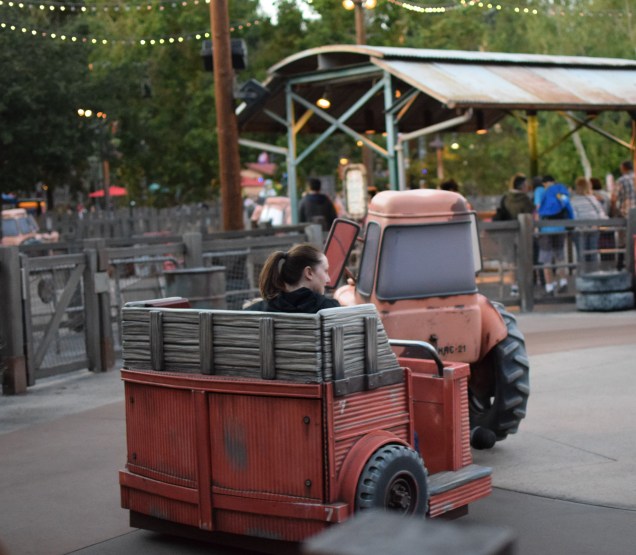

 Truths, Half-truths, and Sea Stories