creative writing

Any enlisted member of the military has undoubtedly encountered three styles of writing: one style encompasses instructions. The Uniform Code of Military Justice (UCMJ), Department of Defense (DOD) Instructions, and a unit’s Plan of the Day (POD) are just a few of these that provide the boundaries of behavior we know as “military bearing”. Another involves “creative writing”, that is, the personnel evaluation, used to qualify a member for advancement.

<!–more–>

Periodically, an enlisted member is required to submit a summary of his or her performance, which provides in short concise bullet format, a skill or achievement, and it’s value to the evaluating senior NCO or officer. There are some individuals who may actually perform far superior to her peers, but without some “inside” information on what a superior in command, or a merit board is looking for, may not stand out. While experience is a good teacher, a mentor in the service provided needed polishing in the specific language the military uses.

INSPIRED MENTORING. 19 OF 20 SAILORS PROMOTED THIS CYCLE.

As the Navy has embarked on a “radical overhaul” ( per Navy Times) of the enlisted evaluation system, I thought it would be worth reminiscing about writing as practiced in the U.S. Navy. The last time the Navy overhauled the evaluation system, it was to refine a grading system that was less objectively-based and more subjective. As anyone from the period of the 1970s to 1990s can attest, there were certain Sailors who were deserving of promotions, but only the “4.0” Sailor was the rare crow who would get advanced. The grading scale rated on a scale from 2 and below, to 3.0 to 3.4 or 3.6 in several areas that were broken down on the evaluation form. In the passing years, more and more candidates learned “how” to write their evaluation, and their superiors learned “how” to get their sailors advanced.

TECHNICAL EXPERT. MACHINERY LUBRICATED EFFECTIVELY.

As a result, beginning in the late 1990s, a “5.0” scale was implemented to refine the process. Another period of ranking creep, and failures of subjective grading (combined with Congressional-mandated manpower levels) probably resulted in this 2017 revision.

My favorite excerpts from the Navy Times article explains this:

(Vice Admiral Robert) Burke says the system created “unwritten rules” and “grade creep” that have eroded the system’s effectiveness.

The Navy has developed an unofficial “code” for writing performance assessments. If you are a supervisor, “you have to be able to write in code,” Burke said. “If you are sitting on a [promotion] board, you have to be able to decipher the code. And each of our tribes — for example, surface warfare, submarines, aviators — each one of these individual communities has a slightly different code.”

New Year’s field day

shopping

Anyone who has served in the military knows that at some point, their installation, military unit, or occupational speciality, will reorganize, merge, or close (“disestablish” in military-speak).  In my experience aboard the USS TEXAS (CGN-39), when the ship entered the Puget Sound Naval Shipyard at Bremerton, Washington in 1992  for an overhaul but was decommissioned part-way through, one of my duties was to remove an accumulation of years of my division’s electronic maintenance materials, records, files, and publications.  Twenty-five years ago,  electronic storage required several cabinets and boxes in an auxiliary storeroom; paper binders, manuals and the local records pertaining to two prior decades of repair, acquisition and transfer of equipment had to be reviewed, removed and sent for destruction.

0512-0707-1115-1056

While not due to any closure,  the reorganization of my garage this past week has drawn on some of those analytical skills in reviewing or disposing of things collecting cobwebs and dust in the garage.  The last time I did this was at least a year ago.  Since then,  most things have been moved from on top of the rafters in the garage, to one side and then the other side of the interior.  (I haven’t been able to park a car in the garage for at least seven months.)  However, I did find (again) my Navy Senior Chief uniforms in a trunk, as well as a box with random uniform insignia in the former Navy working uniform style (blue-gray “camouflage” pattern).   I sorted through boxes of old framed pictures, loose papers, photographs about 50 years old, cards and letters I sent my mother thirty or forty years ago from my duty stations at the time.   

This was all as a result of putting Christmas decorations away for another year.   Since I was boxing them up and looking to consolidate what my wife had already consolidated,  I started to put other random boxes together.  And now. perhaps, I will finally be able to move everything to the opposite side of the garage, so I can pull down all the uninsulated pegboard and half-tacked drywall on the other side, and install new.   At least, before Spring cleaning.

140226-N-YO710-013

Intermediate Maintenance Availability (IMA) periods stink.  I have to continue using the garage (or at very least keep the laundry facilities operating) and preserve my access to my tools and “stuff” throughout this period.   At least, I do not have to stand watch around the clock.   But I do have to keep an eye out for refuse removal.  The crew keeps putting the galley waste in the garage, when the pier trash bins are a short walk to the driveway.  We do not tolerate any stink in my workspaces. 

Takes one to know one

The last time I boarded a vessel the size of the Allure of the Seas, it was gray and I was an enlisted volunteer(ed) carrying equipment. While an aircraft carrier does not deploy lounge chairs nor launch aircraft, on this voyage, my wife and I saw divers launch into a pool several decks above the waterline. This was all part of an entertaining acrobatic and sychronized diving show.

However, the most entertaining part of this trip has been having brief conversations with passengers who are fellow veterans. You see, I wore my “Retired Navy” ballcap boarding in Florida and disembarking on our first port of call. From the first greeting in the line with a retired Bo’sun while getting registered at the embarkation terminal, to the Air Force vet my wife and I sat with at a dinner, to the Navy Vietnam Nam-era airdale, there have been a lot of quick greetings and instant recognition.

” I can recognize veterans”, one Navy wife said.  I think she actually said, she could “smell ’em a mile away”, but I knew what she meant. I think people who served have an instant kinship. One of my fellow passengers, a man and his wife about half my age went snorkeling with my buddy, me and four others at our stop in Haiti. He smiled knowingly, when I remarked how cool it was to be zooming away toward our dive spot in a RHIB. Most Navy people recognize this acronym as Rigid Hull Inflatable Boat. Yet I think he or possibly his wife, was Dutch or German.

Yeah. The folks who are frequent cruise vacationing people also seem to have that camraderie. Many start around our age. I think cruise veterans and particularly Navy veterans get the best new sea stories to swap with one another from trips like this. It does “take one to know one”.

(Image) The last time I was off the coast of Haiti (USS PETERSON)

Rules of the road

When it comes to a contest of wills, civilians should never take on an old Senior Chief.   We are slow to get angry; we more often find means to tie up some sea-lawyer, arrogant know-it-all, or clueless idiot in creative and thoughtful ways.   This was one such day for me on the way home on a horrible stretch of highway in San Diego called the “merge”.

As a career navy man, I understood a few principles that I carried with me when I traded the sea for the concrete highways.   Rules.  Courtesy.  Respect for the vessel in your charge and for those around you.  Knowledge of proper procedure on operating in your lane.

depositphotos_55675069-stock-illustration-angry-woman-driving
woman today determined to keep me from merging

This is not just the required skills of seamanship, ones which have been called into question in the Seventh Fleet,  but applicable to navigating highways in Southern California. This afternoon, a woman who determinedly was going to force me off the road was one such person.  I was properly merging but was forcibly kept in the berm by this person who matched me mile for mph, and got as close as 2 inches from my door handle.  Collision at sea?  Had I a five inch gun, you might have read about it in the national news. Stand by to repel boarders!

Gun control begins on deck

While assigned to a naval ship, from the early 1990s till the late in the decade,  one of my additional duties was as a watchstander .   I was part of the Quarterdeck watch which controls movement of personnel and material on and off ship while in port.    The Quarterdeck watch is made up of an Officer of the Deck (OOD),  a Petty Officer of the Watch (POOW), and a Messenger of the Watch (MOOW), under the general supervision of a Duty Section Leader and a Command Duty Officer.  We all are charged with maintaining the safety and security of the ship – or station (Installations also maintain the same structure) while the vessel is in port.

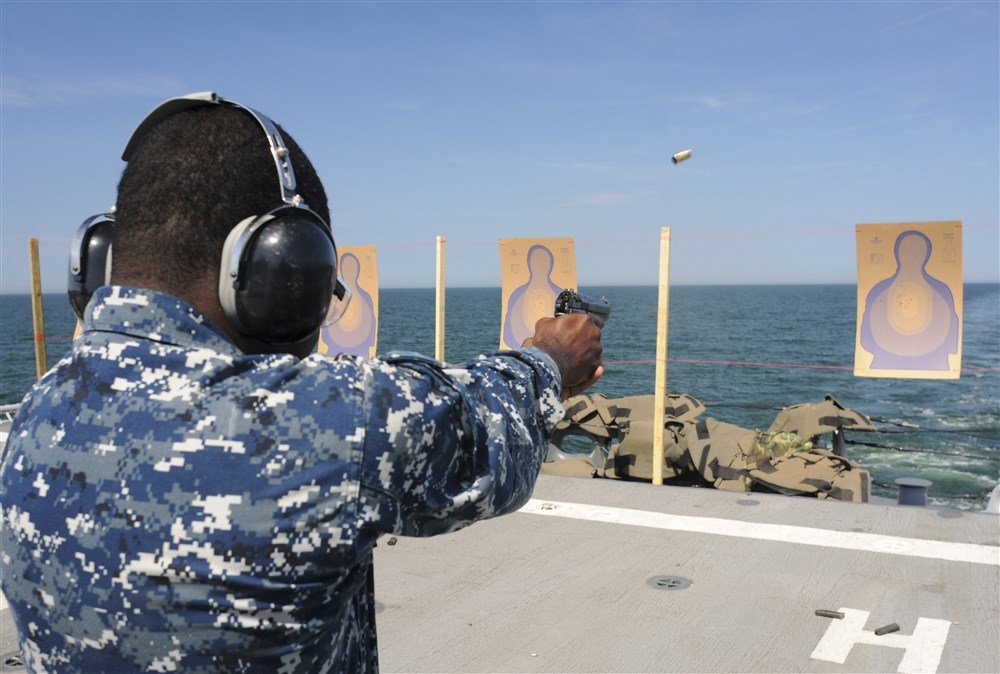
To be qualified to stand a watch on  the Quarterdeck,  each person has to complete training requirements including firearms training.   This is normally managed by a Petty Officer from the Armory,  a Gunners Mate or Master-At-Arms.   On this particular day, were at sea,  and in calm weather.     It was a time to renew my  qualifications at a “range” set up on the fantail of the ship.  We would shoot at targets in the direction of the open sea.

EUCOM Image
image courtesy US NAVY EUCOM, 7 JUL 2011

This was a time for refresher lessons on firearms safety.  Handling of pistol, rifle or shotgun,  hot weapons,  jammed rounds and so forth.   Occasionally we received instruction in prayer.  Prayer?   On one memorable occasion,  a young Sailor, we thereafter called “Barney Fife”, was on the line with four of us,  and the Range Master standing behind and to the left of our group.   At the command to “Commence Firing”, after the first or second trigger pull, there was a “Zing!”, followed by an immediate   “CEASE FIRING!!!” and “UNLOAD!”  or something to that effect.  One of our group had somehow discharged his weapon such that a slug ricocheted off the deck dangerously close to the Range Master.

Billy.   This was the same young Sailor that one of the deck seaman with sound-powered phone ( for internal ship communications) had fooled into waiting for a shore-to -ship phone call  while they both were on a sea detail.  He was a good-hearted but slow-witted guy.

Thereafter, Seaman Jones (not his real name)  was permitted to stand the Quarterdeck watch only as Messenger – and was not allowed to touch a weapon.   We were assigned to the same duty rotation, and as I was generally the OOD watchstander,   I would allow him only to stand downrange of me.   While the Gunners Mate may have pronounced a saltier blessing in our young Sailor’s direction,   I think we all were generally very thankful to the Almighty that day!

Forty years

“I can imagine no more rewarding a career. And any man who may be asked in this century what he did to make his life worthwhile, I think can respond with a good deal of pride and satisfaction: ‘I served in the United States Navy.”  _John Fitzgerald Kennedy,  PT-109 Commander, WWII;  President of the United States

In the pre-dawn hours of Oct 3,  1977  I arrived at the Recruit Depot of Naval Training Center, San Diego, California.    I had signed my life away the previous afternoon at the Military Entrance Processing Station (MEPS),  Phoenix,  Arizona.   And despite the very attractive female Marine Sergeant at the MEPS,  I did not on-the-spot decide to opt for the Marine Corps.

Marched as a gaggle – that would be rectified very shortly – to get haircuts,  none of us really knew what was happening.  Then lined up for clothing issue,  and medical checks and barracks assignment.  Nothing was fast enough, efficient enough nor military enough for the Recruiting Company Commanders that day.    After a full day, we were assigned our bunks.   And at O-dark Thirty,  0330 or  3:30AM,  the loudest bang from a metal trash can thrown down the center of the barracks woke everybody.   Welcome to Boot Camp,  ladies.

Forty years later,  I have been retired seven and a half years.   I can look back on the best  and most challenging times of my life: two periods on Active Duty from  1977 through 1980,   and 1987 through 2000,  and two periods in the Reserve,  1987 till I opted for Active Duty again;  and from 2000 through 2010 when I retired.   Eight years assigned to sea duty – most of which spent going to sea.   Pacific,  Atlantic, Mediterranean ,  Red Sea, and Caribbean deployments.  Panama and Suez canal, Equator and Date Line crossings.

Not a bad life.

my cook needs wine

Her recipe called for Madeira wine, and though I assumed that was Portuguese in origin, the dots connecting it to Port did not follow.  But a Chief when given a mission,  follows through. And Sunday dinner fare succeeded.

In all my years of naval service,  even the best Culinary Specialists, who were once titled “Mess Specialists” when food was  disrespectfully called “chow”,  never prepared meals with wine as an ingredient.   If there was any alcohol involved in food preparation,  I would imagine it would have been more to add sauce to the cook than perhaps to the dish.   Based on personal experience of several decades,  I attest that a man’s heart is soothed by food.  Men, left to themselves, might be soothed by a few tacos and beer;  on a Sunday afternoon,  a barbecue of steaks or burgers, again with a few beers, might be a comfort to prepare for the new week.   But in a world increasingly based on soothing outraged feelings,  it seems the Europeans – who have prepared food for hundreds of years with sauces mildly alcoholic – found the best path to enlightened dining.  Add a little flavoring from marsala – or, today’s recipe item,  madeira ( a type of Port) wine and a  gastronome is born.

20171001_175647
Chicken prepared with Madeira wine, mushrooms and garlic

A clarification I feel is in order.  These dalliances with different recipes and ingredients  never appeared during the years we raised our “bilge rats”.   There never was time or the appreciation (from the diner) to prepare gourmet fare for a crew that was never dining but rather grazing, microwaving, or inhaling “chow”.   Once the Senior Chief and his bride, the command (home) Flag Officer, were left to themselves, chow time became dining together.   And the menu became a little higher on the Michelin scale.

While I may look backward fondly to my Navy days,  I can say that in my home, the Culinary Specialist in the years since my retirement, has never once used a steam vat, does not need to label the dish to identify whether a meat or a vegetable,  and does not have to obtain approval from “higher authority” before adding a little wine or spirit to a dish.   Oh my,   I think I have become French.

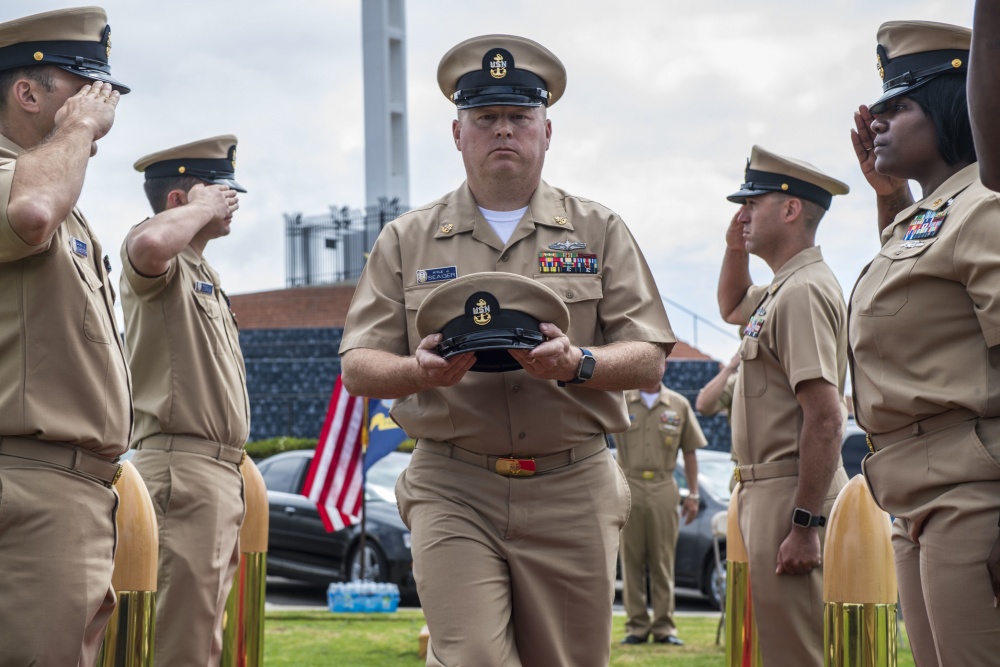
Honor, Courage, Commitment

1000w_q95
from DVIDS  CA, UNITED STATES
09.15.2017
Photo by Petty Officer 3rd Class Christopher Veloicaza 
Navy Public Affairs Support Element West

A Senior Chief Petty Officer I had the opportunity to work with during a CPO Selectee training day once asked a Selectee when did he (or she) become a Chief Petty Officer.

” I was selected this year, Senior Chief.”

“Do you know when I became a Chief Petty Officer, Selectee?”, he then asked.

“When I decided to act and take responsibility as a Chief Petty Officer.   I simply waited for the uniform to catch up.”

The article here honors the example and sacrifice of SEAL operator Michael Monsoor, whose example will be remembered in his namesake naval vessel and her crew.

via DVIDS – News – USS Michael Monsoor (DDG 1001) Crew Welcomes Namesake into the Chief’s Mess

Mid-rats

Saturday morning, 3 AM,  and I am awake.  I really do not want to be; when I was in my twenties and thirties,  I was able to be very productive on four hours sleep.  Six hours would have been “vacation mode”.    For some reason I am reminded of many times I stood watch on the Quarterdeck in the middle of the night while our ship was in port.  Whether aboard the USS TEXAS – the cruiser,  not the present submarine, on the West Coast; or in Norfolk, Virginia aboard the USS PETERSON, a Spruance-Class Destroyer,  it was often very cold standing watch at this time of the morning.

I still remember the sound of the exhaust fans, the deafening, steel rattling as warm air was blown out onto the weatherdeck from the ship’s interior.   Standing at a podium, partly exposed to the wind,  I remember on more than one occasion wrapping my peacoat tighter around me, and sending the Messenger to get me more hot, very black coffee.  The “balls to four” watch,  midnight till 4 AM,  is one of the more difficult watches  since there are few comings and goings, the ship’s commander is either ashore or asleep since getting his last passdown report.   It was a good time to quiz ourselves and study for qualification tests.  At that time,  the ESWS qualification was a big boost to a junior Sailor seeking advancement.  The landline rarely rang at that time unless it was to report a member of ship’s company going on or off- leave.   Sometimes it was the base security reporting a member was being written up for being intoxicated and belligerent or trying to drive onto the base.  We would have to rouse a master-at-arms to go retrieve him.  Normally, unless we were in a period called a Intermediate Maintenance AVailablity ( IMAV) when welders and other contractors were coming and going all night, it was often a dull period of duty.   This was in the decade before 9/11, so the occasional drunk Sailor returning from Liberty and a visit by the base Command Duty Officer might be our only interruption on the Quarterdeck.

Overseas in the Mediterranean in the period following the Gulf War and Bosnian conflict,  the middle of the night was a time we did not have security forces in heightened vigilance as we had once on the other side of the Suez Canal.  On a six-month deployment, our ship might spend a month patrolling in the Med with several port visits. It was often a blessing to be on duty in port.  One of my shipmates was never interested in going out on liberty – he had been to these same ports several times.   He bankrolled a lot of money on these cruises.

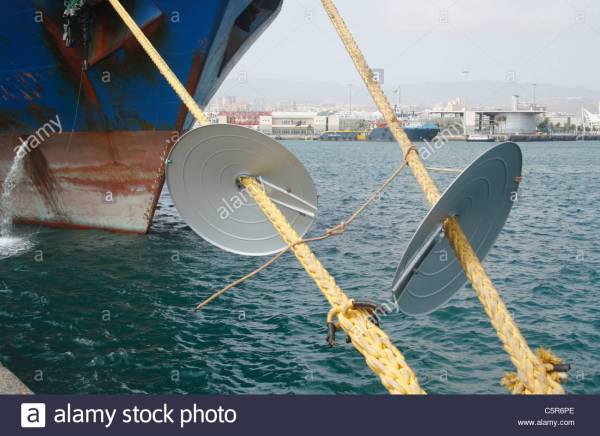
Saving money when overseas was never a strong skill of mine.   Had I not stood midwatch overseas though,  I might never have believed stories I read about mariners, ships, and rats.   When I was standing the Quarterdeck midwatch in Trieste, Italy in the early 1990s,  I remember looking down to the head of the pier at some dog rooting around the dumpster just off the pier.  It was dark, foggy, and things illuminated by the yellow lamps of the pier were not distinct.  But I realized that dog was not a dog.  What would a dog be doing here anyway?  It was a wharf rat,  about the size of a terrier – the largest rat I have ever seen.    And now I know why ships mooring lines have “rat guards” on them.   For good reason.

rat-guards-on-ship-mooring-ropes-to-prevent-rats-getting-aboard-c5r6pe

For those who might be amused, or assume I was exaggerating,  I found an article online of a rat that obviously was well-fed up until his untimely end.

1  mid-rats is the term we use in the Navy for the late night meal prepared for the watchstanders.  RATs is short for “rations”, not an item on the menu.


(ball) bearings, mil

0326cyn65135
image, doncio.navy.mil

As a Navy technician, a graduate of electronic schools where I learned the theory of operation, maintenance and repair of digital and analog (vacuum tubes and relays) equipment, I also had experience in the maintenance of diesel-power emergency generators and battery backup systems.   I’ve crawled under raised flooring ( computer -decking) to run bundled cables from a telephone cabinet, when cables were wire-wrapped in large panels, to equipment in vault-like enclosed rooms.   In my off-time,  I helped fellow trainees swap big block V-8 engines from an 1973 El Camino into a 1970 Chevelle.   But I will always remember one Spring at a base near Washington, D.C. when I got the military to fund my repair of a golf cart.

ez_pre_86
a 1980’s era golf cart

There was a golf cart with a  broken axle and missing  (scavenged) parts rusting away in the back lot behind my building.  It was forgotten.  I was motivated by an idea, that a running cart might serve me and my shopmates travel between one end of the base to the other; however, we had weekly tasks in several buildings at that facility.   Every week we had to bring equipment to take measurements and perform maintenance, and it was annoying to hand-carry everything between the two. It was a ten-minute walk each way lugging gear in a hand-cart.

That particular model of golf cart was no longer being serviced by any company in the metro area.  And parts were difficult to come by.  This was more than a decade before the Internet was available so no Ebay nor Amazon was around to query.    And finding a catalog was impossible.   I called machine shops until I found one that would build the parts to repair the axle and a bearing manufacturer that would take my measurements to make a wheel bearing.   I became a skilled negotiator with the finance office lady in charge of petty funds.   After some weeks of dealing,  I was able to get these items approved.

Two months later we rolled out the now -running golf cart, and was set to do the next round of maintenance at the far  end of the base.  My workcenter supervisor was pleased.   My fellow technicians who earlier thought me crazy,  were also looking forward to using the “shop cart”.   But no good deed goes unpunished.

My shop Chief announced the repaired vehicle was needed by the Department Head.  My Chief also intended to use it to perform audits of the maintenance checks in all the buildings we serviced.   I never used it after that.    I spent the next year working at the Pentagon communications center, so the “Golf Cart Bravo Zulu” was actually my opportunity to support the Director of Naval Intelligence and stepping stone to the next adventure in my Navy career.

What is the most unusual thing you have repaired while in the military?

Thermite games

Among my peers in the world of Navy cryptologic operations,  we enjoyed a sense of humor that few civilians might understand.  To this very day,  when friends or family ask me about my work, I will likely smile, then say, “I could tell you, but then I’d have to kill you.”    I do not get asked very much about my work.

Today,  when recalcitrant equipment that I either test or provide customer with needed support and repair,   I always have a smart-aleck response as my double-secret probation/ inside-voice, final debug plan.   Put it in a barrel and light off some Thermite.   But then, I am hired to fix it;  it is up to my bosses to determine when the expense outweighs the continued troubleshooting.

Very early in the 1990’s, particularly as some hotspots in the world – where intelligence-gathering was not collected from 60,000 feet or a hundred miles in altitude as it may be today, but on the ground – my unit held a demonstration of classified material emergency disposal.   This was the chemical destruction capability of THERMITE.   Given a few minutes to dispose of the contents of a large safe,  personnel might not have time to shred documents;   some equipment that shouldn’t fall into the wrong hands could not be physically destroyed by physical effort.  Ergo,  a thermite grenade could be ignited, placed in or on it, and the object would be reduced to ash and molten slag.

However, history taught me that this material might have been more for show than practical use.   When the U.S. Embassy in Tehran was seized in 1979,  if some stories are to be believed,  shredded documents were reassembled  by people working furiously over months.  When the Iranians again seized our personnel during the Obama Presidency,  was there Thermite to obliterate our crypto gear on board? was it destroyed?  If jettisoned overboard, was it recovered?

And in the digital world of  identity theft,  credit reporting thefts, and hacking,  there’s nothing to render data irretrievable but for military-grade encryption.  And yet it often depends on human beings to practice security.   Of course my mind runs to a different form of “thermite”, but if we cannot find the provocateurs, cannot render them sanitized.

Here’s one video demonstration of this material:

http://www.military.com/video/ammunition-and-explosives/grenades/the-thermite-grenade/983538042001

Examining Collisions at Sea

Via the Naval Institute’s Proceedings. Article by Capt. Kevin Eyer, U.S. Navy (Retired)

In the past two months, two major U.S. warships have collided with merchant vessels. In both cases, lives were lost; personnel were injured; and ships sustained major damages. In both cases, the Navy assigned teams to determine the causes of the accidents.

In theory, these investigations are undertaken to determine what errors were made, by whom, and whether any conclusions or lessons learned might be drawn that would allow for similar disasters to be avoided in the future. While the intent of these investigations is plain—determining the raw material of facts and recommending the assignments of guilt—the question is whether they will produce anything else useful

Part I.   Recommended reading for Navy veterans and military professionals about failures throughout the organizational structure.   It is not the “stand-down”  and the bandaid the Navy rushes in to fix this.  It is long-term, lasting changes.  How many times will the services go through loss of life, damage and loss of equipment, scandals and loss of prestige.   When politicians and bureaucrats at the highest levels wanted to adapt corporate practices, social experimentation, and project power with unclear objectives, the military culture suffers.

In the Navy, anything that causes loss of life, damage or destruction of multi-million dollar systems, or negative public opinion will get reviewed by a Board of Inquiry.  This is a first part of a sobering view of military culture, scandals, and the nature of the bureaucracy to not examine too deeply for root causes.