NCO Club Memories: Celebrating a Life of Service and Friendship

Our neighborhood “NCO club” has ushered my comrade onto his next and final assignment. I am hoping that Valhalla receives him warmly. Sergeant John Norman, US Army veteran, 72 years old, died in the morning of October 19th at his home in El Cajon, California. He leaves behind his wife of 50 years, daughters and grandchildren, friends, golfing buddies and many members of his union retiree club. Though I neither golfed, nor was a truck driver, and our wives only knew one another generally, John and I could say we were as close as two veterans might be.

Origin of the NCO Club

We were neighbors for almost 24 years, and almost weekly over that time we shared several beers, sometimes good bourbon, and small talk. We would reminisce about our military experiences, family, and the state of the country and world. He enjoyed recalling his late mother-in-law, a female Marine, which always seemed odd in that her daughter, his wife, was quiet and reserved whenever I met him for a drink in his garage – our clubhouse. He could remember names of those he went to basic training while I struggle, though our similar experiences were only separated by five years. One story, he particularly enjoyed retelling, concerned a recruit who had money stolen, and the drill sergeant giving the offender time to place the money at night in an office drawer. Apparently, the guilty party did not return the stolen goods; the company then threw the thief a “blanket party”. Team reunified, justice dispensed, and funds recovered.

He served during the later years of the Vietnam War, in a medical compound next to the Korean Demilitarized Zone (DMZ). The stories he recalled treating soldiers’ indiscretions – drunkenness and for things that penicillin cured, never got old. As a truck driver delivering to military installations in San Diego, he would often tell a story of a delivery when a Navy supply sailor would not receive his shipment because he was playing games on a computer. Returning to the freight company, and behind schedule, a senior officer called John’s company to ask why needed equipment was not delivered. The story apparently did not paint the lazy sailor in a good light. As John told it, that officer subsequently reassigned the individual to the point farthest away from his home in the south of San Diego County, to Camp Pendleton 50 miles away. And one of the stories that I particularly recall had to do with his long-unused medical training. Though John never continued working in healthcare after his Army service, like some former Army medics and Navy Corpsmen I knew, I believe a cabinet installer owes his present use of fingers to John’s quick thinking. Some eight or ten years ago, in a brief lack of focus, the man installing cabinets for John’s kitchen strayed too close to his table saw. John packed the wounds and bundled the amputated fingers in ice, and got him to the ER.

Roses are not only red

We all benefitted from Sergeant Norman’s many talents. His passion was growing roses and he was a dedicated member of the San Diego Rose Society. He would show me many different varieties he tended, recognizing all by name. For several years, he would help me tend to roses I had grown under his mentorship. This continued until I could no longer hide that I was absolutely horrible at keeping them alive. His prowess as a gardener, though compromised years ago by a war with gophers (still ongoing), was unmatched. For 2 decades, the neighbors in our little block were recipients of delicious oranges and grapefruit, squash, tomatoes and peppers, which he distributed over his wife’s protests all year long. When he brought these gifts to my wife, she would generally nod in my direction, and say I should go over to have a beer (or 3 or 4 or 5!) with him. These were the best times for the “NCO Club”. Each Christmas, we traded gifts – my wife’s peanut butter chocolates were exchanged with his homemade cheesecakes. Sometimes these individual cheesecakes, gifts to neighbors, family and friends, might include an additional gift as an incentive for a little NCO Club time – a Bloody Mary he concocted for my wife. (I am allergic to spicy peppers but that’s another story.) Though we had conflicting New Years Day festivities, he would always subsequently invite us to enjoy a lavish spread for a Superbowl party at his home.

His talent thus extended to more than roses, vegetable gardening, golfing, or consuming Coors Light. Using skills I assume developed in his formative years of the 1960s and 70’s in carpentry, welding, plumbing and auto mechanics, he lent expertise to others. Those were great times to recall during our “NCO Club”. Though we served in different eras, and different branches of the military, we were able to see eye-to-eye on many issues. We routinely talked politics, gardening, social issues and married life. He was never concerned with spiritual things – rejecting me politely but brusquely or lecherously off-putting the infrequent door knocking parishioners of a local church. He knew I practiced my faith and would tease me to have a beer with him before going to my evening church meetings.

Neighborhood watch

In the early 2000’s, John would dutifully text or call to report at 10pm to his newly-married neighbor, “neighborhood watch: your garage door (or car door or trunk) is still open”. He kept an eye on things when my family traveled out of town. Over a quarter-century, we only had a few incidents that gave us reason to lock our doors at night and install security cameras. Before COVID, a lost, drunken sailor crashed into a neighbor’s home. On a street that boasted 3 veterans, a retired federal agent and a retired cop as longtime residents, thieves broke into my car and one night, sawed off the catalytic converter from John’s 1992 Ford F250. But John’s watchful eye kept wanderers out of the area. We often joked of protecting our street with sandbags and a 50 caliber gun emplacement. Instead, we had the watchful John Norman.

He used to encourage me after I retired as Navy reservist, that we would have more time to defend our homes once I retired from the job I commuted to for another eight years. Whether it was someone recently licensed speeding up the street, or learning that the long-parked car beside the overgrown pepper tree at the boundary of his front yard belonged to my middle son, things did not escape him. Through and after COVID, we never needed to defend ourselves from the Zombie Apocalypse but with age came more challenges to health. We all endured small bouts of COVID, and survived. We attributed our longevity to all the exposure we had in the service – everything from malaria pills and flu vaccines to anthrax shots and chemicals we worked around. As other neighbors and I joined him in retirement, while I and others endure age-related heath problems, John was the enigma. He worked in his yard constantly, tending to dozens of roses, vegetables and harvesting fruit from lemon, lime and grapefruit trees. He volunteered every year at the county Fair Rose garden. Every Thursday, he was part of a foursome playing golf all over the county. He liked his beer and Crown Royal. He boasted but for his neck and his waistline and overall health defied doctors expectations. When his wife’s medication no longer let her eat grapefruit, the harvest would be distributed to me. Then I went on the same medication. For the last ten years, John changed his eating habits to cooking mostly vegetarian meals to support his wife’s health. I assume those habits kept him going right until Sunday morning.

I shall miss you my friend. Until we all meet in that next realm, rest easy. We will stand the watch.

for amusement only

Any discussion today about the future of society, in peace or in wartime, or the future of art and entertainment, or scientific discoveries seem to include Artificial Intelligence or AI. Yet just as the ancient Greek story of Prometheus, punished for eternity by giving the secret of fire to mortals, we mortals are hell-bent on discovering and distributing ever-more sophisticated means to curb our curiosity, intellect, creativity, and human interaction.

I read online that AI can now deliver various sorts of creative solutions, including drawings and even blog posts. I decided to make a simple test. These drawings were produced by a web application in response to test queries I made using Microsoft Copilot. For the first drawing, I gave Copilot a few parameters such as the blog name on a scroll and sea-god Poseidon. After being a bit more structured in my defining parameters, Copilot returned the latter drawing.

I do not think I will be amused if Copilot starts to independently publish posts on this blog based on my Internet history.

Remembrance

Twenty-two years ago, we watched in horror when terrorists killed thousands, using airliners as weapons. I lost a former shipmate and mentor, CDR Dan Shanower, at the Pentagon that morning. As a Navy Reservist, several of my unit members were recalled to Active Duty that first month, beginning a campaign involving thousands of servicemembers -the Global War On Terror – that concluded twenty years later. What veterans look upon as “moral injury”, that the bloodshed over decades conclude in a wasted effort of politics and trillions of dollars spent, we must reassure ourselves. As veterans we did our duty honorably. Our fellow veterans -Americans, Allies, Afghan and Iraqi partners, Kurds, and others helped squash terrorism globally. All of us suffered loss. The lesson we all should learn is that conflict between differing politics, cultures and ideologies has always and will continue, to fester. Only unity creates a strong defense against hatred and tyranny.

Yesterday, September 10th, was national Suicide Awareness Day, and I volunteered to help the organizers of a Remembrance Walk in San Diego. Hundreds of people who have lost loved ones, colleagues, or friends come together annually to support one another, and to help spread awareness so that others will have tools and resources to help those contemplating suicide. There were groups and agencies present, informing us that aid is available to the suffering. As many know, the horrors of war, horrific accidents, murder, physical and mental abuse, addiction and apathy are conditions for veterans, family members, school children and First Responders to contemplate suicide. As many have learned, painfully, those who seem to be strongest under such conditions, are themselves suffering and in need of support. Only an engaged, educated and empathetic community creates a strong defense against self-harm.

Ed. A future post will publish various San Diego, as well as national, resources for veterans and others to obtain emotional and physical help, help prevent suicide, and to build community.

Leave No one Behind

Reprinted, with permission, from Lt Col. (Ret) Scott Mann’s post on LinkedIn, 22 August 2023

In the fall of 2004, a handful of Green Berets volunteered to risk their lives and recover an Army Air Crew that had crashed their small aircraft in the Hindu Kush. Pushing the chopper to its altitude threshold envelope, they landed near the crash site well above 13,000 feet.

Sadly, the crew had succumbed to the elements and didn’t survive.

Storms started to roll in. The SF team stayed on station and battled severe altitude sickness. They extracted every single crew member and their personal effects so that they could be returned to their families for closure.

It mattered.


Our men and women warriors deserve to be remembered. Teach these stories of courage and sacrifice to those too young to remember. And teach them to every generation who come afterwards, that we are a people willing to help the vulnerable against the oppressor. -Editor

Lt. Col. (Ret) Scott Mann, U.S. Army Green Beret, served multiple tours in Afghanistan. Author, veterans advocate, keynote speaker, and leadership coach, has testified before Congress on behalf of our combat veterans, Afghan coalition partners and their families. Author of the play Last Out: Elegy of a Green Beret, is helping to heal the moral injury to thousands of veterans inflicted on them by 20 years of war and America’s ignominious withdrawal at the end of August, 2021.

sea stories and the Costco connection

For a veteran’s spouse, a trip to get groceries may take a little longer than planned. It has become de rigueur for me on casual outings to wear one of my Navy veteran ballcap collection or t-shirts that recall a 25-year career. Several of my friends today are veterans; however, among millions of San Diego residents there are only a few with whom I share a specific place, time and mutual acquaintances where we served.

I added another last week.

During a shopping trip at Costco, when I excused myself passing a “Shipmate” wearing an “AD-19 Yosemite” ballcap, it started us swapping sea stories. He served at sea on that destroyer tender. I recalled a Machinery Repairman at the Transient barracks who was waiting on orders for that tender. Then we talked about bootcamp. A few years my senior, he was a Recruit Training Company Commander in San Diego at the time I went to Boot Camp here in 1977 and knew my “CC”. As we talked, I was reminded of several others I last talked with decades ago from those early years in my career. But this was the first time in more than forty years, I talked with someone from that period of my life, who knew the first Sailor who shaped my Navy career, Company 941Company Commander, ABE1 Robert Walsh.

Advocating for the homeless veteran

Homelessness. The word itself conjures up all sorts of desperate images. Many who have not experienced homelessness are often one paycheck away (layoff or an economic recession) from such a fate. Some of these veterans whom I have encountered in the past, did not expect to be homeless, but due to marital issues, mental health challenges, the high cost of living, or addiction ended up in shelters or on the streets. Help, for those who want it, requires diligence and patience to navigate the bureaucracy. Finding an advocate to help is not easy, and often there are many seeking assistance who require a time-consuming process to provide needed services. For a volunteer not employed in the social services public sector, it means lots of research. Judging by the number of veteran outreach programs started by veterans, we take care of our own.

One such case I have been seeking to help has been “identity-less” for a very long time. In his words, he lost all his identification, military separation papers (DD-214), social security card, state identification, and personal papers, leaving him unable to easily re-engage into society. Twenty years later he reached out to me, finding my business card where he gets mail. In a close circle of friends, and the kindness of a homeless shelter, he was encouraged to take steps to recover. As a veteran, he was originally input in the VA medical system, and yet, without a government-issued document, he cannot prove that the record is his. To verify his identity, a military or VA identity card, social security card, utility bills, or a certified birth certificate are steps to obtaining a state identification card. He will need to have financial means to meet required payment of fees through check or money orders. Even though initially contacted to obtain a personal criminal background check – as a means to confirm his identity, the Department of Justice requires a government-furnish identity card (at minimum an social security card) to submit fingerprints.

As he was once married, even though his spouse has since deceased, he may request a certified copy of a marriage license from the state where it was performed, as a document to confirm identity. However, as he claims he is a native of California, regaining his identity can begin with an application, notarized, to request a certified birth certificate from the Department of Public Health. From there, he can apply at a Veterans Administration office or through a veteran service organization, to request his DD-214. With these government documents, he can request a replacement Social Security card through the local government office, and a state identity card.

Steps to identity recovery in California:

  • VS-113A Obtaining a certified marriage license, for a marriage performed in California (other states have their own processes) as a form of identification
  • VS-111. Obtaining a certified birth certificate . Submit notarized statement from a recognized family member See application, pg 5. Also, an authorized member of a government agency can request the registrant’s birth certificate.
  • If the requestor knows his or her Social Security Number, he may use the government website to request a replacement Social Security card online. Certified copies of other identity documents can be uploaded to the request. These have to bear an official stamp and not be photocopies nor a notarized one. If the SSN is unknown, a visit to a local Social Security office is necessary.
  • For a DD-214, the official Release from Active Duty, visiting a Veterans Administration office may be necessary, unless the former service member has taken the steps to enroll in milConnect. An advocate, or next of kin, may, with the veteran’s permission in writing, request the veteran’s military record or DD-214. Here are the instructions. Noted in the instructions, “Certain basic information needed to locate military service records, includes: the veteran’s complete name as used in service; service number; Social Security Number (if applicable); branch of service; dates of service; date and place of birth. For records affected by the 1973 Fire, additional information, such as place of discharge; last assigned unit; and place of entry into service may be useful.”

Ask the Chief: steps in getting your life back

Privacy, in its purest sense, is impossible. All of us at one time or another require some good or service from the world. I once mocked a friend who declared he wanted to “drop off the radar” and therefore, not be surveilled by big business, targeted by advertising on the Internet, to cease getting spam mail and email, and not have “Big Brother” know his movements. Exactly, in this totally-connected, iPhone- and Amazon-connected generation, would anyone manage that? From my earliest years, and particularly once I joined the military, I was DNA-catalogued, fingerprinted, listed in voluminous credit bureau and bank records, and school files going back more than 40 years. In almost any setting, we exchange information that is tracked and personally-identified. Retail and ATM transactions, recordings on store surveillance cameras, hospital records, Netflix accounts, school IDs, drivers licenses, and social security numbers are just a few records we all know about. For the last twenty-five years, our daily lives have become an interwoven record of billions of data points, such that a native-born person’s identity is rarely questioned.

What happens when someone dropped out of the “mainstream” and has spent decades in the “fringe” of society? We have hundreds of thousands of homeless people in the United States, many of whom might want to live as many of us do, with jobs, safe conditions, and self-respect. What if you do not have anything that identifies you, as you? No photo identification, no credit card, bank statement, social security card, or birth certificate that can be readily produced. Assuming someone has not been incarcerated, what records can they produce – to get a job, a government id card, or SSN card? The homeless often suffer since many of their belongings may be lost or stolen, and family members may be unwilling to help.

Recently, I was asked about a service I provide, live scan fingerprinting, as to whether it would help get someone assistance in obtaining identification. The person on the other end of the call was reportedly a military veteran who had been homeless for twenty years. And at the urging of a family member, was seeking assistance to start moving his life back in the right direction. Namely, to obtain identification documents to help transition from a homeless shelter.

It begs the question, how does anyone begin to piece your life, in 2023, together? What little I know of government processes, indicate that someone has to show some government-furnished document – an identity card, drivers license, visa, or at minimum some bills that indicate your identity is recognized. In the absence of these, or to begin the process of obtaining identification, a person needs to request a copy of their birth certificate (which may be difficult without “proof” of identity). As a veteran, one’s military records or Veterans Administration medical files should be accessible, but these take some effort to obtain. Organizations that serve specific groups, such as Veteran Service Organizations (American Legion, VFW, DAV, and so forth), the VA, and local community resources may be able to help guide someone to regain identification. However, it often requires someone trustworthy and willing to help. And time and money, to petition agencies and courts, obtain certified records, and more than likely, a willingness to be an agent or advocate for the person seeking his or her “identity”.

I am motivated to help this veteran. As a veteran advocate I follow on social media, Lt Col Scott Mann states in the case of our veterans, “it is up to us”. I have asked the vet I spoke with today to keep my number tucked away. In the meantime, I will do some research to see whether the avenues I consider in this post will help guide this individual forward. If you have any experience in such things, I will welcome your feedback.

Lessons from Manzanar, part 2

Human Rights and the public good

At the visitor center at Manzanar National Monument, my wife and I spoke with a docent about a book of images available at their store There were images that Ansel Adams, the famous photographer of landscapes, had taken of internees over the years. Apparently, another famous portraitist, Dorothea Lange, also had taken a series of images that captured the human pain more succinctly (only such images that reflected positively were published; the others, subsequently, were not released publicly by the Government). Forty years later, after incremental policy reversals and President Ronald Reagan publicly apologizing to survivors and descendants, these sites were turned into monuments to make future Americans remember.  However, racism finds other targets.

 “After the attacks of 9/11, when people angrily singled out people wearing Muslim headscarf”, she said, “it was the Nisei – the children of those who had been in the relocation camps, who defended Americans of Mid-eastern decent.” They did not want the painful lessons of the past to be repeated.  She identified a child’s photograph on display there in the center, from the Manzanar camp, as one who defended a Muslim woman after September 11th. Like the refugees of the last few years who fled civil wars in Libya, from ISIS in Syria, crossing the Mediterranean and interdicted in Greece and Italy, Ukrainian women and children fled the Russian invasion there. With these emigrants joining those who have been resettled in several countries including the United States, the competition for services only gets more competitive. However, these recent immigrants are learning valuable skills to support themselves, notably in healthcare, which after the global COVID pandemic have seen a large need but few new workers among the native born. In the fifty years since Vietnam, Americans of Vietnamese ancestry hold public office. Americans of Philippine ancestry serve in the military and in public services. Americans of Middle Eastern ancestry hold public office. Americans have elected and reelected a black President, Vice President, congressmen and mayors. However, the public is still being persuaded through government institutions and media conglomerates that racism is the single most prevalent problem in America.

Lessons from Manzanar

For what they “might do”

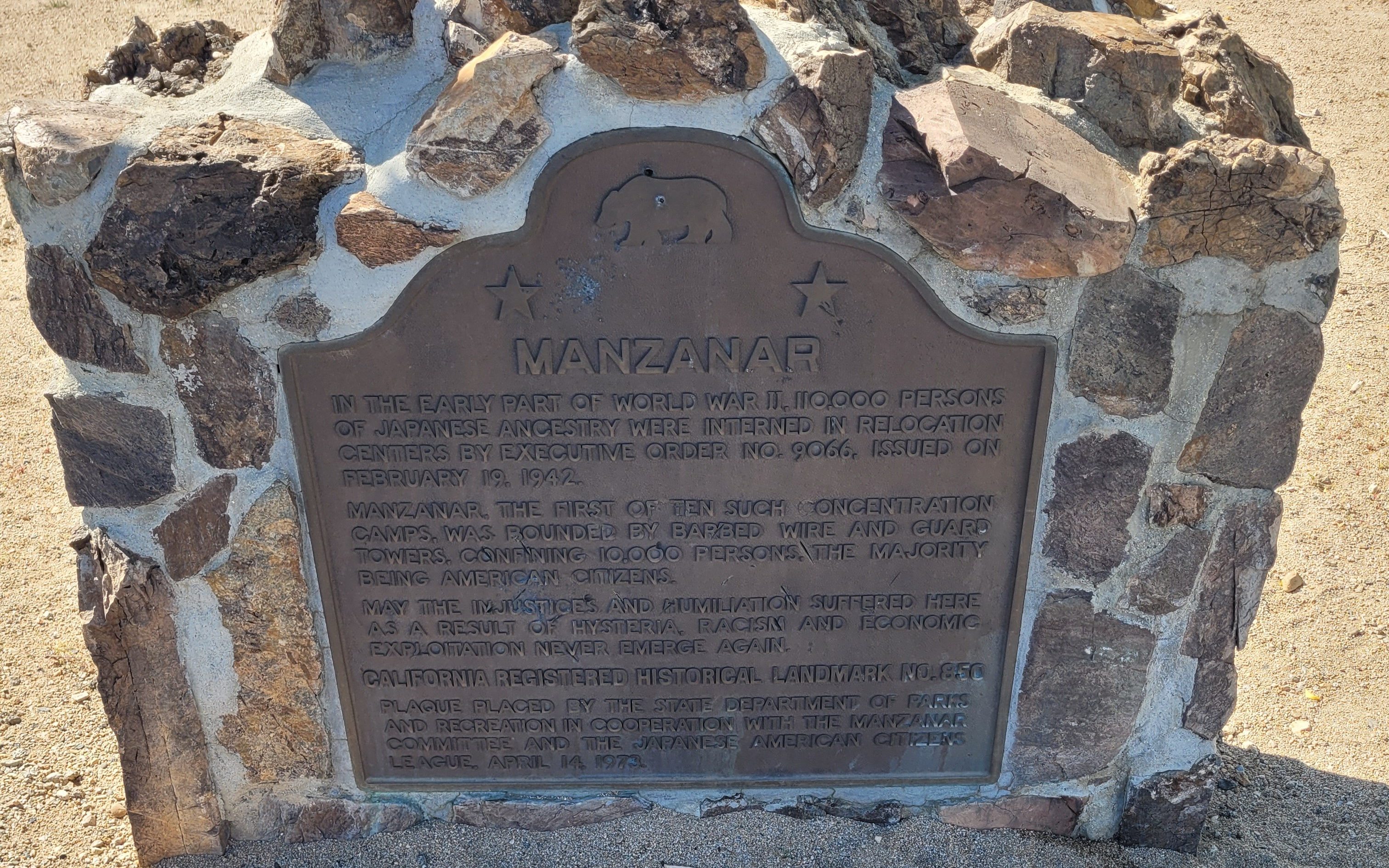
A road trip north of Los Angeles on Highway 395 went past a monument to one of the ugly chapters in Twentieth Century history: the Manzanar War Relocation Camp where eleven thousand Americans were imprisoned during World War II for what they ‘might do’. It was one of ten such concentration camps in the American West incarcerating 110,000 men, women and children. Here, in the Owens Valley of California, the Eastern Sierra Nevada mountains present a stark contrast of geologic beauty and human shamefulness. The United States Government, abetted by local politicians and the media, unconstitutionally deprived Americans of their rights without due process. With racist laws in western states, particularly in California, people of Asian ancestry were prohibited from owning real estate or businesses.  While incarcerated in these camps, these men, women and children were publicly humiliated, lost property (through unpaid leases and property taxes), and forced to live in dusty, cheaply constructed conditions.  During the war, these people were subjected to “loyalty interviews” and eligible men were expected to accept being enlisted in the military to prove themselves. Once FDR realized that the Supreme Court was going to hear a case that would publicly shame him and the policy of internment, the Government initiated a plan to release the internees, comprising $25 payment and a bus ticket to another inner part of the country.

To be continued

Port o’ Call: Cape Canaveral, Florida

Performing a maintenance routine for equipment topside on the USS PETERSON as it arrived in port on a sunny Spring morning thirty years ago was actually fortunate timing. We were just tying up at the naval pier not far from the launch site where NASA’s missions to the moon had flown. But that morning was an unexpected treat. At nearly the same time as we moored, a Space Shuttle roared off the launch pad.

I had been a fan of space flight ever since I the middle Sixties when I had watched the Gemini and Apollo launches on a television wheeled into our elementary school classroom. In the 1980s, I had been with a group of college students touring the Johnson Spaceflight Center near Houston during a national convention of the Theta Tau engineering fraternity. Living in Tucson, Arizona in the early Eighties, I also saw an early Shuttle (the Enterprise(?)) being flown piggyback on its modified 747 airline as it routed through Davis-Monthan AFB on the way back to the Cape. And in four years prior to my assignment aboard the PETERSON, I was stationed in the Washington DC area, where one of the tasks our department performed was to install a mobile van with equipment to communicate with the Shuttle as it orbited the Earth during a particular mission. Being in the Capitol region also gave me opportunities to visit the Air and Space Museum where visitors could walk into a mockup of the first orbiting space station, SkyLab, and to see many exhibits, including items returned from the Apollo Moon missions.

With my grandchildren not yet old enough to appreciate the excitement I felt watching spacecraft launching toward the Moon, I am glad that the first ARTEMIS mission to the Moon is still a few years away. Perhaps when they are my age, they will not have thirty- or fifty-year old memories to recall when we reached for space.

Ask the Chief: an entrepreneur never ceases learning new things

Becoming self-employed is not as difficult as keeping your enterprise healthy (and hopefully profitable) a few years later. A few decades ago, my venture into self-employment did not account for the market changing, making my side gig unprofitable almost at the start (consumer electronics and small appliances became cheaper to replace than repair). Fortunately, during the ’90s my Active Navy service provided a decent living for a single man. In 2001, I married shortly after I became a Reservist. That Navy Reserve income plus my civilian job kept a roof over our head, children fed and contributed to our retirement savings. However, when I turned sixty, my wife and I decided to start a business. It was a niche opportunity that she and I both were suited to fill. Before “burning our boats” and committing to self-employment fully, my wife continued to hold a jobs for several months.

keys to a successful enterprise

The first advice we had learned years before, was to not stop working for someone else until we had continuing income from our new project. Additionally, receiving a small pension from the Navy beginning that year allowed us to keep the dream going. With most of our income servicing businesses in a segment of the healthcare industry, And then, the global pandemic caused businesses to falter and many to fail. But the fact that nursing care and supplying new nursing workers was “essential”, kept our business services fully engaged. And now, after four years as an entrepreneur, the small business my wife and I started has regional and national clients.

a business mentor

While together we had years of expertise in various aspects of our services, developing a business plan, obtaining financing, organizing, then streamlining the infrastructure, cutting costs and determining how to be more efficient in operation took shape over a few years. While experience is a great teacher, and failure often breeds a “never quit” in those whom are destined to be successful, it is easier for entrepreneurs follow other successful entrepreneurs, including having a mentor or coach who is trusted to give constructive criticism as well as advice. We took advantage of resources available to get our business started by getting needed guidance from the Small Business Administration (SBA). The SBA funds advisers to help entrepreneurs, at no cost (the local offices are funded by the government) in many communities throughout the US. Other resources exist including a national organization of business professionals who volunteer through SCORE, conducting seminars and mentoring small businesses. And businesses can find assistance through networking in local Chambers of Commerce and Rotary Club.

formal and Non-Traditional Education

Formal education may be an option though challenging for the self-employed. Several sailors when I was on Active Duty, attended classes which were paid for by Tuition Assistance. Reservists and veterans used the GI Bill, and veterans with certain VA disability ratings were able to complete baccalaureates or post-graduate programs tuition-free. For most who intend to be self-employed, it comes down to what is required by a particular industry, and what the market dictates is required to be successful. In a technology sector, a self-employed engineer often must have a certain education level and industry-recognized certification to be a contractor. A welder who demonstrates the requisite skills, may be fully employed without a college degree. Continual education, through reading, attending seminars, participating in industry conferences and sitting on corporate boards, never ends for a business leader, or those who are working toward self-employment. Many universities offer continuing education programs, for executives, managers, and entrepreneurs, online, off-campus, and in evening and weekend formats. (Peers at my former employer gained various Program Management Institute credentials through such training and passing a certification exam.)

Informally, I know several who became successful through intensive preparation by reading textbooks, trade publications, study guides, and practicing in home workshops and computer labs. They passed certification exams easily, found employment, and with additional skills, became employed at higher levels of responsibility until becoming entrepreneurs.

education for the self-motivated at low or no-cost

For the last twenty years, a cooperative project between universities and the government has made thousands of college course available online tuition-free. Recently, I accessed MIT’s Open CourseWare (OCW) for a graduate course, Managing and Volunteering in the Nonprofit Sector. These have lecture notes, assignments and readings. With a little research, articles and books which are in the reading list, can be found through libraries, read online or purchased used from online retailers. (A personal favorite has become alibris.com).

reading is fun-damental

I have purchased books on several different topics, from language, biblical resources, gardening, and business from several sources:

  • alibris.com
  • thriftbooks.com
  • amazon.com
  • Goodwill
  • libraries

Having completed the first book I obtained in the above mentioned course, Managing the Non-Profit Organization, by Peter Drucker (1990), I am becoming acquainted with the principles and practices that not only apply to my for-profit company, but also with a non-profit organization, a church, I wish to aid. Other books in the university course focus on leadership, vision, communication, marketing, and employee (volunteer) performance. Access to books in any number of subjects is available in libraries, through stores selling used books, and through Internet access which is generally available throughout the world. Books can overcome the is one of the oldest avenues to learning that does not require large investment, nor computer access. For those who have computer and access to the Internet, a course syllabus from a free course (OCW) is easy to find.

As someone once said, “if you aren’t learning, you’re dying” (William S. Burroughs, paraphrased). There is always someone who takes advantage of tools and materials to advance his or her goals. If you still want to wing it, remember a young man in Sierra Leone, in Africa who taught himself engineering and is helping change his world.

Port o’ call : Cyprus

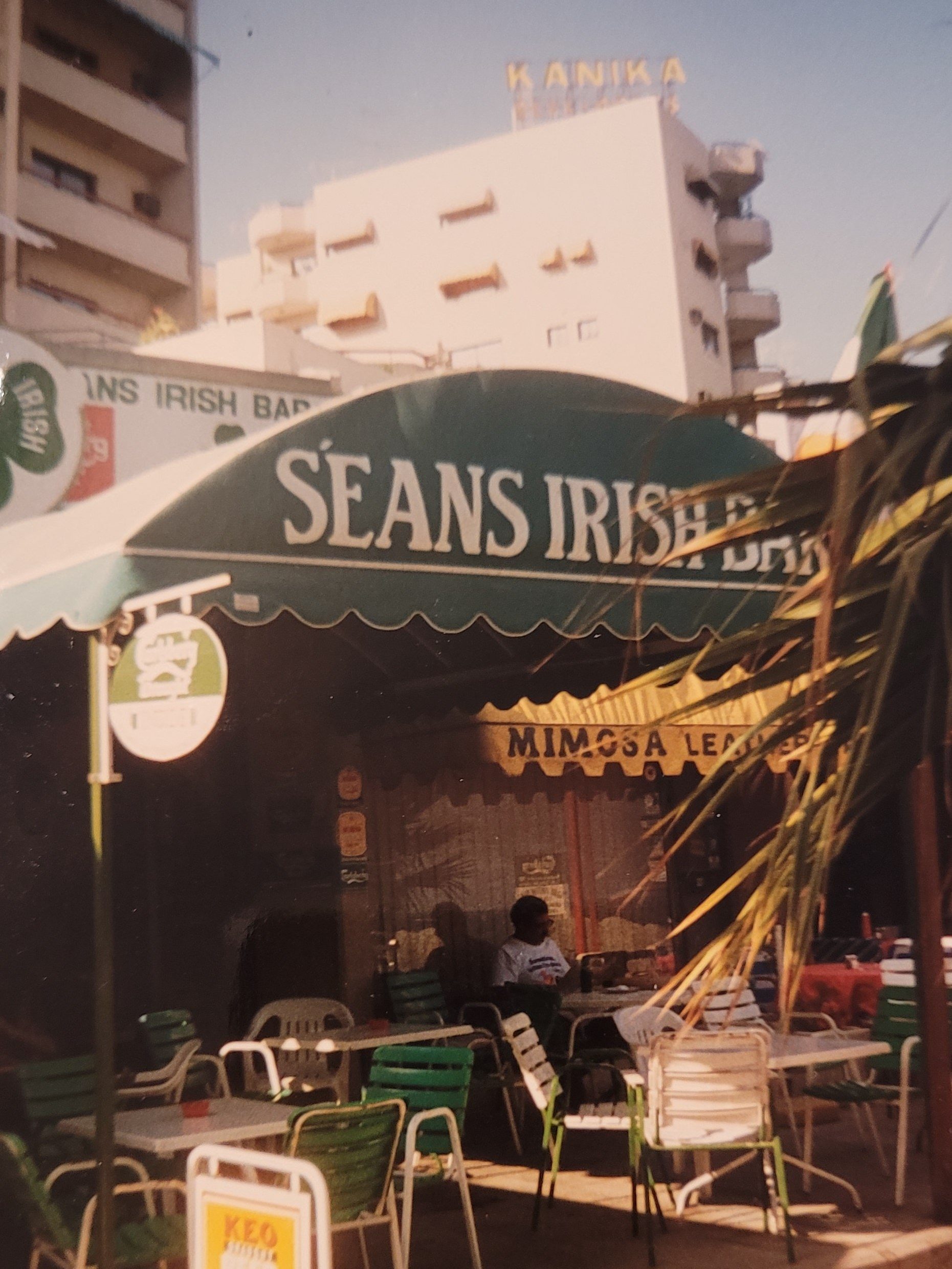
On a Mediterranean deployment aboard USS PETERSON (DD-969) thirty years ago, I visited an Irish pub in Limassol, Cyprus. While a tourist destination for many British and Irish citizens, the island has had its share of trouble and even war, with the northern part of the island dominated by Turkish Cypriots and in the south, Greek Cypriots. For decades, the United Nations has maintained a truce between the two halves of the disputed island as a result. Though I got to see firsthand the uneasy relations between the two NATO countries (while conducting naval exercises with one country’s navy, we were overflown by jets of the other!), the port city of Limassol catered to tourists as well as the UN troops on liberty. Although my 2 shipmates and I were as versed as any about the political situation (given we were cryptologists), we followed command direction to blend in with other tourists (ballcaps, collared shirts, and short hair) to not stand out as Americans and to avoid any discussion of politics or our missions. We were just looking for a few beers and to explore the beach after several weeks at sea since our last port.

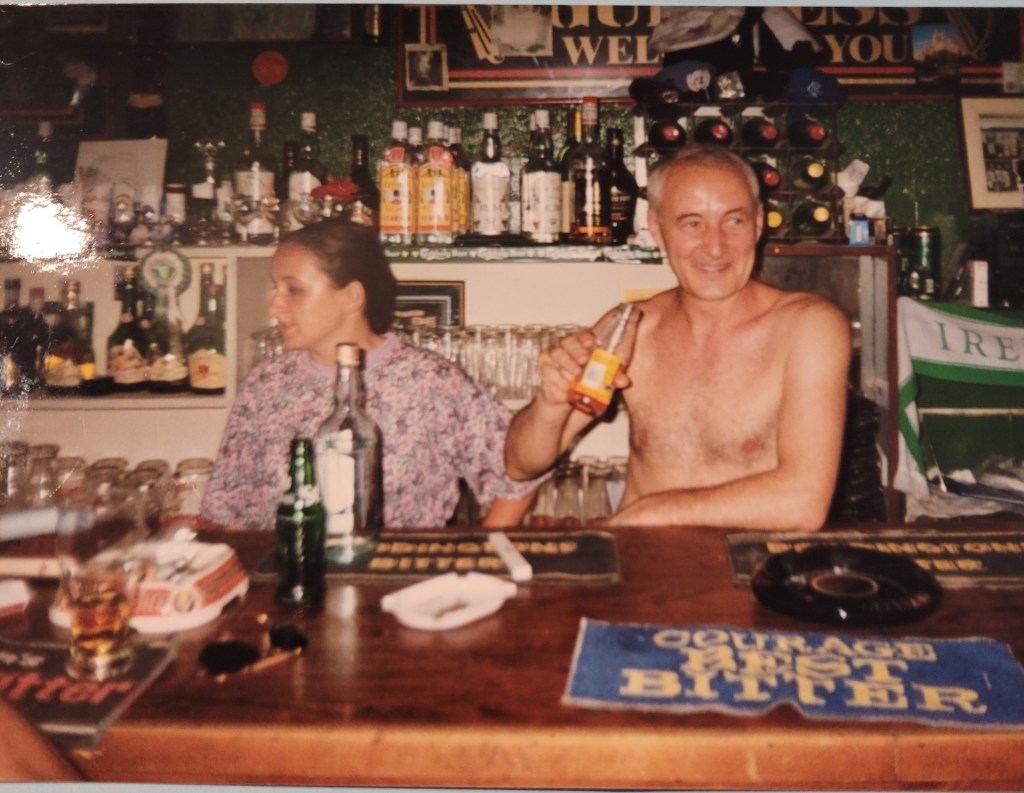
Sean’s Irish Pub was run by an Irishman and his daughter, serving both British and Irish beers and liquor. Talk about soccer teams was as peaceably divisive as with any sports fans in the USA. One of the patrons we chatted with was a Dublin businessman who amiably offered that Muammar Ghaddafi was a pleasant fellow he had business dealings (this was 1994, eight years after the US retaliated against him for sponsoring terrorism). It was best to let that slide. Being of Polish descent (dad) but Irish on my mother’s side (I neglected to mention they were Protestants), Sean made a couple of toasts over good Irish whiskey. We met and had a couple of drinks with one of the UN troops there – I forget whether he was Irish or British. The thing I do remember is that this pub catered to both the Irish and the Brits, but they came by at different hours. And the pub would either have a more “independent Ireland” or “welcome British” atmosphere (both Irish and UK flags displayed, ) depending on the clientele hosted.