the cradle of uncivil-ization

Opening this week’s edition of TIME magazine (June 26, 2017), my eye caught a pictorial article on the environmental battle that was waged last year in Iraq when ISIS set fire to oil fields to hinder the advance of the Iraqi and coalition force pushing them out from the territory they terrorized for years.
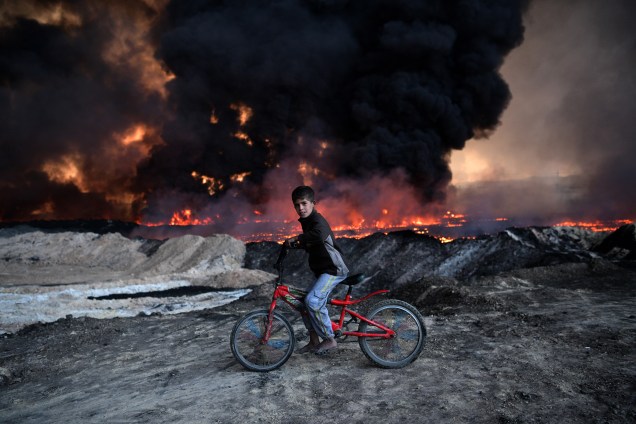
Joint Forces Battle To Retake Iraqi City Of Mosul From ISISIt is quite instructive that the world has become well-versed in the environmental  and human toll of oil spills and fires.  In that region, decades of poisoned water, poisoned wildlife,  and landscapes as a result of months of exposure to deliberate acts of evil men,   toxic fumes, oil -laden smoke and chemicals have been largely overlooked by the European and American “globalists”.   Twenty-five years ago,  while one American political party blamed another party,  the apolitical Government bureaucracy was ignoring the toll on forces of the first Gulf War;  I remember the “Gulf War Syndrome”  where U.S. veterans had to fight through the courts to obtain needed care and Government acknowledgement of responsibility for their ailments.
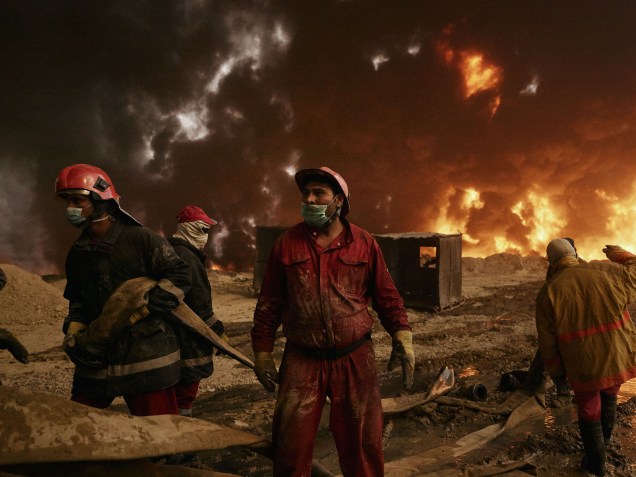
qayarrah_iraq_joey_l_photographer_11_resizingThe TIME article and other sources make the point that the Iraqi firefighting forces – petroleum engineers specialized in fighting these – have been doing so for years.   With ongoing battles against terrorists’  IEDs, bullets at the same time as fires hot enough to incinerate men and equipment,  Iraqi forces extinguished the fires the terrorists set along their retreat.   The Iraqi people who lived through a “scorched -earth” mandate from Saddam Hussein to his forces in 1991, are the same people who suffered again from an extremist army who once again set fires, IEDs, and booby-traps;  from the oil fires damage caused in the aftermath of the Gulf War,  those exposed suffer from cancer, skin diseases, birth defects,  mental issues and myriad other life-shortening illness.  And that terrorists set their world ablaze again, the effects will continue to plague people.   It is no wonder that the poor have risked dying in the attempt to flee to other countries.

While we wonder whether carbon dioxide in the air over the U.S. is a harmful pollutant,  perhaps the same “climate change” advocates can travel to Iraq to advise them that ending America’s reliance on hydrocarbons will end their suffering.

Further reading:

Nose — Little Fears

“Every time I do an Internet search for my symptoms, it says I have cancer,” moaned Spectre. “What symptoms?” asked Sprite. “Running nose,” sighed Spectre. “Is that it?” asked Sprite. “It’s been running for four days,” grumbled Spectre. “How do I stop my nose running?” “Have you tried tripping it up?” asked Yuffie. ~ Enjoy…

via Nose — Little Fears

Tools and their uses

For this very reason, make every effort to add to your faith goodness; and to goodness, knowledge; and to knowledge, self-control; and to self-control, perseverance; and to perseverance, godliness; and to godliness, mutual affection; and to mutual affection, love. For if you possess these qualities in increasing measure, they will keep you from being ineffective and unproductive in your knowledge of our Lord Jesus Christ. -2 Peter 1: 5 -8 (NIV)


Academy to so educate train and develop midshipmen 1 That they may have a fine sense of honor,  a wholehearted love for the best traditions of the service,  an enduring love for country,  subordination based on proper initiative of the subordinate,  an appreciation of the humanities,  and a keen sense of responsibility in assuming authority over others

– Report of the Board of Visitors to the United States Naval Academy, p 10, 1910

“What tools are in your toolbox?”. the speaker asked last night at our men’s church devotional service.   tools_and_their_uses_tm_9-243-10He went on to offer several additional scriptures on faith and perseverance, as tools.   As a former Navy Senior Chief Petty Officer,  I understood that  any young Sailor – or young (spiritually) disciple of Jesus,  life is embracing that you do not know what you do not know but then learning the doctrine, spending time with a mentor and persevering through conflicting desires and priorities.  Perhaps it is safe to say that “duty” is the first concept I embraced.   As a Sailor matures,  the life that each voluntarily accepted  on the NAVY’s terms has certain obligations and responsibilities.  So to as a student of Jesus,  voluntarily but without a ‘contract.   Some skills are beneficial as they will potentially save you or a shipmate in times of peril.  Mastering your calling and seeking to help others grow stronger – for a greater good – will keep you from being ineffective and unproductive in your naval career.


So too, with a spiritual compass.  The Master Mariner, Jesus, sets my course though I voluntarily follow.   But a path voluntarily chosen can build character, endurance, positive outlook and joy that the world desperately needs. (Happiness is a shallow, easily damaged emotion where joy is not.)   Where the military prepares a service member to prepare for war,  it is no less true with even a glimpse of a spiritual life,  war continally rages around us.  For us to rise and help others to rise out of violence,  hatred,  greed, fear, selfishness, loneliness, and misery,  requires faith in a gracious God and the proper tools – faith, perseverance, knowledge, self-discipline, good character, and whole-hearted love.    God’s Word  and the Navy I served for a quarter-century are tools for life.   FB_IMG_1491759647178

Courage at sea

“Until you have the courage to lose sight of the shore, you will not know the terror of being forever lost at sea.”  -Ovid

As most of the world knows by now,  a horrible collision at sea occurred between a merchant freighter and a U.S. Navy destroyer, the USS FITZGERALD (DDG-62),  a couple days ago off the coast of Japan.  Three Sailors, the Commanding Officer and two others were injured and are in the Naval hospital in Yokosuka.  The ship was obviously extensively damaged above and below the waterline.

With the ship now safely in port, the Navy has announced that the remains of several of the seven men, previously unaccounted for, have been recovered from the flooded compartments.   It is a credit to the training and resolve of the crew that the ship and crew were able to control the flooding and that not more lives were lost.  At sea,  compartments below the waterline are maintained at modified-Zebra, where the hatches are closed between compartments and between decks, with the scuttles opened for crew movement.

In an emergency, announced over the 1MC system, they would announce “General Quarters” with perhaps only seconds to respond in this case.   I remember one emergency response in our berthing compartment when a sensor in Engineering erroneously detected a poisonous gas (freon) leak in the space below ours (the compartment was above the refrigeration system compartment).  From a dead sleep, all my shipmates and I evacuated in less than 2 minutes.  But in a collision and the resultant flooding might allow for less that half of that time to get out and secure that hatch.

Regardless of the questions as to events leading to this catastrophe, the loss or injury of a single Sailor is a blow to the community of Sailors.   I pray God’s comforting embrace for my brothers and sisters who continue to serve every day.   For the lost and injured at sea.  And for the surviving crew and families of the USS FITZGERALD.  Serving with HONOR, COURAGE, and COMMITMENT.

Civilians say the darndest things

Men do not make conversation of the sort that women tend toward.  Outside of the walls of a Chiefs Mess, or among men in my church small group,  men do not normally express emotion.  And in those settings, it mainly has to do with frustration or some mis-steps in leadership situations that an  older or more experienced Navy leader (or church leader, given the situation) can provide counsel.    But in the normal daily venues that men gather, in a workplace, at a football game, or in a social setting, I have never heard men discuss emotionally about relationships, weight gain or loss, or the onset of  ‘life changes’.     Continue reading

the Navy remains in good hands

Commuting home on a Monday, I knew that the traffic on the second leg of my drive would be better if I stopped by the cigar lounge for a little while.  Watching basketball (Golden State won the championship!) this evening at my favorite den of man-dom, it was also a chance meeting for this old Senior Chief to swap sea-stories with a 9th-year Sailor currently on training orders to San Diego.

Though he is an Operations Specialist (OS) on the USS STENNIS now in Washington state, and I was an Cryptologic Technician,  any Sailor I know would relate to the conversation; it was observations, opinions and swagger that a solidly capable, mentoring-focused, take-no-b***t career Sailor and I enjoyed that evening.  Even though I haven’t set foot, in uniform, on a ship or installation in eight years,  the conversation about current events,  deployment, camaraderie, and the social and political changes the Navy has undergone, invigorated me.  There’s something about watching the NBA Finals with a bunch of guys – some veterans, some civilians, and like this fellow, currently serving, that made a Monday great hangout time.  dont-tread-300

heroes aren’t like in the movies, part 2

File created with CoreGraphicsRest in Peace, Adam West

The heroes of my childhood were black and white.   Well, they were.  We did not get a color TV in my home until I was in 7th or 8th Grade.   As a child of the 1960s, I watched Batman and Robin, with Adam West and Burt Ward.  It was a campy good versus evil, solving the crisis that befell Gotham in thirty minutes or less Continue reading

Sailors of fortune

Before the advent of  Cyber warfare,  when a ruler wanted to extend his (or her) sovereignty beyond the geographic boundaries of mountains or the sea, sailors were called upon.   Three thousand years BCE,  from their largest settlements on Crete, the Minoans had extensive trade with Egypt and the Syrian people of eastern shores of the Mediterranean.  They were wiped out from the sea– literally.   But the Philistines, whom Ramses III battled (his monuments bear witness to his Philistine captives) were likely either Minoan or proto- Roman Etruscan immigrants.  So once again sailors were prominent in history.

The Homeric tales of Greek mythology reflected actual battles of the Mycenaeans (Greeks) with the Trojans about 1100 years BCE in present-day Turkey.  Scholars think these wars were probably for access to the Black Sea through the Dardanelles.  Sailors as soldiers of fortune again made history.  Troy, whether or not fooled by a wooden horse at the time,  was laid waste, and likely sailors had some role.   About 500 years BCE,  the Mycenaeans battled and eventually repulsed invasion of the Persian Xerxes empire (attacking from the sea).   And as Greek seapower grew, sailors extended their reach and culture all through the eastern Mediterranean.

Alexander the Great, the Macedonian, about 300 BCE, created a Greek empire from Europe east to India and south into Egypt.  And the Romans about that time started to extend their reach by land and the sea.  For hundreds of years,  sailors extended the Roman influence from Britain to Egypt and North Africa.

Since the age of Christ,  European sailors have extended empires and trade to and from all corners of the globe. While squabbles between armies and navies are now over football games,  I think each is beholden to the other.   Sailors may have a tradition of rowdiness in ports around the world, but also gained a reputation for “girl in every port”.  FB_IMG_1491759647178From sailors, over the thousands of years of our known history,  we all potentially have some  DNA of people they encountered:  Assyrians, India,  Egyptians, Carthaginians,  Mongols, Polynesians, Chinese or aboriginal (native american or australian).  If not for Sailors of Fortune,  the dust of time would perhaps cover us.

heroes aren’t like in the movies

There are things that we remember from our youth ( or while I was still ‘under 30’) that should be left in those musty corners of our mental garage.  Just like the old cassette tape  I found during one ‘Spring Cleaning’ out there,  hearing the Split Endz again – or 38 Special  just doesn’t make me “feel” the same thirty years later.   Same thing tonight. A little casual dinner on the couch while watching the beginning of “Highlander” – the one with Sean Connery and Christopher Lambert.  (I recognized the villain, but I can’t remember his name.)   The effects are so rudimentary and the dialogue is rather lame – Sean Connery sounds a Scot but is supposed to be Spanish; however, Chris Lambert – he’s got one of those Kevin Costner-like non-accents due apparently to limited ability to speak English.

Even the swordplay and beheadings are cheesy.   I am trying to figure out why that movie spawned sequels and a television series.  Men in kilts?  Swords?  Perhaps it is the decades in the Navy that have colored my judgement.  I often let reality get in the way of plot on a lot of alien, superhero, or alien versus battleship dramas.   I should have read Mental Floss ‘s review here before I realized a few minutes in that watering the plants and picking up the dog poop was a better use of my time.

I offer a list of dropped must-have guy movies (or TV collections) of the last 30 years.    Some I don’t get why I liked them in the first place.  I don’t have either on DVD or nor recorded on the DVR:

  1. Top Gun (I still can watch Minority Report – for Max Von Sydow ) Cruise movies annoy me
  2. Die Hard (sequels)  ( the first was a classic, then they just kept coming)
  3. Highlander ( love Connery, but fast-forward 20 years to see how comic book-type movies are made WELL)
  4. Smokey and the Bandit ( Gleason’s last films, but such a dumb plot!)
  5. Battlestar Galactica (1978) (Lorne Greene still Cartwright for me !)
  6. Star Trek (only one of those movies I’ll watch again is Wrath of Khan with Monteban – I saw the original TV episode and loved the movie.)  However, the reboot movies with Chris Pine are great!
  7. Talledega Nights  ( now I wonder why I thought Ferrell was funny)
  8.  X-men after the first one.  I cannot keep up with the comic book plot jumps)
  9. Outlaw Josey Wales ( I prefer the Eastwood movies he’s made since 2000)
  10. Taken.  I liked Liam Neeson’s portrayals in Star Wars, the villain in Batman Begins, and Taken -even Love, Actually.  Then he just annoyed me with his Taken sequels   and his anti-gun off-screen preaching.

I think I need to watch Gladiator,  Lone Survivor,  and any of the movies that Sam Elliott was in. Testosterone, guts, courage and attitude.  What we need now more than ever are heroes: dads who want to raise their children responsibly,  people who recognize the effort and support the work of cops, volunteers to help our senior citizens  and young people who don’t want a hand out, or a “safe space”.

Pardon me while I gasp for air

“For, with a ship’s gear, as well as a sailor’s wardrobe, fine weather must be improved to get ready for the bad to come.”
Richard Henry Dana Jr., Two Years Before the Mast: A Sailor’s Life at Sea

Call me “somewhat concerned” with my deterioration during and after naval service.  Thirty years ago, I was prescribed steroids for some medical issues.  Twenty years ago, my appendix ruptured at the start of the Labor Day weekend holiday.  I was recuperating for a month.  I started to put on weight (happily-married weight) ten years ago.   And three  years ago, after getting too obsessed with cycling exercise, using clipless pedals  I fell and broke my wrist  in three places.  A year ago, I self-diagnosed that an annual or semi-annual trip to the ER  ( for ten years) was due to a food allergy to capsaicin.  Now that I have sworn off the spicy food or food containing bell peppers I ate for more than 30 years I am not poisoning myself.

This year I seem to have been crushed by flu and colds.  First year in three that I didn’t get a flu vaccine.   Congestion and nasal drip that chokes me at night will persist for a month, then off for a month or two and then come back just to be annoying.   With some of the crazy medical issues I’ve encountered over my life,  I don’t understand how I don’t have anemia like my late mother ( and low blood pressure)  Nor do I have high blood pressure or a  brain tumor like my late father (in his twenties).  Instead,  I find myself obsessed with breathing.

I always associated breathing problems with asthma, chain-smokers, or the people who live in horribly polluted environments.   I visited Samsun, Turkey one winter while in the Navy, and the coal smoke was literally down to waist-level height by the port . (And they were chain smokers as well.)    I only in the last couple years started smoking the occasional cigar figuring that after age 50,  would take twenty or thirty years to harm me. I probably now have only smoked a half dozen cigars in six months. In the next six months I will quit entirely.    I am very aware that my more sedentary life outside of the Navy renders me more susceptible to ills.   An article I read online tells me a healthier diet and exercise will counter the phlegm that is making breathing at night a chore.

Of course, I may have to cough up a lung or two exercising in my deteriorated state, to get healthier.

On the anniversary of D-Day

bravery and sacrifice

Seventy three years ago on June 6th, 1944  several hundred thousand men dared to assault the beaches and countryside of Normandy, France.   Not very many are still living from those days to remind the world of the valor, honor, and determination of people to defeat an enemy that threatened the entire world.  And those born since the end of the Vietnam war are particularly ignorant of the history that determined the world they inherited.

family tradition

My paternal grandfather came to the United States through Poland in the 1920s.  Any Jewish family that remained behind in Europe were likely murdered by the Nazis;   only a few extended family who emigrated before the invasion of Poland in 1939 are known to my elderly relations.   My grandfather worked in the Brooklyn Shipyard during the war, and my father was an aerospace engineering student during Korea and worked on developing  submarine missiles during the 1950s and 1960s.   My maternal grandmother’s American cousin served in the Merchant Marine and was decorated for heroism during the Battle for Malta.   My maternal cousin served in the Marines in the Iraq War.  My son serves in the Army today.

if the meaning gets lost

The anniversary of D-Day, Operation Overlord, has meaning for that generation now averaging 90 years old as the beginning of the end for a bloodthirsty ideology that began, for Americans, with a surprise attack on Pearl Harbor.    Without the resolve of these young men (and women who served in the factories and supporting industries to keep the military moving), very likely America and Europe would be a different place.  The Nazis would have eliminated diversity.  There would be no Jew, no black, no homosexual, no physically or mentally challenged people.  Death by starvation, street-corner execution, or work-camps would have been the norm.  College protests?  Executions would prevent those.  Black Lives Matter –  there would be none due to Nazi genocide.   The No boundaries/ no borders/no illegal-immigrant lobbyists?   The Nazi control of borders and transportation would stop that.   Question the government?  Surveillance, arrest, imprisonment, and torture.    And short of genocide, many of these same controls were in place in the Soviet bloc for decades.

history doesn’t have to be kind, only truthful

As with any culture in the historical past,  there are any number of evils perpetrated on one group by another.  No county is without failings, suppression of civil liberties and freedoms, and some reprehensible behavior in its past.  But in light of all the current death and suffering perpetrated almost daily in the Middle East and now occurring nearly as frequently in Europe,  many of my countrymen today ignore responsibility, integrity,  work ethic and the blessings that becoming “an American” represented in the years after WWII.  They only see a shameful past that must be rectified with ‘fairness” and “coexistence”.    As a student of history, as one who served his country with honor,  and as a disciple of Jesus,  I do not take freedom and the blessings that living in America has afforded me lightly.  Freedom of religion affords me practice of my faith; opponents still seek to diminish it in the American culture.  They have done so in many parts of Europe.   Perhaps these opponents do not see Islam as a religion?   How many failings of men are attributed to christianity as a whole in the culture compared with the barbarism that seems widespread in the Islamic world, yet constantly referenced by state agents as the violence of a few extremists?

Do not use freedom to deny it to others

We should strive to hold each individual accountable for their deeds or misdeeds.  We can have respect for people and cultures around the world.  But the freedoms that were gained by those who sacrificed and served in the Armed Forces in our nation’s conflicts  are now used by members of the latest generations to abuse others in the name of “freedom”.

Hurghada by the sea

When I last saw Hurghada, Egypt, it was at the end of a nineteen- hour series of flights from Philadelphia, Pennsylvania.   My orders had me wait in this port city on the Red Sea until my ship arrived.   This was 1993 and our East Coast ships patrolled the Mediterranean,  Red Sea and the Gulf of Arabia 249-37-l(Persian Gulf).

While recent images online show a fancy beach resort (!) in Hurghada,  I recall then only sand, heat, scorpions, and prickly pear cactus.  Hotels were still in a state of construction – apparently as their proprietors were not taxed until construction had complete.  To this day I recall the port worker and a shopkeeper who both spoke english.   I got to learn a little about the culture and the European visitors.  I don’t think americans generally visited along the Red Sea as the ancient Egypt they come to see is along the Nile and in Cairo museums.    Back then Hurghada main clientele were German tourists vacationing on the beach.   Egypt is also where I presumed America’s contribution to the world must have been the car horn.  It certainly was not the turn signal.  Perhaps because one hand on the horn and the other gesturing angrily at a pedestrian leaves no hand free?

Egyptian cabbies have a penchant for three things – their vehicles travel at a high rate of speed,  they constantly are honk the horn, and at night, headlamps are strictly of optional use.  You have to realize how crazy riding in a cab at night is: camels, donkeys, street vendors, and folk fill the streets.   None seem ever involved in an accident with these mad drivers.   From visits to our New York City on several occasions,  I now know where these Egyptians learned to drive.   And Turks.  And Africans.