Ask the Chief: the “i” in Chief means “invested”

With the pinning of newly-selected Chief Petty Officers (CPOs) on October 21, 2022, these men and women will be expected to lead their division enlisted personnel in accord with 129 years of tradition and responsibility that comes with the uniform. Anywhere and at any time, a junior enlisted sailor -trying to find a personnel office or an Officer needing stores to be on-loaded, may see that uniform and have an expectation that the Chief will get the job done. While no CPO is assumed to have instantaneous knowledge of every given situation, it is well-known that the Mess can be counted upon to have its collective wisdom to impart.

During the weeks or months preceding the pinning ceremony for new CPOs, a period of training, team building and familiarization known as “Initiation” was a period of ritual, physical conditioning, and service to others. However, there were accusations over the years that some had been victimized by shenanigans that were not in keeping with Navy standards of conduct. Between the early 2000s and 2014, “Initiation” was no longer an authorized term for this training. But during the tenure of MCPON (Master Chief Petty Officer of the Navy) West and then Stevens, the program was revamped to align with the core values of the Navy. Under MCPON Giordano, in 2017, “initiation” became an acceptable term again. In a 2021 letter distributed to leading Chief Petty Officers, then-MCPON Smith reiterated, “

“Command Senior Enlisted Leaders will ensure that all selectees are guided through the Teaching to the
Creed syllabus, as these sessions form the backbone of our training effort. Each of our selectees must
understand what is expected of them as a Chief Petty Officer, and leveraging our Creed as the primary focus will accomplish this goal. Additionally, a specific Culture of Excellence and Warrior Toughness training session will be conducted; training materials and instructions will be provided. Other training topics that have historically been included as “additional items” should be carefully weighed to determine the actual value they provide. Laying the Keel (May 2019) remains in effect and provides guidelines and a framework for a successful Initiation. The legacy CPO Selectee Leadership Course (CPO Indoctrination) is officially “sun-downed,” and a new CPO Leader Development Course will be launched next year as part of the Enlisted Leader Development continuum.
The focus of our season is “preparing” our newest Chiefs to enter the Mess, not screening them out….”

Among those who are actively participating as members of the Mess, this testifies to a sense of duty to foster future enlisted leaders that transcends a Chief Petty Officer’s current status (whether serving on Active Duty, in the Reserve, or as a retired “Old Goat”), community (Surface, Submariner, Aviation, etc.), or location (aboard a frigate, working on a Joint Base, or perhaps, a retired “Goat” who works with Reservists as a civilian manager in a local commercial company).

“I decided long ago to become a Chief Petty Officer, and waited until the uniform caught up”

– Senior Chief Petty Officer, Naval Reserve Center Phoenix **

investment is personal

Forty-five years ago, my career aspirations to become a member of this unique ‘salty’ fraternity (male and female) began while I was in a sort of limbo pending the outcome of a medical board deciding my re-enlistment eligibility. I had been assigned duties akin to Brig duty, monitoring misfit sailors in custody prior to being administratively discharged. The Senior Chief Petty Officer a prior Marine Gunnery Sergeant, gave me a “life talk” I still remember. I re-enlisted in the Navy several years later, and was at one point assigned to the Pentagon. There, a Master Chief would pull me aside to ask me what my plans were for a career and to give me suggestions how to proceed to reach them. Though it took nearly twenty more years, ship – and shore- assignments and transfer to the Reserve, I faithfully followed his advice.

Several outstanding Master Chief Petty Officers, who were respected civilian professionals out of uniform, were no less dedicated as Reservists. One after the other, the career and leadership capabilities of enlisted personnel, some recently promoted to Chief Petty Officer, were honed. The Global War on Terror saw many deployed to Afghanistan and Iraq, where some lead their Base Chiefs Mess working alongside Army, Marine and Air Force operators (Joint operations became a reality over the last 20 years of war). Returning from the war zone, the experience lead to some to become outstanding leaders and mentors, just as their own mentors had done for them. As a Chief Petty Officer, “investment” is as important as the core values of “Honor”, “Courage”, and “Commitment”.

** The quote from the unnamed SCPO was in response to his own question to a “selectee”, as to when he “became” a Chief Petty Officer. (He intentionally sought out greater responsibilities and mentored his peers, akin to the role of a CPO, until he was himself selected)

Remembering September 11, 2001

Twenty-one years ago today, in the early hours of a late summer morning, evil attempted to destroy the American ideal. They thought by striking symbols, the World Trade Center, the Pentagon and the White House, they would succeed in their endeavor. They were wrong. Three thousand men and women, airline passengers and crew, working people, First Responders and members of the Armed Forces perished that day. Instead of fear, the terrorists ignited resolve, beginning first with the passengers in the plane above Shanksville, Pennsylvania who opposed them. Though perishing, the passengers halted the attack on one of Al Qaeda’s targets. Like the surprise attack of Imperial Japan sixty years earlier, a “sleeping giant” was awakened. Before the towers collapsed, Americans (whatever their actual citizenship) demonstrated this evil “holy” war was a failed attempt. Heroism, courage and sacrifice emerged that day.

Men and women rushed into the burning buildings to save others, and some perished in doing so. In the ensuing months, fatherless and motherless children, widows and widowers, neighbors and strangers were comforted. The World these terrorists hated, put aside their differences, then united in crushing the safe haven in Afghanistan and sending its leaders to prison or to hell. Twenty years later, most Americans living today have at least one family member, co-worker, friend, or neighbor who served in the military after September 11th, some of whom returning with the scars of war. Though collective memory of nations fade, governments equivocate, and old ways persist, veterans still remind us of duty and responsibility of the defended. Ordinary citizens support, encourage, and volunteer to assist the injured, homeless, addicted, and refugee. Though many who have come of age in the two decades since question the purpose of the sacrifices in Afghanistan, Iraq, Syria and elsewhere, this day should be remembered and honored.

Embrace those who lost a loved one on that day. Put aside any differences in race, politics, religion, economic condition or gender. Thank a member of law enforcement, firemen, veterans and Active Duty service members for their dedication. Get to know your neighbor. Praise your God for peace and love. Most importantly, teach your children respect, honor, courage, and selflessness.

Were you exposed to toxics while at Camp Lejeune, NC Marine Base?

Between 1953 and 1987, toxics leached into drinking water at Camp Lejeune, NC. How many potential victims, active duty Marines and other military members, civilian workers, and family members may have become victims, injured, ill or died as a result of exposure? One of the chemicals that this article references is something I am intimately familiar. Early in my career in the US Navy, I frequently cleaned electro-mechanical parts in 1,1,1- trichloroethylene, getting it on my skin and breathing in fumes. This cleanser, a few years later, ceased being used.

A law firm in New York reached out to us recently. I have decided to publish their brief about Camp Lejeune toxic exposure, as a public service to my readers. I have received, nor shall I accept, any compensation as a result of publishing this information. Do your research, and let others know who may have been exposed to these contaminants.

Here is the Veterans Administration page describing symptoms / illnesses identified with exposure to contaminants at Camp Lejeune.

If you feel that ailments or illness you or a loved one now suffer, or may develop in future, might have a link to time spent at Camp Lejeune, get screened by the VA and /or private physicians, to provide support for any compensation claim through the Veterans Administration.

Ask the Chief: Seaman to Admiral program

While developing talented junior enlisted and officers into highly-skilled and effective leaders is a goal of the military in general, some leaders’ examples are more inspirational than others. During the late 1990s, aboard the destroyer USS PETERSON, commanded at the time by a former “snipe” (nickname for a member of the Engineering Department), the mission effectiveness and morale of the crew were exceptional, earning the ship awards from the combatant commander. It may have been his model of leadership that inspired a shipmate in my work center, and a Boatswains Mate (another division in the Operations Department) to apply and be accepted for, commissioning. Recently I learned that a peer Cryptologic Technician Maintainer (CTM), with whom I served in the early 1990s, is now a Captain who serves as Commander of Information Warfare Training Command, Pensacola, Florida.

I had the privilege of working for two commanding officers who had begun their careers as an enlisted Seaman Recruit and retired forty years later as Rear Admiral. Both were inspirational in developing military professionals, both officer and enlisted. Officers who modeled the standards set by these COs, became commanding officers in later years. These same units produced enlisted members who rose to become unit Senior Enlisted Leaders, achieve the highest rank of Master Chief Petty Officer in their respective Ratings, and some of these same MCPOs became their Rating’s Enlisted Community Manager.

It has been nearly thirty years since the Navy established a career path for enlisted Sailors to seek a commission. The Chief of Naval Operations (CNO) Admiral Mike Boorda was the first Sailor to start a career as an enlisted man, receive a commissioning, and promote all the way to the highest rank and office in the Navy. It was he who instituted the “Seaman to Admiral Program”, now referred to as STA-21. Each year, exceptional male and female enlisted sailors may apply to become officers. July is the cutoff for applications to be received for the following year.

From websites such as Station Hypo, which posts stories of the history and personnel of the Navy Information Warfare (and Cryptology) community as well as the official website of the Navy Public Affairs office, the news that men and women have set the bar for others to model. Like the story of Mark Burns, Navy SEAL and Rear Admiral, his insight, having attained Flag rank, will inspire others to pursue what is possible.

.

Ask the Chief: a necessary skill for the self-employed

A skill that anyone with something to protect, whether consumer or a business owner, is developing shrewd thinking. Most understand that identity or intellectual property theft occurs through phishing in email and hidden code in compromised websites. However, old fashioned schemes to separate the unwary from their income, disguised as personal or business “services”, are no less successful a lot of the time.

An emailed newsletter from the California Office of Attorney General this week reported charges being filed against a man who defrauded veterans’ families with false college tuition waivers, for which he charged $500, netting him about $500,000. But this is far from the only scam that victimizes veteran and non-veteran alike. This afternoon, my mom n’ pop small business received a fairly sophisticated mailing (arriving by Postal Service) that wanted to assist my business with filing a California form – for $150 – that I have routinely filed, free of charge, with the state. This scam sends an official-looking form warning of the consequences of not filing required documentation, and is populated with the publicly-available information on your business, to confuse a novice business owner. Of course, this scammer assumes that small business people would react without having the experience to know that these things do not require a third-party’s assistance. But then the scammer knows that he or she only needs a few among thousands of new business owners to send them the fee, to enrich themselves.

The State of California’s OAG has been prosecuting perpetrators of this sort of scam for more than a decade. Apparently, this is some sort of mass mailing. However, any criminal who intends to defraud a military veteran should be forewarned. We have all been subject to the just-off-base” hucksters who have sold our young military men and women everything from revolving contract gym memberships, multi-level marketing schemes, herbal remedies, and vehicle-service contracts. A year or more into our enlistment, we all become a bit more shrewd in discerning what we are getting for our hard-earned pay. Most veterans have various sage wisdom (or cynicism) that all come down to “I may have been born at night, but not last night. Get lost!”

Keeping your identity, finances, and personal information secure, and especially when you are in business for yourself (and cannot afford Wall Street attorneys). It is a full-time occupation. While I would toss this obvious nonsense in the trash, I will instead forward this to the Attorney General as the website indicated. I’m perhaps too cynical about taxes, fees, and business. While this is California, I will imagine that there are thousand of other mailings in mailboxes or en route at this time..

seewater** lawyer

“water water everywhere but not a drop to drink”

“Rime of the Ancient Mariner”, Samuel Coleridge, poet, ca 1798

Among humans, particularly those living on the North American continent, the prudent planning and mobilizing a coordinated effort to prepare for difficult times, is most often too little, too late. However, individuals who are a bit more cynical about large bureaucracies’ promises and are more self-reliant as a result (terms which often describes military veterans), often see future hardships and prepare accordingly. We have stories passed down to us: all of Noah’s countrymen mocking his family’s construction of a boat in the desert; the mockers all drowned. An ancient Egyptian Pharaoh’s governor, Jacob, filled storehouses way ahead of a famine that lasted for years; he supplied the nations around them (and incidentally enjoyed a “family reunion” as a result). In the present day, “preppers” are mocked for assembling food, having power generators, accumulating stores and being prepared for defense in the event of pandemics, supply disruptions, and famine. Truthfully, with evidence of civilizations collapsing from these things, human beings are rarely capable of acting together in crisis.

One crisis that gets a lot of discussion, but sees little to no actual action, is the lack of water. On on hand, the reality that the poles are melting – storehouses of trillions upon trillions of gallons of water – has generated a lot of governments to generate taxes, declare fines upon “offending industries”, and incur restrictions and rationing; few places are constructing defenses against rising oceans or storage capacity for rainwater. According to most experts, even an unimaginable immediate end to all global human activity “linked” to the warming of the planet will not reduce the effect for hundreds of years. If the oceans rise for the next 300 years, beachfront may be a few miles to ten of miles farther inland. Agriculture in the western States supplying much of the globe will not be supportable without other sources of water. Ideas are periodically “floated” to capture annual rainfall; these include storing “Monsoonal” summer rains in Arizona and other western deserts or piping westward floodwaters of north-central river systems which overrun their banks in Spring. Piping water over the Rocky Mountains from Minnesota to the West, however, is probably never going to be affordable. Thousands or even hundreds of desalinization plants ringing the continental coastlines might help relieve desertification, but the regulations, cost, and delivery is draconian. In California, one county, San Diego, took a dozen years or so, to approve, construct and operate ONE ocean desalinization plant. It supplies a little of San Diego’s needs.

** A play on “sea lawyer”, a pejorative used to describe someone who believes himself to be an authority, but is generally inexperienced with Navy practices and regulations. As a retired Navy Senior Chief Petty Officer, I am well aware that I am neither an expert on climate, a hydrologist nor bureaucrat specializing in water policies, but have some experience as a consumer as well as having observed naval desalinization practices to create potable water.

Photo by Pixabay on Pexels.com

Ask the Chief: is public health, like national security, a responsibility of Government?

It is the summer of 2022 and our household managed to stave off COVID until early July. In spite of the furor of a pandemic since late 2019, we maintained a ‘common sense’ approach to wearing masks and being vaccinated. Small measures to mitigate the effect to our business, employees and clients. Since we perform services for a large number of people, requiring all parties to wear masks has also helped us dodge cold and flu viruses. But not entirely safe. Catching the latest strain of COVID was both annoying and caused breathing difficulty that lingered long after we tested negative for COVID. Were we not vaccinated I can only imagine how severe it might have been?

Whether the issues are public safety, the economy, food and product safety, or infrastructure (transportation, roads, etc), most citizens and most consumers are supportive of oversight that leads to “life, liberty and the pursuit of happiness”. But are government mandates to mitigate the spread of a virulent disease appropriate? Is public health in the purview of a constitutional government? And if so, which is the most appropriate agent – each local community, county, state or federal? Volumes could and have been written on these topics. Social media is overflowing with commentary on rights, wrongs, opinions, and conspiracies on these things.

As a military veteran, we were required to submit to vaccinations for everything from tuberculosis to anthrax. This was one of the measures to maintain a disease-resistant fighting force in areas our forces operated. And our nation was a party to international agreements on a whole host of topics that benefited one another. More than seventy years ago, the international community made health one of its responsibilities. Every few years a disease like the Swine Flu or Bird Flu, Ebola or SARS COVID-II, and infestations of insects, parasites, plants and animals are transmitted globally through international travelers and trade. Without governmental oversight, the response to an outbreak of disease, parasites, or organisms affecting local populations would neither have the resources nor experience to respond appropriately.

Have you encountered a “pension poacher”?

Every day many of us receive a call or email from a scammer intent on stealing our hard-earned savings, benefits or property. The Veterans Administration is warning military pensioners to be vigilant for unsolicited contact by pleasant-sounding people who intend to fleece us.

Highlights of their article:

To avoid being a victim to these tactics, here are some helpful tips to remember when protecting yourself from fraud:

Be suspicious if someone offers to shift your assets around to qualify for VA pension. You may be required to repay benefits to the government. 

NEVER share eBenefits, VA.gov, or other VA login credentials with anyone.

VA does not threaten or take adverse actions such as jail or lawsuits on claimants. If in doubt, call VA directly at 1-800-827-1000.

To report suspected activity, please contact the VA Office of Inspector General (OIG) by calling 1-800-488-8244. You may also file a complaint with the Federal Trade Commission by visiting http://www.consumercomplaints.fcc.gov.

Ask the Chief: California’s veterans’ benefits enhancement

On the day Americans celebrate our Independence, we all should recognize and thank our military service personnel including those currently serving and veterans. As a veteran and Navy retiree, and a small business owner, I am mindful that many of my peers may not be as fortunate as I have been in my military and civilian careers. And as I grow older, healthcare is becoming a more significant concern. Many of our older veterans with health issues may not have a support network to learn how to obtain federal and state medical services they are afforded due to their military service. For Medi-Cal -eligible seniors who are veterans, California assists them in obtaining pensions, prescriptions, and other services they may be qualified to receive. In turn, this enables California to allocate more resources to Medi-Cal recipients who are not veterans. In California, the Department of Health Care Services (DHCS) has the Veterans Benefits Enhancement Services project. More information and contacts to begin the process, is available here.

Photo by Brett Sayles on Pexels.com

The Battle of Boston Harbor

In maritime warfare, has there been a case where a United States Navy Midshipman was promoted to commanding officer? And then, upon losing a battle, was court-martialed? The answer is yes to both questions.

It was the War of 1812. The battle itself was very short and resulted in the deaths of many of the American crew and capture of the American vessel. Captain Philip Broke, commander of HMS Shannon challenged Captain James Lawrence of the Chesapeake – he had been her commander less that 2 weeks. The Chesapeake got underway to meet the Shannon and in the short conflict her masts and steering were damaged by the British warship and became inoperable. Two hundred-fifty of her crew were killed. Captain Lawrence was mortally wounded, and as he was taken below, he promoted the only surviving officer, midshipman William S. Cox to the rank of Third Lieutenant. Though ordered to continue the fight until sunk, she was captured, and the Chesapeake‘s remaining crew were imprisoned in Nova Scotia. After the war, a court martial found Third Lieutenant Cox guilty of briefly leaving his post during the engagement. He was stripped of rank and discharged. William Cox died in 1874, but 75 years after his death, in August 1952, President Truman signed a legislation posthumously restoring Cox’s rank of Third Lieutenant.

folding clothes and other lost habits

A popular video that still makes the rounds on the Internet, a now-retired Admiral and Commander of Naval Special Warfare (SEAL), shared that your best days begin by making your bed. Today, I read a post on Facebook from the Naval History and Heritage command which reminded me of my early Navy days. It has a series of illustrations of how a Sailor’s uniforms were folded so they would fit in a seabag. Folding precisely was necessary to fit in the minimum space provided (shipboard life has exacting space for each member). While many of us had parents who modeled that sort of self-discipline of making your bed, folding your clothes, taking out your laundry to be washed and dried, and other household chores growing up, many did not. But the military service branches, when we all entered recruit training, would change us all into the sort that had an eye for detail, precision in our activities, and ability to stow our military uniforms and personal effects in the space we were given.

More than two decades have passed since I was part of a shipboard crew, and half that since I last wore the uniform. While the attention to detail and attitude about priorities and performance may still be part of my DNA, sadly other habits have gotten sloppier. No sharp creases in my skivvies, nor do my belongings neatly fit in my much larger “coffin locker” (the small storage space below each sailor’s bunk aboard ship) closets and a 5 -drawer dresser. Linens on my made-up bed would never bounce a quarter, nor do I take 3-minute showers (spray to wet, soap down, spray to rinse, get dressed). I do not stencil my underwear, nor do I fastidiously clean floors, walls, showers to Navy standards. While standards have been stretched over the years, the habits of nearly 30 years do result in frequent “field days”. And I still have Army, Navy and Marine veterans who may visit from time to time. Informal inspections can happen at any time (and my spouse keeps me mindful that a clean home is an inviting home) so I am well-stocked with cleaning agents.

Camp feathers

A veteran friend of mine sent me the link to an article on the military use of pigeons back before Marconi’s invention revolutionized communications. The Navy employed pigeons to courier messages, even developing a Navy Rating with special training to care for and train the birds. If the world goes to seed, I may have some recruits for a new pigeon command here.

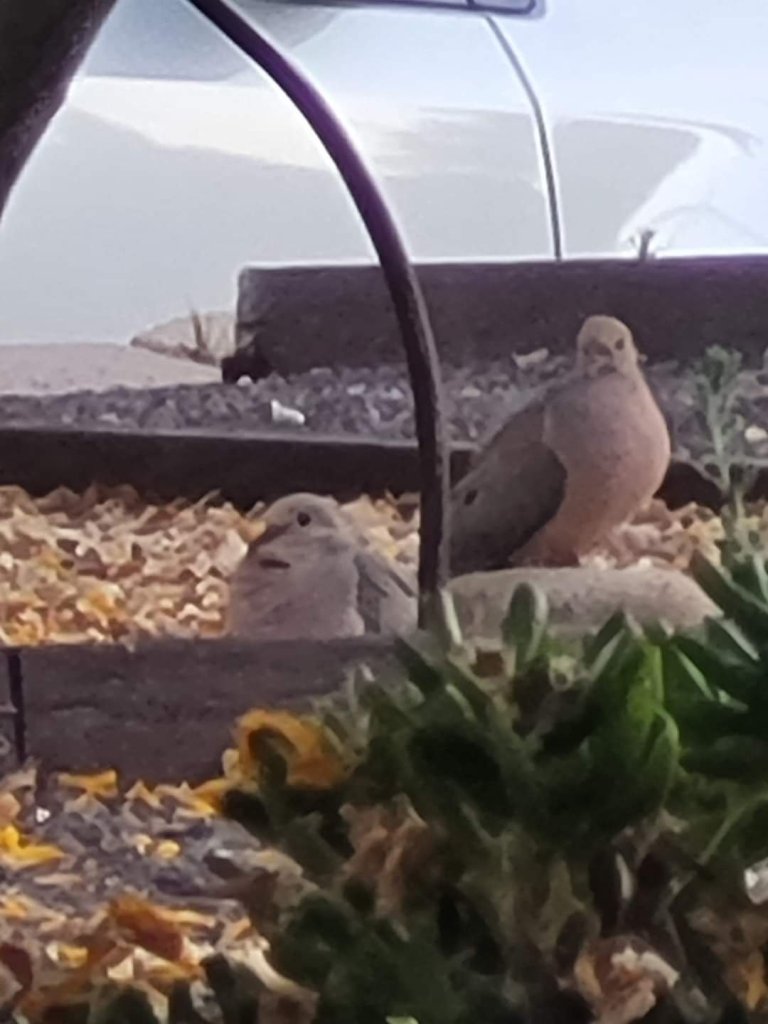
Doves at camp

I may not have been a Navy Pigeoneer in my career (I was a guy who maintained the electronics), though I am getting more into birds at home. With the change to some waterwise shrubs, my wife wanted to put seeds and sunflowers to bring them back. Recruitment seems to be working. Finches, hummingbirds, California Towhees, and mourning doves are again welcome guests at Camp Feathers. I had originally wanted to attract some nearby raptors, but these are perhaps following the gophers which have gone elsewhere in the neighborhood.