why ships are “she”

There is nothing more enticing, disenchanting, and enslaving than the life at sea. Joseph Conrad

In February 1992,  at age 32, my personal life in shambles ( an estranged wife with mental illness, and crushing debt were the big issues),  I received orders to the USS TEXAS (CGN-39), a nuclear powered guided missile cruiser homeported in Alameda, California – across the bay from San Francisco.  I drove out from Florida by myself.   Arriving at the bottom of the brow,  I was ready and excited to begin my first period of “sea duty”.    I was reporting as one of three technicians, supporting the communications and  RF surveillance systems – which I had just spent half a year learning.  Looking back today, the electronics and the computer control – running octal code!  – were less complex than the average electronic toy today.    But in 1992,  few people owned a personal computer, and maybe the well-heeled might have a “car phone”  — bulky device, with bag, battery and a cigarette lighter socket charger.

The duties I was assigned – as the newbie out of school – were general.  I was already being called “grandpa” since I was nearly six or seven years older than the senior tech in our workcenter.  As the new guy,  I was put in a harness to go aloft.   (The harness came with a “ball-buster”, so-called  because of the mechanical brake used as a safety line for ascending and descending the mast — if you disconnected without thinking, a few pounds of metal would swing away and crash into your groin! )
4347_1153409082038_7039634_n
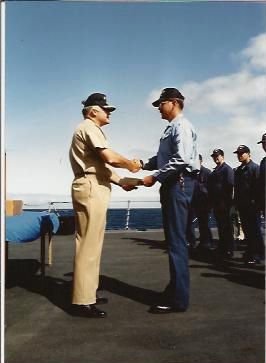
Capt Neal Brennan commends me

For a guy that wasn’t all that fond of heights – I had been rappelling mountains in Virginia to end that timidity climbing a hundred feet up above the water pierside was my “welcome”.    Of course, the lamp at the top of the mast, attached to our TACINTEL antenna had no need to be changed.   But the gentle sway was calming, and height never troubled me after that.  I spent a lot of time over the course of several years greasing fittings, cleaning away salt buildup, sanding and painting equipment.  Since each communications shop : the CT and EW (electronic warfare or ELINT guys)  were in my division;  the Radiomen and the Combat Systems groups also had things to maintain aloft.  The primary time to do these chores were in port for extended periods as we would have the rotating and radiating (radars especially)  for our ship and neighboring ships “tagged out”.   Nobody wanted to be sterilized or cooked (think of a  microwave oven) from RF energy.

Between performance tests, maintenance, cleaning, and cross-training as an operator in our own center, we had training in security force ( rapid reaction team), firefighting, damage control and other collateral jobs.    Because of the nature of the job, most of the crew knew us only as “spooks”, and Maintenance (CTMs) were not above getting strange looks from the hot and sweaty Engineering (Snipes) crew.  You see, in a couple of our workspaces, the air conditioning (chilled water) system were overly efficient.  Large, heat-generating equipment had been replaced with newer systems that were much  less power consuming.  The now much colder workcenter  made it necessary for the techs to wear our winter coats or “foul weather jackets”;  we might forget to remove them when we went to the Mess Deck to get some coffee.  Some sweaty, greasy shipmates were a little irritated at some “topsiders” easy living.  shopping

Working behind the “Green Door”  with its OZ Division sign (“Oh-Zee” meant we were part of the Operations Department)  required special access and security protocols.  We would get asked from time to time what we were doing.  We would come up with all sorts of stories.  “Actually,  I could tell you, but then I would have to kill you” was our running joke.   In the days when email and Internet were toddlers,  when the AFRTS broadcast was still received  and rebroadcast in the evening through the ship’s entertainment system,  we might get sports scores or news before the rest of the ship.

While the underway schedule was tedious and I would sometimes spend up to eighteen hours working, cleaning, training or on watch, it was peaceful.  All the noise at sea – equipment, machinery, buffers, alarms, announcing systems were less unnerving than the sudden “silence” – an equipment casualty occurring at that moment – followed by an alarm and a all-ship announcement through our 1MC intercom.   I really felt at home on the TEXAS.  Compared with the stress of the home I had left back in Florida, I was in a long-term relationship.  That ship and crew were my family.   I set out to learn everything I could about the ship as part of the Enlisted Surface Warfare qualification  and earn my silver Surface Warfare pin.

It was a shame that the ship’s schedule was a few months deployment s, before it was to go into the shipyard for a couple of years in order to replace the nuclear fuel and receive upgraded systems.   My first underway period occurred in the late Spring of that year,  and it was not long afterward that I was able to add Panama and Ecuador to foreign places I had visited.   Transiting the Panama Canal was one of the highlights of my Navy career.   And becoming a member of the honored Shellbacks – first, as pollywogs, we had to be properly indoctrinated in a raucous smelly, greasy, traditional welcome. And being hosed down with salt water in the pre-dawn of the equatorial waters near the Galapagos Islands, is a memory I cherish. My years of spanish from school, living in southern Arizona, traveling in Mexico, paid huge dividends in Central and South America.  Where some Panamanians or Ecuadorians were bemused or put off by American Sailors,  I was able to share jokes, catch deals on local crafts,  negotiate fantastic deals on a hotel room for shipmates and even trade wits with a streetwise New York-born kid visiting relatives.

On our return to Alameda,  a segment of the crew was able to take change of station, house-hunting leave  for our pending move to Bremerton, Washington.  In June, I was soon after to realize, that the weather was perfect though temporary.  For the remaining 11 months until the following June, it was cloudy, misty, rainy, snowy or sleeting.  Prior to going into dry dock, the TEXAS made a trip across the Puget Sound for Esquimalt , British Columbia, Canada.   Killer whales in a pod accompanied us for part of the trip.  Between maintenance assignments and duty rotation,  I was briefly able to take in the view outside the skin of the ship.   The view of the Olympic Range (the Olympic peninsula is the large portion of the state west of Seattle) puget-by-pacificnwseasons-blogspotdotcomto the south is amazing – when the fog or mist lifts long enough to see the snowy mountains.    The Canadian naval base is next to Victoria, a city that looks every bit as if it was lifted out of England and deposited there.  For the couple of days that we were visiting, I had my first experience with craft beer.  My present infatuation with micro-breweries, got started there.    greater_victoria_780_64


I still think about going back to hike in British Columbia, visit the tea shops and markets, and maybe enjoy scones and english marmalade.

In the coming year,  the ship, now in dry dock, was cut open, all the decks were covered with plywood,  giant tarps hung over the side of the ship while sandblasting away the paint, barnacles, and growth of many years at sea.

With my equipment shutdown or removed for maintenance, I was left to clean, to document maintenance – I worked fairly closely with the  Maintenance Material Management System or (3M) Coordinator  by that time.  For a couple of months I was assigned off the ship to help coordinate the maintenance of the Bachelor Officers Quarters which at the time was being transitioned to a civilian who had been running large hotels.  Officers had it pretty cushy.  Enlisted sailors in base quarters in Bremerton  didn’t have it too rough either.   At the time the Navy made its decision to halt the refueling and scrap the TEXAS,  I had moved off base to renting a home not far from the shoreline.  Seattle was visible across the bay.

I was enjoying the little town of Manchester.  Then my estranged wife showed up, long enough to take most of my valued possessions and several firearms.  And leave with her boyfriend.   I was ready to transfer to my next ship,  a destroyer in Norfolk, Virginia, the USS PETERSON (DD-969).

Ships are known to the men who go to sea in them as “she”.   Temperamental, attractive, frustrating, consuming, difficult, requiring a lot of commitment and hard work. And romantic.  All at the same time.  But like a woman you are with, you can be successfully only in one relationship at a time — and a ship is jealous for your time.
Flying anvils

I have been both a Navy consumer, a Navy technician, and civilian test engineer supporting Information Security – securing networks and securing data storage.  Currently I am working on the manufacturer’s development side.

In a profit-driven company I’ve noticed some truths: resources are finite;   managers focus on meeting the contract requirements with least impact to manufacturer’s bottom line; a complex design takes longer and with more manpower than allowed to perfect; customer requirements change during the test and production phases; performance or production challenges occur when starting production;   faced with budget constraints themselves,  some (new) customers deploy the product in ways not specifically considered in the design.

As one of the warfighters, I wondered why some equipment I routinely used was poorly designed (in my estimation).  Overheating, power supplies that needed frequent replacing, maintenance or rework that was labor-intensive, required shipment to a depot, or some “special handling” when called for.   Banging, tweaking, and massaging were often employed to get recalcitrant gear to operate.  One particular situation occurred when my communications system was overheating- the room (called a “space” or compartment aboard ship) was co-located within an office used by several officers.  Since they were too cold – the air conditioning system had to be kept low to maintain the equipment side at optimum performance- they demanded the temperature to be comfortable.  This resulted in equipment overheating and breaking down.

After my military career,  I vowed to be a better designer and tester of gear for the warfighter, but as an employee of a public company, economic reality tempers my best intentions.  Brilliant engineers working to specific constraints are split between several products, test and development has greater latitude in acquiring test equipment and components than in production.  The manufacturer’s vendors are relied upon to provide parts and subassemblies that perform to the specifications!   But the most challenging aspect I have experienced is the customer using a product in ways that I have not tested directly but am asked to debug when they fail.   More often than not,  we find that the parts of our system we did not design and build but purchased  as COTS (consumer off the shelf) are not subject to the same quality as the supplier advertised.

In the former world of huge Government development budgets, a new system can be fielded, bugs worked out, mistakes corrected, and used for decades.  The Space Shuttle program, a computer-reliant, spacecraft and terrestrial glider,  a “flying anvil” of sorts, most likely had the same development challenges, and the public is aware of the two critical failures that occurred during their working lifecycle.  Overall, these systems were very reliable.   In a public company,  products have to enter the market before the competition and be embraced by consumers whether government ( military) or public, generating profit and demonstrating reliability in a very short time.

And my focus is remaining the Subject Matter Expert for my product line, and the test engineer who successfully brings the prototype through acceptance testing: Job security.

separating salt from the fake salt

I’ve had many occasions, at work, driving cross-country, at various public events to meet people who are veterans or on Active Duty with one or another branch of the military.  Driving around San Diego, I am saddened by the number of homeless on the streets.   As a veteran, I know that there is a substantial percentage of these men and women – or imply through the hand-lettered signs that they are down-on-their-luck veterans.   Many unfortunately are, but may also be in an untenable position due to alcohol or drug-addiction.   Yet I admit, I am more drawn into conversations  when encountering squids, jarheads, ground pounders or zoomies working in shops, service industries, Costco,  or government offices   mutually recognizing a military connection.   And whether it is initiated by a ballcap, t-shirt or window sticker, we can converse about shared life experience.

4347_1153409202041_3983536_nThere is something instantly bonding about men ( and women) who share the common experience of military service.   Yesterday, I was enjoying a little rest on my homeward commute at my little bastion of like-minded libertarians, and got interested in a conversation one of the guys was having about an exchange with a cop.  Turned out this cop was practiced – but not in a good way – of embellishing some prior Navy experience.  As it happened, my acquaintance, like most of those who have had some years in the military was correcting this cop’s recounting of his service by providing some firsthand expertise in the details (occupation codes known as NECs or MOS in other services, training specifics, locations) that this storyteller had fudged– as would have I in the same exchange.

4347_1153409082038_7039634_nThere is nothing more disingenuous than a person misrepresenting military service.  “Stolen Valor” is the term many may be familiar.  Most of the perpetrators are playing on the sympathies of the public, trying to obtain benefits not owed, or wooing the gullible.   While there have been several court cases deciding that ’embellishment for the purposes of misleading public opinion’ – politicians, editors, bureaucrats, teachers have not been worthy of punishment,  there have been equally social media shaming of these con artists who were bringing discredit to those who serve or served honorably.

Yet it was the exchange of sea stories with my shipmate which brought back great memories for us both.  Both of us entered the Navy a year apart in the 1970s.   He was a fellow technician, working with computer systems aboard ship before the Navy combined the ratings,  Many times, the Navy consolidated skills that had their own individual occupations with others,  as was the case with my own rating after my retirement.   Regardless of the fool trying to boast about details of service that other “salty” Sailors – ones with years of sea duty and military experience – could immediately call his bluff,  my conversation yesterday was refreshing in bringing the memories back to the surface.

4347_1153409602051_4092653_nIn those days, there were traditions and customs, regulations and deckplate leadership.  When some Sailors who were otherwise experts in their trade, had a little too much to drink on the prior night’s liberty, their shipmate including the supervisor would look ot for them.  As Mess Deck Master at Arms, a temporary assignment aboard ship,  the ability to encourage the crew, curry favor, or even to mentor and train some junior sailor were all part of my experience.     There is nothing that someone with sea duty, can really describe to a civilian about life at sea – noise,   drinking water with a little trace jet fuel (JP5) in the lines, the drills, the boredom, and port visits that another military member doesn’t instantly know what you are talking about.
4347_1153409362045_4581716_n

“field day” is not outdoors

I love the smell of Pine-oil cleanser.  Many years ago, I was taught, or should I say, I was indoctrinated, in  proper cleaning technique by the United States Navy.   One of the cleansers we used was Pine-oil, in water.   With a mop and a wringer bucket – known as a swab and a cadillac, respectively and a tremendous amount of elbow grease, we would render things sanitary.   One of the least sanitary places,the bathroom – head to the Navy and Marines, a latrine, to Army and  Air Force,  was subject to daily, or even twice-daily cleaning.  In boot camp, there are two primary skills impressed on the incoming rag-tag civilian to turn him into military personnel.  Behind all the barking orders, trash can tossing, marching, calisthenics, and of course, basic military training, is attention to detail, and instinctive obedience to orders.

cropped-2c1c4-picture1Cleaning is one of those “attention to detail” skills.  One of the favored techniques of boot camp instructors when our unit was housed in Korean War -era barracks, was to set us to performing “field day” (deep cleaning) the barracks.  These were a magnet for dust, flaking paint and generally the decks (floors) were yellowed or dull.  The reward for passing inspection was relief from a marching drill, calisthenics, or even a short recreation period.  The punishment for failing that inspection was enduring the former two choices and then, to field day all over again.   As a trainee at a military technical school, the same inspections and field days occur, though the “Fleet Sailor” is normally separated from the recent boot camp graduates at a training command.  pinesol

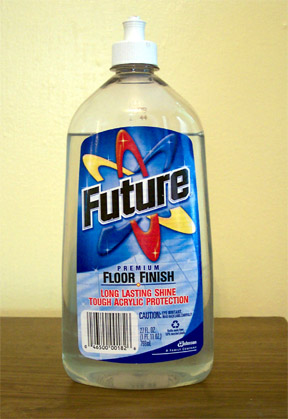
You see,  the “Fleet Sailor” has learned over years, that drills, inspections, and cleanliness are necessary, but she has developed a cynicism, a sarcastic response -mouth, and a few shortcuts to the cleaning process, particularly at a training command.  Enter Pine-Sol  and Future acrylic floor shine.  Pine-Sol cleans very thoroughly, and even a few drops will permeate the living quarters to smell “clean”.    Since waxing is a very time-consuming process to get applied properly and looking even,  Future, when the floor has been thoroughly stripped of wax and cleaned, and applied carefully, generally resulted in inspection grades of “OUTSTANDING”.   And that normally resulted in a duty-free day. That was,  relief from standing a watch.  Of course, the acrylic easily scratched, so occupants of those quarters would leave shoes by the door when entering the room for the next several days.

Some fifteen years later,  aboard ship,  our Executive Officer, “XO”, would periodically inspect areas of the ship to determine if the proper attention to detail was being paid.   One favorite memory involved him, in coveralls and gloves, flashlight in hand, prostrate on the deck in the head next to a urinal.  I was carrying a clipboard to note deficiencies.  Up came the XO with palm up glove “asking” the senior Petty Officer in the compartment,  “WHAT IS THIS, PETTY OFFICER?”

“PUBES, SIR”, he replied.

Pubic hairs on the deck behind the urinal and some dried pee were contributing factors to impending doom in armed conflict with an adversary.  It indicated a lack of attention to detail.   It was the XO’s job to see to it that everything on a ship was as near perfection as humanly possible.  Efficient machines and a capable crew, ready and able to fight catastrophe – fire, accidents, flooding, and the unexpected has saved lives.

FuturebottleAnd now twenty-five years later,  three boys now grown, and living in one of the dustiest environments I have experienced, with shed-prone dogs,  my home has only been subject to a ‘fairly good’ field day about once a month, and a decent sweep and swab each week before company comes over.    I am not complaining.   Were I to dare to get out the glove, flashlight and query about pubic hairs and pee, the “Admiral” would point me in the direction of a bucket and swab  and have me re-do it.
My former Commanding Officer and now, Rear Admiral, would probably be smiling, approving of an old Senior Chief getting re-acquainted with the swabbie skills.  She always like my wife, the Ombudsman as much if not more than me.

Where the heck is the Pine-oil?  I need to get to work.

NEVER clean a Chief’s coffee mug

One of the best and worst times of my young Navy Sailor life was performing as a “Mess Crank”.

While I have heard that the services now seem to employ civilians in the galleys or chow halls  – all recruits learned kitchen duties  in the recruit training commands’ cafeterias when I went through forty years ago.    I can only imagine what shipboard life is now  but it was a fact of sharing in responsibilities especially with the non-rated junior Sailors to help in all the Mess (kitchen) duties.    You might find a “Mess crank”  ( not a pejorative but a traditional term that none in my day might offer they were offended by)  at all hours scrubbing, putting away dishware, or running a buffer across the waxed decks.  For those assigned to the Officers Mess,  Commanding Officer’s or the Chiefs’ Mess,  duties came with varying levels of perks.  Basic duties included setting up the coffee urn. On military installations, the 24-hour nature of the job meant coffee should always be fresh and never run out.  This may have changed somewhat with the Millenials entering the ranks.  About the time I retired, many Sailors were drinking those Energy drinks – all highly caffeinated – so some may have not taken up the coffee habit.

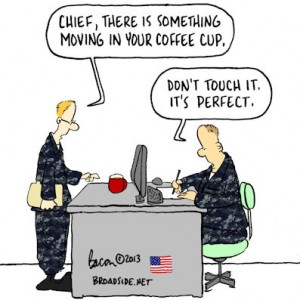
I might be old-fashioned, but woe to a Chief in the “Goat Locker” who disdains coffee!130715-28coffeemovingcolor397-300x300   A Chief and his coffee cup are fundamental to Navy lore.   Just as my predecessors, I was unable to function without my coffee cup.   Though some mugs might be now metal or some thermal metal/ plastic amalgam, the traditional one, a sturdy ceramic, that might be emblazoned with the Command logo,  a CPO anchor, or the rating and warfare designation.   Sometimes the outside of the cup was quite worn as might be any treasured possession through many years of service.

A retired Chief Petty Officer,  despite the passage of years, can still be identified by his or her crooked finger,  use of one favorite mug,  or the ongoing need to balance work with coffee – and usually a bit of advice that begins. “now this is a no-sh*t*er..”   On duty, the Navy Chief might otherwise be off-balance were it not for that crooked finger cradling a steaming mug.  It is a tool for supervision, training or correction.   The tell-tale hallmark of a “salty” Chief Petty Officer is the dark, some might say even crust-like, layer of black-brown coffee rings within a Chief’s coffee mug.   “Added flavor” we all say.

And under NO circumstances, be the one “Mess crank”, who takes it upon himself to wash out the “filthy” mugs in the Chief’s Mess.    The Chief’s Community has better information sharing than the latest satellite technology, and while you may eventually rise to become an initiate into the CPO community, someone might have been waiting 10 or 15 years to live down that sacrilege.   These days I keep one cup at work that never, ever gets washed.  Perhaps it is part of my charm.   I have been known to several for years by,  and still earn the respect of  co-workers, as the “Chief”

** Cartoons    Broadsides,   Jeff Bacon

** more interesting asides about coffee mugs and the Chief’s community –http://www.navyhistory.org/2013/11/dont-wash-that-coffee-mug/

binnacle list

I am an old seadog these days.  In my youth I would rarely miss work, school or a duty day for something as irritating as a cold or flu.  For centuries, if a Sailor went to Sick Call and was placed on the “binnacle list”,  the leading Seaman or later, the Chief Petty Officer would let it be known that Sailor had better be suffering Scarlet Fever or a severed artery.   Shirkers normally found themselves on duty rosters during port calls.   These days I have accepted that I no longer can bicycle fifteen miles to my duty station and immediately run ( and pass) the PRT fitness test –  I was then still under 30 years old;   I probably would not be able to hoist a sixty or seventy Damage Control bag over my shoulder while wearing an OBA * and hustle up or down the ladder during one of the shipboard training sessions – the General Quarters Drill ( I was not quite 36 then).    My older body has stopped writing the checks my ego really can’t cash.  (For those who may never have seen a check, this idiom was once a popular expression.)

There once was a time in America when self-reliance, mental and physical toughness were characteristics of mature males – college educated or working class.  So when an acquaintance talked about his Army veteran dad only recently talking with a Veterans Administration representative about  medical issues he has had for the last thirty years, and getting a disability rating as a result, I listened.

More than twenty years ago,  I was  hospitalized after weeks-long exposure to toxic fumes;  However,  the service and my young invincibility complex made little of it.  In hindsight, a ruptured appendix that year and 20 years of  hospital visits for gastric issues might be connected.   And for good measure, Gulf War inoculations, and radiation might be worth a good look.   Even if the Government declines,  I will gain experience that I can pass on to my son in the Army.  He’s definitely got physical issues that were aggravated by his service.  But he too, is a tough, self-reliant type.  I don’t want him to wait 20 years.

Iron men and wooden ships

I think I should learn to sail before I die.  In a sailboat.  Perhaps on the ocean.  After all, I spent a seventh of my life on the ocean, in vessels that patrolled the world.  Of course, none of these used wind power and fabric for propulsion.   But as crew aboard a warship crossing the Pacific and at other times crossing the Atlantic,  I recall seeing adventurers on their tiny cork

For inspiration,  I was reading about a couple adventurers, beginning with Robin Knox-Johnson who was first to sail solo and non-stop around the world in 1968 ( it took him 10 months to complete)  and latest, Thomas Colville, whose fifth attempt at breaking the 2008 record of 57 days  accomplished circumnavigation in only 49 days.

Or maybe I will just take lessons this summer on a smallboy at the Navy MWR marina and sail in San Diego Bay.

Tools and their uses

For this very reason, make every effort to add to your faith goodness; and to goodness, knowledge; and to knowledge, self-control; and to self-control, perseverance; and to perseverance, godliness; and to godliness, mutual affection; and to mutual affection, love. For if you possess these qualities in increasing measure, they will keep you from being ineffective and unproductive in your knowledge of our Lord Jesus Christ. -2 Peter 1: 5 -8 (NIV)


Academy to so educate train and develop midshipmen 1 That they may have a fine sense of honor,  a wholehearted love for the best traditions of the service,  an enduring love for country,  subordination based on proper initiative of the subordinate,  an appreciation of the humanities,  and a keen sense of responsibility in assuming authority over others

– Report of the Board of Visitors to the United States Naval Academy, p 10, 1910

“What tools are in your toolbox?”. the speaker asked last night at our men’s church devotional service.   tools_and_their_uses_tm_9-243-10He went on to offer several additional scriptures on faith and perseverance, as tools.   As a former Navy Senior Chief Petty Officer,  I understood that  any young Sailor – or young (spiritually) disciple of Jesus,  life is embracing that you do not know what you do not know but then learning the doctrine, spending time with a mentor and persevering through conflicting desires and priorities.  Perhaps it is safe to say that “duty” is the first concept I embraced.   As a Sailor matures,  the life that each voluntarily accepted  on the NAVY’s terms has certain obligations and responsibilities.  So to as a student of Jesus,  voluntarily but without a ‘contract.   Some skills are beneficial as they will potentially save you or a shipmate in times of peril.  Mastering your calling and seeking to help others grow stronger – for a greater good – will keep you from being ineffective and unproductive in your naval career.


So too, with a spiritual compass.  The Master Mariner, Jesus, sets my course though I voluntarily follow.   But a path voluntarily chosen can build character, endurance, positive outlook and joy that the world desperately needs. (Happiness is a shallow, easily damaged emotion where joy is not.)   Where the military prepares a service member to prepare for war,  it is no less true with even a glimpse of a spiritual life,  war continally rages around us.  For us to rise and help others to rise out of violence,  hatred,  greed, fear, selfishness, loneliness, and misery,  requires faith in a gracious God and the proper tools – faith, perseverance, knowledge, self-discipline, good character, and whole-hearted love.    God’s Word  and the Navy I served for a quarter-century are tools for life.   FB_IMG_1491759647178

Courage at sea

“Until you have the courage to lose sight of the shore, you will not know the terror of being forever lost at sea.”  -Ovid

As most of the world knows by now,  a horrible collision at sea occurred between a merchant freighter and a U.S. Navy destroyer, the USS FITZGERALD (DDG-62),  a couple days ago off the coast of Japan.  Three Sailors, the Commanding Officer and two others were injured and are in the Naval hospital in Yokosuka.  The ship was obviously extensively damaged above and below the waterline.

With the ship now safely in port, the Navy has announced that the remains of several of the seven men, previously unaccounted for, have been recovered from the flooded compartments.   It is a credit to the training and resolve of the crew that the ship and crew were able to control the flooding and that not more lives were lost.  At sea,  compartments below the waterline are maintained at modified-Zebra, where the hatches are closed between compartments and between decks, with the scuttles opened for crew movement.

In an emergency, announced over the 1MC system, they would announce “General Quarters” with perhaps only seconds to respond in this case.   I remember one emergency response in our berthing compartment when a sensor in Engineering erroneously detected a poisonous gas (freon) leak in the space below ours (the compartment was above the refrigeration system compartment).  From a dead sleep, all my shipmates and I evacuated in less than 2 minutes.  But in a collision and the resultant flooding might allow for less that half of that time to get out and secure that hatch.

Regardless of the questions as to events leading to this catastrophe, the loss or injury of a single Sailor is a blow to the community of Sailors.   I pray God’s comforting embrace for my brothers and sisters who continue to serve every day.   For the lost and injured at sea.  And for the surviving crew and families of the USS FITZGERALD.  Serving with HONOR, COURAGE, and COMMITMENT.

Civilians say the darndest things

Men do not make conversation of the sort that women tend toward.  Outside of the walls of a Chiefs Mess, or among men in my church small group,  men do not normally express emotion.  And in those settings, it mainly has to do with frustration or some mis-steps in leadership situations that an  older or more experienced Navy leader (or church leader, given the situation) can provide counsel.    But in the normal daily venues that men gather, in a workplace, at a football game, or in a social setting, I have never heard men discuss emotionally about relationships, weight gain or loss, or the onset of  ‘life changes’.     Continue reading

the Navy remains in good hands

Commuting home on a Monday, I knew that the traffic on the second leg of my drive would be better if I stopped by the cigar lounge for a little while.  Watching basketball (Golden State won the championship!) this evening at my favorite den of man-dom, it was also a chance meeting for this old Senior Chief to swap sea-stories with a 9th-year Sailor currently on training orders to San Diego.

Though he is an Operations Specialist (OS) on the USS STENNIS now in Washington state, and I was an Cryptologic Technician,  any Sailor I know would relate to the conversation; it was observations, opinions and swagger that a solidly capable, mentoring-focused, take-no-b***t career Sailor and I enjoyed that evening.  Even though I haven’t set foot, in uniform, on a ship or installation in eight years,  the conversation about current events,  deployment, camaraderie, and the social and political changes the Navy has undergone, invigorated me.  There’s something about watching the NBA Finals with a bunch of guys – some veterans, some civilians, and like this fellow, currently serving, that made a Monday great hangout time.  dont-tread-300

Hurghada by the sea

When I last saw Hurghada, Egypt, it was at the end of a nineteen- hour series of flights from Philadelphia, Pennsylvania.   My orders had me wait in this port city on the Red Sea until my ship arrived.   This was 1993 and our East Coast ships patrolled the Mediterranean,  Red Sea and the Gulf of Arabia 249-37-l(Persian Gulf).

While recent images online show a fancy beach resort (!) in Hurghada,  I recall then only sand, heat, scorpions, and prickly pear cactus.  Hotels were still in a state of construction – apparently as their proprietors were not taxed until construction had complete.  To this day I recall the port worker and a shopkeeper who both spoke english.   I got to learn a little about the culture and the European visitors.  I don’t think americans generally visited along the Red Sea as the ancient Egypt they come to see is along the Nile and in Cairo museums.    Back then Hurghada main clientele were German tourists vacationing on the beach.   Egypt is also where I presumed America’s contribution to the world must have been the car horn.  It certainly was not the turn signal.  Perhaps because one hand on the horn and the other gesturing angrily at a pedestrian leaves no hand free?

Egyptian cabbies have a penchant for three things – their vehicles travel at a high rate of speed,  they constantly are honk the horn, and at night, headlamps are strictly of optional use.  You have to realize how crazy riding in a cab at night is: camels, donkeys, street vendors, and folk fill the streets.   None seem ever involved in an accident with these mad drivers.   From visits to our New York City on several occasions,  I now know where these Egyptians learned to drive.   And Turks.  And Africans.