if Jonah had a Spanish accent

15 Then they took Jonah and threw him overboard, and the raging sea grew calm. – Jonah 1:15 (NIV)

At sea,  even on a Navy warship, when the storm is raging, you feel very small and vulnerable.  In eight years, on three different ships,  I have been through squalls, gales, and hurricanes.  It is truly awe-inspiring – and foolhardy – to venture out on the upper weatherdeck when a destroyer is rolling 30 – 35 degrees port and starboard.   The churning, foamy grey and black sea is so different from the steel blue calm water of several hours earlier.   The power of the sea to bash in metal plates is also that same ocean that can leave sailboats without a breath of wind to move them.   In either condition,  I never want to be at the mercy of the ocean.

If one is to be stranded at sea, there are some more preferable spots than others.   Shipping lanes are well-traveled and charted,  like marked highways around the globe.   And then there are those when outside those lanes, who if they become stranded, rely on the grace of God,  or Neptune,  or  whales, dolphins or whatnot will send help their way.   The ocean, out of sight of land is a very lonely place, even in a part of the ocean that is well-traveled.

I was aboard the TEXAS, one of the last great nuclear-powered cruisers  about eight hours southwest of the Panama Canal  on a bright, sunny day.   I was performing some routine maintenance near the forecastle ( pronounced foc’sill”) when an announcement over the ship’s 1MC,  its intercom, that we were rendering aid to a small boat off our starboard bow.

“Boat” was an approximation as I recall.  It was more like a dugout, with two Panamanian men, and a couple of chickens – roosters, actually, in small cages in between the two men.  In the first minutes,   I was the only person on the deck who spoke Spanish and the deck officer asked me to translate some questions and directions for them to be brought aboard.    Apparently,  they were traveling from one of the islands off Panama to another – the birds were to be in a contest – and the motor started to have problems.   In starting to work on it – the motor clamp dislodged and motor and all fell into the depths.  They had been drifting with the currents for a day.

We were fortunate to be at that place and time to rescue the men and return them  to Panama with only a delay in our schedule.   Oh,  as for schedules,  sometimes they can be a pain in the neck with military precision.   At the moment we had the small boat along side,  and were preparing to bring them aboard, they happened to be under a bilge valve.  Yes.  Engineering began pumping waste overboard at that exact moment.  Furious calls over the radio,  straining on ropes and a few dozen choice expletives succeeded in halting the pumps, getting the men – and roosters, and their boat on board.

I wonder if those men recall the day the “americanos” rescued them.  And do they tell their children, when you are going to a cock-fight, be sure to bring a lot of rope for lashing,  maybe have all your shots updated, and most importantly, get a bigger boat.
night at the museum

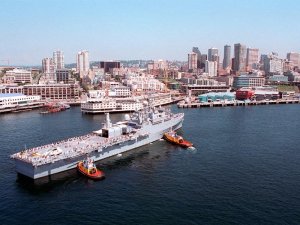
USS_Coronado_04AUG1999
USS CORONADO, AGF-11

Looking at old mementos this evening,  of my days in the Navy makes me feel, well “Well-seasoned”.  As I look back,  the ships where I was a crewmember are all now dismantled,  and sunk to the depths of the ocean.

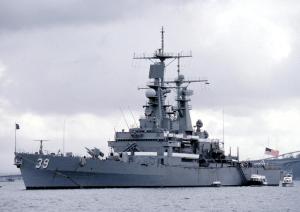
CGN-39
USS TEXAS, CGN-39

The USS TEXAS, a nuclear -powered missile cruiser was several firsts for me: first year at sea; designation as an Enlisted Surface Warfare Specialist (in 1991);  and Shellback.   I did enjoy living near Seattle for nearly a year – the ship was in drydock – before I was transferred at its decommissioning.  It was decommissioned,  dismantled and scrapped at the Puget Sound Naval Shipyard in the late 1990s.

I first fell in love with Canada – Esquimalt,  B.C,  and Vancouver aboard the TEXAS.  I visited, Ecuador,  Panama and cruised through the Panama Canal on that ship.

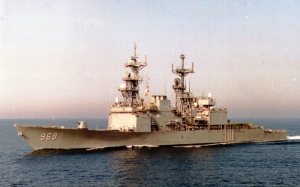
The  USS PETERSON, a Spruance-class Guided Missile Destroyer,  where I made friendships still strong twenty five years later, was decommissioned and sunk in the Atlantic.  But that’s the ship where I got the opportunity to visit Europe – Spain, France, Italy, Greece,  and Turkey, Bulgaria, Israel, Egypt, and island nations of Crete and Cyprus.  On the USS PETERSON,  I visited Panama and Ecuador a second time – was based out of the East Coast. (That has to be a first two-coast, two ship and back-to-back visits for any Sailor since that time!)    On another PETERSON deployment, we visited Nova Scotia.   Halifax has a friendliness towards seafarers of all sorts.

And from San Diego, the USS CORONADO, a special projects testbed, and command ship for the U.S. THIRD FLEET, took me to Japan, Korea and Alaska ( and Honolulu a number of times)  was decommissioned and sunk in the western Pacific.

DD969
USS PETERSON, DD-969

Equipment I used to maintain I found in a museum a decade ago.   Uniforms I wore when I first enlisted and then subsequently through 3 uniform changes have been sent to resale and thrift stores.  Occasionally,  I see a homeless person with one of the old pattern utilities and foul weather gear.

Memories are now appearing regularly on EBAY and other second-hand online stores.  But I have a few things that are still worth keeping.   shopping One of the last USS TEXAS calendars, postcards issued by the USS PETERSON, and pictures and challenge coins given to me by CINCPACFLT for earning Sailor of the Year for THIRD FLEET in 1998.  And my retirement shadow box lists installations that have either disappeared or been revamped, remodeled, and redesignated.

So in some future yard sale, should you, dear reader, happen upon a bunch of trinkets from an old Sailor’s box of mementos, enjoy them.  We can now Pinterest and Twitter and Facebook around the whole world.  But, trinkets, salt air and ocean waves are still analog.

Knossos, but no bull

kingminospalaceknossoscrete4

4000 years ago, the Minoan civilization, on what is now the island of Crete, was a thriving,  sea-going people.   The Classic Greek legend of the Minotaur, a half-man, half bull-like beast which is still being taught in universities today, was a story set in the Palace of King Minos at Knossos on Crete.  In the 19th Century,  archaeologists began excavating this site;  some of the buildings were partially reconstructed to show the amazing art and technology that they developed.   in 1994, I had the opportunity to see this site with fellow crew members of the USS PETERSON during a port visit.  One of the highlights for me was the world’s first flushing toilet, in the queen’s chambers.

I still laugh at one of the comments made by a young sailor on that trip. ‘What a bunch of crap, everything is in pieces”,  he said.

“Well, this entire site was buried in the ground for FOUR THOUSAND years”. someone responded.  “I wouldn’t expect it to be all standing at all.”

“Oh,  wow.”

Who knows what history would have recorded about the Minoans had not a little environmental disaster overtaken them.   Four thousand years ago,  in one of the largest volcanic eruptions ever,  the island of Thera, about a hundred miles to the north of Crete, vaporized.  The resulting tidal wave obliterated the Minoans.  According to history, the Bible, and other records,  elsewhere around the Mediterranean,   the Etruscans – who were the forerunners of Romans, the Egyptians, Israelite tribes all were impacted by the Minoans.

Sailors get around.   And that ain’t no bulls…”

Go far in life by going far (away)

When I initially joined the Navy in the late 70s, I  had already travelled to both coasts of the United States and to Great Britain – Northern Ireland, Scotland and London, England. But as a kid traveling with your parents or with a grandmother,  it doesn’t really make for an adventure.

I joined the Navy to see the world.  For nearly three years, I trained at various bases – in San Diego, at the Great Lakes Naval Training Center north of Chicago, in Pensacola, Florida and in Georgia.   And then I returned to Arizona.    I still wanted to see the world.  So in between university semesters, paid in part by my military service, I spent several weeks each summer on the eastern shore of the Sea of Cortez,  Mexico with a group of scuba divers from Arizona.

I joined the Navy again in 1987 for the adventure – and spent the next three and a half years near Washington, D.C. working as an electronics technician ( a Cryptologic Maintenance Technician specifically).  I travelled all over the region from the shores of Lake Erie in the northwest to New York City, and all the historical places from Philadelphia to Annapolis, and then spent some vacation time as far south as Daytona Beach.   But it was my decision to specifically request a sea-duty assignment, rare for those in my job specialty, when my world travel really took off.

After training, my orders sent me to San Francisco to board a cruiser, the USS TEXAS.   Panama, Ecuador, and then north to and through the Panama Canal to the western Caribbean.  I’ve ordered red snapper dinners in Panama,  cigars and hotel rooms in Ecuador, and taken pictures of the Galapagos Islands as we sailed past.   I’ve lived in the Kitsap peninsula opposite Seattle for a year,  travelled to Esquimalt, British Columbia and Vancouver, Canada.  (it is where I first learned about micro-brew beer and ales).  On different ships and at different times,  I enjoyed visiting countries around the Mediterranean, and one of the first American Navy ships to visit Bulgaria in 50 years.

As a kid who joined the Navy out of high school,  I had been itching to get away from the desert.  I never understood why my old Navy mentors, WWII sailors would have settled in Arizona and not near the sea. “We have had plenty of ocean.  I am here because it is all beach”.   After eight years of sea-duty, I understood that comment.   And I was glad that I had a love of history and foreign languages to complement my technical profession.  I’ve met and hung out with Spaniards in Cartagena, Spain.  Enjoyed smoky jazz and partying with the French in Toulon and Paris,   and sipped cappuccino in Catania, Sicily, Naples and Trieste.  By the way,  Trieste was also the place I was cussed out, in German, by a shopkeeper with he presumed, a German tourist and his lousy italian!

Whether visiting the historical sites of the Minoan civilization – and a 4000 year old queen’s working toilet,  or seeing the Wailing Wall in Jerusalem,  I was grateful for my teachers from high school and college for fostering my interests.

In wartime,  there are often too little focus on the wonder of travel and the opportunities to get to know people.  The world is still full of wonderful places and people, but also dangers that sobers an American’s optimism at times.  In an age when political forces are talking walls and not tackling the forces that cause people to come to the United States,  we have put bandages and temporary dams up.   There are forces also that want there to be no restrictions, and yet are unwilling to discuss the restrictions existing in the travelers own countries.  And language and education advocates want to change history and eliminate a common language.  All of these are just as ignorant as those who have never travelled to faraway places.   America used to lead the world in the post-WWII years not solely out of the hubris of a few, but because it defied the hatreds, disunity, and class struggles of ninety percent of the world’s population.    When Americans travelled to places outside the US, whether in the military or for other purposes, they would get assurances that we had it pretty wonderful.

Reading Mark Twain’s Innocence Abroad, I would love for us to have some of that innocence again.