In pre-war (WWII) Northern Ireland, the businesses that my grandfather inherited and ran made a sufficient income to have a generally comfortable middle class living; in the post-war economy, those businesses collapsed and they were forced to emigrate, with little option but to start over. My grandfather found work selling insurance and wanted his daughters to work as bookkeepers or in such work. Mom applied, was accepted, and ultimately graduated at the top of her nursing class at Mount Sinai Hospital.
My father, son of a Polish immigrant, was born and grew up in the Bronx; he excelled in school and ultimately pursued aerospace and mechanical engineering at college. His, too, was an act of desperation. My grandfather was a shipfitter at the Brooklyn Navy Yard during WWII. He and my grandmother ran a small bakery for a time. When my grandmother passed away relatively young – my grandfather was a restaurant -equipment repairman. My dad had to excel in a profession to make his way.
Life was always complicated in America. It went through successive struggles of growth, industrial expansion, war, and immigration open to the world. Through the centuries, Dutch, English, German, Irish, Italian, and eastern Europeans (Slavs) arrived from the East. Japanese, Chinese, Filipino, and all over came via the West. They came as Protestant, Catholic, Jew. The came as indentured servants, slaves and refugees. African-Americans after the Civil War spread out from the South to the urban Mid-West and Northeast. Before the influx of immigrants from the Middle East, Latin America, and Asia, life was quite complicated, and particularly so after a World War. The Cold War, Viet Nam and the wars in Iraq and Afghanistan have colored the last 75 years of the American psyche.
It was no less complicated since the 1960s. In my lifetime, I have personally practiced in elementary school for impending nuclear attack. I heard the unusual reports of someone in high school bringing a firearm. Metal detectors and drug-sniffing dogs in schools and public places. School mass-shootings. A President in office while an Islamist revolution held American diplomats hostage for more than a year. The first World Trade Center bombing. September 11, 2001, in which a mentor and friend was murdered by terrorists using a commercial aircraft as a weapon.
The late Woodie Guthrie, folk singer, wrote a song that we sang as schoolchildren in California in the 1960s.
When I was very young I was taught to swim, and recall that I was quite fond of holding my breath and ducking underwater and pushing off to see how far I could swim before I had to come up for air. My father had been a great swimmer my mother tells me, but when he was still in his twenties, illness took away his athleticism. With his DNA, I enjoyed being in the water: swimming pools, rivers, ponds, and the ocean. With my mother’s DNA (she grew up by the Irish Sea), cold water was not preferred but also not dreadful for me.
As a pre-teen I took a Red Cross Life-Saving certification class at the community pool near our apartment building. I had always been a good swimmer and athletic, but the certification test proved to be my brush with drowning. The backup instructor was a huge Marine-looking man who jumped into the pool and pointed at me. I swam toward him as trained and he started to thrash about. Then he seized hold of me, and climbing up my shoulders, forced me under the water. That simulation was all too-real. Whether fear of death or anger at embarrassment, as I started to choke inhaling pool-water, I managed to strike him as hard as I possibly could. They awarded me the Life Saving certificate. I don’t think the instructor wanted to advertise that a lanky kid had overpowered him. I have told the story previously how, on a beach in Cape Cod, my mother and I were walking along a tidal sand bar with the tide going out. I ran ahead into a channel that appeared to be no more than knee-depth. It wasn’t and I lost my footing in the swifty oceanward water and was washed about a quarter-mile into the Bay. I was rescued by a couple in a power boat who were near enough to see my mother’s frantic waving and my bobbing. In the Navy at seventeen, it was not water that got the better of me but a failure to properly secure my gas mask in the tear gas training chamber. Lord! I was crying, spewing and hacking with stuff running out of me long before we all had to remove the masks and sing “Anchors Aweigh” for our boot camp instructors! Years later, after my first enlistment ended and I was a student at the University of Arizona, I took scuba diving lessons, certified and spent several weekends in successive summers, in the Sea of Cortez. During one of these, I was a now, more-experienced diver paired up with a newly-qualified teen (ten years my junior). “Jacques Cousteau” did not heed the diving limit so we found ourselves about a hundred feet instead of the sixty-foot maximum set by our dive master. Pointing him to the surface, we were several hundred yards from the dive boat and had a challenging swim to get back to the boat.
In all the scenarios that we undertook during my second enlistment in the Navy and eight years of sea duty, we performed a lot of dry simulations of flooding casualties to the ship. We had hands-on training ashore for firefighting, and we had both well-lit, and blackout compartment simulations on entering, exiting, and securing compartments. As part of the training for the Enlisted Surface Warfare qualification, I had a familiarity as well as a number of hours monitoring and performing skills that might save my life or my shipmates someday.
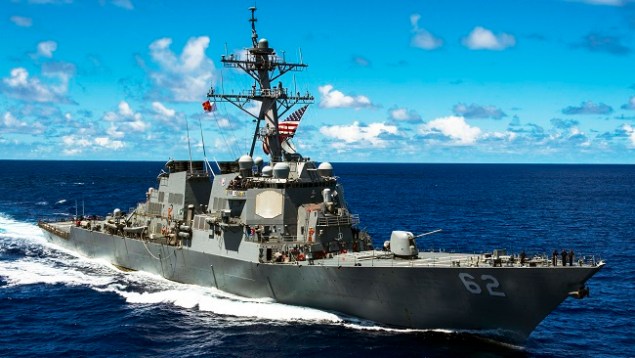
USS John S. McCain DDG-56, By Photographer’s Mate 3rd Class Todd Frantom – 030126-N-1810F-002 from http://www.news.navy.mil/view_single.asp?id=4306, Public Domain, via WikipediaUSS Fitzgerald, DDG-62
I have no idea what has caused shipmates on two Navy combatant ships, the USS John S. McCain, and the USS Fitzgerald, to collide with merchant ships this summer, but the intense bravery and training of the men and women who saved their ships has not been told in the questioning by observers on how that could possibly happen in the first place. The facts will certainly be collected, studied and whether training or terrorism-related, the truth will be known. It is the response of the crew to a potentially fatal breach of the hull that should be studied equally and used to train subsequent generations. There were definitely those who, knowing they could possibly die, chose to try to save their shipmates in the flooded compartments instead.
Numerous injuries and the deaths of at perhaps seventeen Sailors at sea are horrible. The mere seconds between personnel sleeping, eating breakfast, taking pressure readings, monitoring electrical panels — and the aftermath of a collision: the crushing metal, screaming men, pitch darkness, and flooding seawater, are mind-numbing for those who have not been in peril. We should all pause and pray for those Sailors and their families. The loss of life in combat, in training accidents, in freak-occurrences on routine days, or even the acts of a madman or terrorists are never acceptable, but the mental preparation as members of the military one might accept the possible call to put yourself in harm’s way to save your fellow service members.
Blessed are the peacemakers, for they will be called children of God. (NIV) Matthew 5:9
As a younger ( admittedly, I was thirty-one years old) Sailor, I had brushes with questionable people and groups. In Pensacola, Florida since I was trained in the use of various firearms and owned a few different weapons, I had on occasion gone to a shooting range in the rural red-clay part of Escambia county. One Saturday, I came home to a message on my answering machine inviting me to join the Klan! I never responded. It wasn’t something you mocked in person. I presumed they got my home phone (this was long before cell phones) from the sign-in sheet at the range. On one occasion, when a black community group – I’m assuming a church group – would picnic in a local park, I would notice a couple of large pickup trucks with very ‘white’ occupants would cruise by slowly.
Those who make peaceful revolution impossible will make violent revolution inevitable. John F. Kennedy
With the whole country worked up into a frenzy over Trump, cultural identity, destruction of historical places, names and monuments, and social media, I have to confess I have never been ashamed of my race, ethnicity, education, religion, gender, sexuality nor veteran status. In the last forty years, I have been a card-carrying member of several national organizations: the Navy, the Veterans of Foreign Wars (VFW), Fleet Reserve Association (FRA), National Cryptologic Veterans Association (NCVA), Tin Can Sailors, the Navy Memorial Association, and the American Legion.
There is no grievance that is a fit object of redress by mob law. Abraham Lincoln
I can only speak specifically to my experience over forty years in the military and industry, that the least tolerant of different opinions, least skilled in critical thinking, and least appreciative of the benefits and blessings of the United States, are generally the ones raised and taught by non-veterans. I served with and was mentored by some of the most professional, inspiring, and capable leaders, female and male, black, hispanic, asian, and white. I would march into hell itself with these role models leading me. When there needs to be leadership, from the local school board, up to and including the White House, the military-trained leader needs to step up.
Men make history and not the other way around. In periods where there is no leadership, society stands still. Progress occurs when courageous, skillful leaders seize the opportunity to change things for the better. Harry S Truman
*** 5, U.S.C. 3331 codified in 1868, that all Federal employees take an oath to work within the bounds of the Constitution, to support the government and not to circumvent it. It was part of the healing process to re-unite the defeated Confederacy. Part of the oath states support for the Constitution and to oppose all enemies, “foreign and domestic”.
There is nothing more enticing, disenchanting, and enslaving than the life at sea. Joseph Conrad
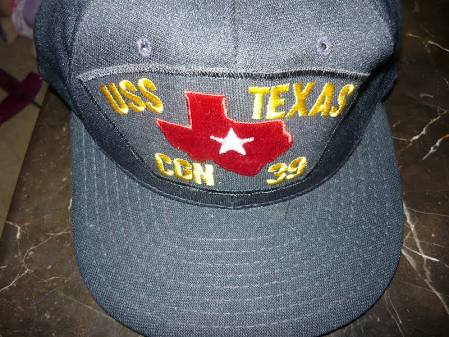
In February 1992, at age 32, my personal life in shambles ( an estranged wife with mental illness, and crushing debt were the big issues), I received orders to the USS TEXAS (CGN-39), a nuclear powered guided missile cruiser homeported in Alameda, California – across the bay from San Francisco. I drove out from Florida by myself. Arriving at the bottom of the brow, I was ready and excited to begin my first period of “sea duty”. I was reporting as one of three technicians, supporting the communications and RF surveillance systems – which I had just spent half a year learning. Looking back today, the electronics and the computer control – running octal code! – were less complex than the average electronic toy today. But in 1992, few people owned a personal computer, and maybe the well-heeled might have a “car phone” — bulky device, with bag, battery and a cigarette lighter socket charger.
The duties I was assigned – as the newbie out of school – were general. I was already being called “grandpa” since I was nearly six or seven years older than the senior tech in our workcenter. As the new guy, I was put in a harness to go aloft. (The harness came with a “ball-buster”, so-called because of the mechanical brake used as a safety line for ascending and descending the mast — if you disconnected without thinking, a few pounds of metal would swing away and crash into your groin! )
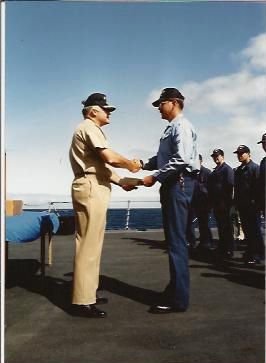
Capt Neal Brennan commends me
For a guy that wasn’t all that fond of heights – I had been rappelling mountains in Virginia to end that timidity climbing a hundred feet up above the water pierside was my “welcome”. Of course, the lamp at the top of the mast, attached to our TACINTEL antenna had no need to be changed. But the gentle sway was calming, and height never troubled me after that. I spent a lot of time over the course of several years greasing fittings, cleaning away salt buildup, sanding and painting equipment. Since each communications shop : the CT and EW (electronic warfare or ELINT guys) were in my division; the Radiomen and the Combat Systems groups also had things to maintain aloft. The primary time to do these chores were in port for extended periods as we would have the rotating and radiating (radars especially) for our ship and neighboring ships “tagged out”. Nobody wanted to be sterilized or cooked (think of a microwave oven) from RF energy.
Between performance tests, maintenance, cleaning, and cross-training as an operator in our own center, we had training in security force ( rapid reaction team), firefighting, damage control and other collateral jobs. Because of the nature of the job, most of the crew knew us only as “spooks”, and Maintenance (CTMs) were not above getting strange looks from the hot and sweaty Engineering (Snipes) crew. You see, in a couple of our workspaces, the air conditioning (chilled water) system were overly efficient. Large, heat-generating equipment had been replaced with newer systems that were much less power consuming. The now much colder workcenter made it necessary for the techs to wear our winter coats or “foul weather jackets”; we might forget to remove them when we went to the Mess Deck to get some coffee. Some sweaty, greasy shipmates were a little irritated at some “topsiders” easy living.
Working behind the “Green Door” with its OZ Division sign (“Oh-Zee” meant we were part of the Operations Department) required special access and security protocols. We would get asked from time to time what we were doing. We would come up with all sorts of stories. “Actually, I could tell you, but then I would have to kill you” was our running joke. In the days when email and Internet were toddlers, when the AFRTS broadcast was still received and rebroadcast in the evening through the ship’s entertainment system, we might get sports scores or news before the rest of the ship.
While the underway schedule was tedious and I would sometimes spend up to eighteen hours working, cleaning, training or on watch, it was peaceful. All the noise at sea – equipment, machinery, buffers, alarms, announcing systems were less unnerving than the sudden “silence” – an equipment casualty occurring at that moment – followed by an alarm and a all-ship announcement through our 1MC intercom. I really felt at home on the TEXAS. Compared with the stress of the home I had left back in Florida, I was in a long-term relationship. That ship and crew were my family. I set out to learn everything I could about the ship as part of the Enlisted Surface Warfare qualification and earn my silver Surface Warfare pin.
It was a shame that the ship’s schedule was a few months deployment s, before it was to go into the shipyard for a couple of years in order to replace the nuclear fuel and receive upgraded systems. My first underway period occurred in the late Spring of that year, and it was not long afterward that I was able to add Panama and Ecuador to foreign places I had visited. Transiting the Panama Canal was one of the highlights of my Navy career. And becoming a member of the honored Shellbacks – first, as pollywogs, we had to be properly indoctrinated in a raucous smelly, greasy, traditional welcome. And being hosed down with salt water in the pre-dawn of the equatorial waters near the Galapagos Islands, is a memory I cherish. My years of spanish from school, living in southern Arizona, traveling in Mexico, paid huge dividends in Central and South America. Where some Panamanians or Ecuadorians were bemused or put off by American Sailors, I was able to share jokes, catch deals on local crafts, negotiate fantastic deals on a hotel room for shipmates and even trade wits with a streetwise New York-born kid visiting relatives.
On our return to Alameda, a segment of the crew was able to take change of station, house-hunting leave for our pending move to Bremerton, Washington. In June, I was soon after to realize, that the weather was perfect though temporary. For the remaining 11 months until the following June, it was cloudy, misty, rainy, snowy or sleeting. Prior to going into dry dock, the TEXAS made a trip across the Puget Sound for Esquimalt , British Columbia, Canada. Killer whales in a pod accompanied us for part of the trip. Between maintenance assignments and duty rotation, I was briefly able to take in the view outside the skin of the ship. The view of the Olympic Range (the Olympic peninsula is the large portion of the state west of Seattle) to the south is amazing – when the fog or mist lifts long enough to see the snowy mountains. The Canadian naval base is next to Victoria, a city that looks every bit as if it was lifted out of England and deposited there. For the couple of days that we were visiting, I had my first experience with craft beer. My present infatuation with micro-breweries, got started there.
I still think about going back to hike in British Columbia, visit the tea shops and markets, and maybe enjoy scones and english marmalade.
In the coming year, the ship, now in dry dock, was cut open, all the decks were covered with plywood, giant tarps hung over the side of the ship while sandblasting away the paint, barnacles, and growth of many years at sea.
With my equipment shutdown or removed for maintenance, I was left to clean, to document maintenance – I worked fairly closely with the Maintenance Material Management System or (3M) Coordinator by that time. For a couple of months I was assigned off the ship to help coordinate the maintenance of the Bachelor Officers Quarters which at the time was being transitioned to a civilian who had been running large hotels. Officers had it pretty cushy. Enlisted sailors in base quarters in Bremerton didn’t have it too rough either. At the time the Navy made its decision to halt the refueling and scrap the TEXAS, I had moved off base to renting a home not far from the shoreline. Seattle was visible across the bay.
I was enjoying the little town of Manchester. Then my estranged wife showed up, long enough to take most of my valued possessions and several firearms. And leave with her boyfriend. I was ready to transfer to my next ship, a destroyer in Norfolk, Virginia, the USS PETERSON (DD-969).
Ships are known to the men who go to sea in them as “she”. Temperamental, attractive, frustrating, consuming, difficult, requiring a lot of commitment and hard work. And romantic. All at the same time. But like a woman you are with, you can be successfully only in one relationship at a time — and a ship is jealous for your time.
I have been both a Navy consumer, a Navy technician, and civilian test engineer supporting Information Security – securing networks and securing data storage. Currently I am working on the manufacturer’s development side.
In a profit-driven company I’ve noticed some truths: resources are finite; managers focus on meeting the contract requirements with least impact to manufacturer’s bottom line; a complex design takes longer and with more manpower than allowed to perfect; customer requirements change during the test and production phases; performance or production challenges occur when starting production; faced with budget constraints themselves, some (new) customers deploy the product in ways not specifically considered in the design.
As one of the warfighters, I wondered why some equipment I routinely used was poorly designed (in my estimation). Overheating, power supplies that needed frequent replacing, maintenance or rework that was labor-intensive, required shipment to a depot, or some “special handling” when called for. Banging, tweaking, and massaging were often employed to get recalcitrant gear to operate. One particular situation occurred when my communications system was overheating- the room (called a “space” or compartment aboard ship) was co-located within an office used by several officers. Since they were too cold – the air conditioning system had to be kept low to maintain the equipment side at optimum performance- they demanded the temperature to be comfortable. This resulted in equipment overheating and breaking down.
After my military career, I vowed to be a better designer and tester of gear for the warfighter, but as an employee of a public company, economic reality tempers my best intentions. Brilliant engineers working to specific constraints are split between several products, test and development has greater latitude in acquiring test equipment and components than in production. The manufacturer’s vendors are relied upon to provide parts and subassemblies that perform to the specifications! But the most challenging aspect I have experienced is the customer using a product in ways that I have not tested directly but am asked to debug when they fail. More often than not, we find that the parts of our system we did not design and build but purchased as COTS (consumer off the shelf) are not subject to the same quality as the supplier advertised.
In the former world of huge Government development budgets, a new system can be fielded, bugs worked out, mistakes corrected, and used for decades. The Space Shuttle program, a computer-reliant, spacecraft and terrestrial glider, a “flying anvil” of sorts, most likely had the same development challenges, and the public is aware of the two critical failures that occurred during their working lifecycle. Overall, these systems were very reliable. In a public company, products have to enter the market before the competition and be embraced by consumers whether government ( military) or public, generating profit and demonstrating reliability in a very short time.
And my focus is remaining the Subject Matter Expert for my product line, and the test engineer who successfully brings the prototype through acceptance testing: Job security.
I’ve had many occasions, at work, driving cross-country, at various public events to meet people who are veterans or on Active Duty with one or another branch of the military. Driving around San Diego, I am saddened by the number of homeless on the streets. As a veteran, I know that there is a substantial percentage of these men and women – or imply through the hand-lettered signs that they are down-on-their-luck veterans. Many unfortunately are, but may also be in an untenable position due to alcohol or drug-addiction. Yet I admit, I am more drawn into conversations when encountering squids, jarheads, ground pounders or zoomies working in shops, service industries, Costco, or government offices mutually recognizing a military connection. And whether it is initiated by a ballcap, t-shirt or window sticker, we can converse about shared life experience.
There is something instantly bonding about men ( and women) who share the common experience of military service. Yesterday, I was enjoying a little rest on my homeward commute at my little bastion of like-minded libertarians, and got interested in a conversation one of the guys was having about an exchange with a cop. Turned out this cop was practiced – but not in a good way – of embellishing some prior Navy experience. As it happened, my acquaintance, like most of those who have had some years in the military was correcting this cop’s recounting of his service by providing some firsthand expertise in the details (occupation codes known as NECs or MOS in other services, training specifics, locations) that this storyteller had fudged– as would have I in the same exchange.
There is nothing more disingenuous than a person misrepresenting military service. “Stolen Valor” is the term many may be familiar. Most of the perpetrators are playing on the sympathies of the public, trying to obtain benefits not owed, or wooing the gullible. While there have been several court cases deciding that ’embellishment for the purposes of misleading public opinion’ – politicians, editors, bureaucrats, teachers have not been worthy of punishment, there have been equally social media shaming of these con artists who were bringing discredit to those who serve or served honorably.
Yet it was the exchange of sea stories with my shipmate which brought back great memories for us both. Both of us entered the Navy a year apart in the 1970s. He was a fellow technician, working with computer systems aboard ship before the Navy combined the ratings, Many times, the Navy consolidated skills that had their own individual occupations with others, as was the case with my own rating after my retirement. Regardless of the fool trying to boast about details of service that other “salty” Sailors – ones with years of sea duty and military experience – could immediately call his bluff, my conversation yesterday was refreshing in bringing the memories back to the surface.
In those days, there were traditions and customs, regulations and deckplate leadership. When some Sailors who were otherwise experts in their trade, had a little too much to drink on the prior night’s liberty, their shipmate including the supervisor would look ot for them. As Mess Deck Master at Arms, a temporary assignment aboard ship, the ability to encourage the crew, curry favor, or even to mentor and train some junior sailor were all part of my experience. There is nothing that someone with sea duty, can really describe to a civilian about life at sea – noise, drinking water with a little trace jet fuel (JP5) in the lines, the drills, the boredom, and port visits that another military member doesn’t instantly know what you are talking about.
Every time I see a car with a bumper sticker “COEXIST”, I am given to wonder why these probably well-intentioned, folks are so ignorant of history and many are so rabidly determined to shut out any comment, observation, or objection. The world is a dangerous place, and the people who see aggressors as victims and victims as aggressors are generally unable, unwilling, or unprepared to find real solutions -other than bumper stickers and molotov cocktails. Here’s a refresher from 2006. Via the Chinese and the Iranians, the terror group Hezbollah continues to be weaponized….
I was once (still?) a cynic. I started to consider years ago that ten percent of people were the top intellectuals, philanthropists, inventors, artists, and warriors (I was in the military at the time). That also got me thinking about all the gloom-ers, doomers, and desperado, folks whom I likened to the bottom “ten-percenters”. In the middle were the remaining eighty percent who either were sketchy, but not necessarily “bad” or the more reasonable just-trying-their-best-to-get-by folks. In a world today where people determine the answer they want first, and go in search of, or create the evidence they need to support their pre-determined answers, it seems unnatural to work the other way round. So I came up with an 10/80/10 proposition. I have not conducted rigorous research. During my worst cynical days and weeks, personal experience and social media provide me a predetermined answer in search of validation. I often apply it to everything that humanity touches. Continue reading →
In the steamy opening week of August, I have been daydreaming of exotic hikes. Bloggers have been posting about hikes in Nepal, or Kyrgyzstan, or Zion National Park in what I’ve read this week. My thoughts run to a vacation in Kauai, my wife and I last took in 2013.
Waimea Canyon, the “Grand Canyon of the Pacific”, was spectacular.
While I admit to watching only parts of the movie, Life of Pi, is a survival adventure novel of a young Indian man lost at sea sharing a lifeboat with a tiger. Can you think of a better anti-piracy agent? Yet, perhaps land animals at sea is not entirely an uncommon phenomenon?As reported by several news sources *, the Sri Lankan Navy a couple days ago rescued an elephant at sea — in a great demonstration of compassion. Leave no elephant behind! This elephant was crossing a shallow channel and was swept out to sea where it eventually was rescued — nine or ten miles out in the ocean! Continue reading →
I am an old seadog these days. In my youth I would rarely miss work, school or a duty day for something as irritating as a cold or flu. For centuries, if a Sailor went to Sick Call and was placed on the “binnacle list”, the leading Seaman or later, the Chief Petty Officer would let it be known that Sailor had better be suffering Scarlet Fever or a severed artery. Shirkers normally found themselves on duty rosters during port calls. These days I have accepted that I no longer can bicycle fifteen miles to my duty station and immediately run ( and pass) the PRT fitness test – I was then still under 30 years old; I probably would not be able to hoist a sixty or seventy Damage Control bag over my shoulder while wearing an OBA * and hustle up or down the ladder during one of the shipboard training sessions – the General Quarters Drill ( I was not quite 36 then). My older body has stopped writing the checks my ego really can’t cash. (For those who may never have seen a check, this idiom was once a popular expression.)
There once was a time in America when self-reliance, mental and physical toughness were characteristics of mature males – college educated or working class. So when an acquaintance talked about his Army veteran dad only recently talking with a Veterans Administration representative about medical issues he has had for the last thirty years, and getting a disability rating as a result, I listened.
More than twenty years ago, I was hospitalized after weeks-long exposure to toxic fumes; However, the service and my young invincibility complex made little of it. In hindsight, a ruptured appendix that year and 20 years of hospital visits for gastric issues might be connected. And for good measure, Gulf War inoculations, and radiation might be worth a good look. Even if the Government declines, I will gain experience that I can pass on to my son in the Army. He’s definitely got physical issues that were aggravated by his service. But he too, is a tough, self-reliant type. I don’t want him to wait 20 years.

 to the south is amazing – when the fog or mist lifts long enough to see the snowy mountains. The Canadian naval base is next to Victoria, a city that looks every bit as if it was lifted out of England and deposited there. For the couple of days that we were visiting, I had my first experience with craft beer. My present infatuation with micro-breweries, got started there.
 There is something instantly bonding about men ( and women) who share the common experience of military service. Yesterday, I was enjoying a little rest on my homeward commute at my little bastion of like-minded libertarians, and got interested in a conversation one of the guys was having about an exchange with a cop. Turned out this cop was practiced – but not in a good way – of embellishing some prior Navy experience. As it happened, my acquaintance, like most of those who have had some years in the military was correcting this cop’s recounting of his service by providing some firsthand expertise in the details (occupation codes known as NECs or MOS in other services, training specifics, locations) that this storyteller had fudged– as would have I in the same exchange.
 In those days, there were traditions and customs, regulations and deckplate leadership. When some Sailors who were otherwise experts in their trade, had a little too much to drink on the prior night’s liberty, their shipmate including the supervisor would look ot for them. As Mess Deck Master at Arms, a temporary assignment aboard ship, the ability to encourage the crew, curry favor, or even to mentor and train some junior sailor were all part of my experience. There is nothing that someone with sea duty, can really describe to a civilian about life at sea – noise, drinking water with a little trace jet fuel (JP5) in the lines, the drills, the boredom, and port visits that another military member doesn’t instantly know what you are talking about.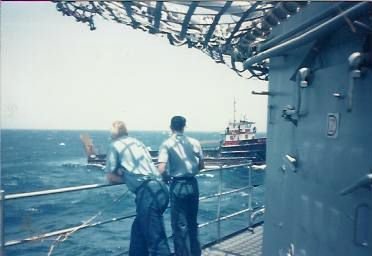


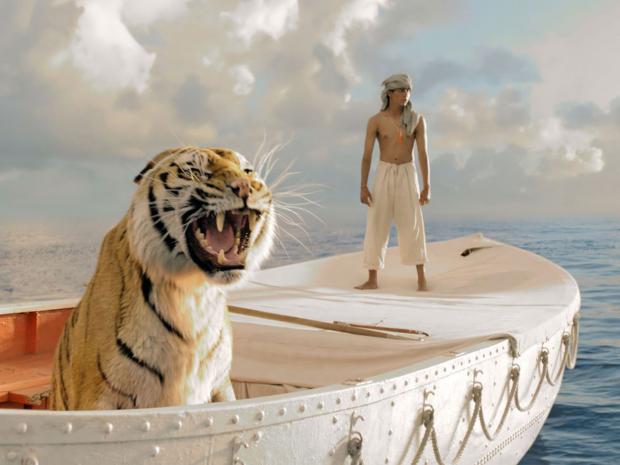 As reported by several news sources *, the Sri Lankan Navy a couple days ago rescued an elephant at sea — in a great demonstration of compassion. Leave no elephant behind! This elephant was crossing a shallow channel and was swept out to sea where it eventually was rescued — nine or ten miles out in the ocean!
  Truths, Half-truths, and Sea Stories