https://www.kqed.org/news/12022479/why-are-there-so-many-abandoned-military-bases-in-the-bay-area
Navy
for amusement only


Any discussion today about the future of society, in peace or in wartime, or the future of art and entertainment, or scientific discoveries seem to include Artificial Intelligence or AI. Yet just as the ancient Greek story of Prometheus, punished for eternity by giving the secret of fire to mortals, we mortals are hell-bent on discovering and distributing ever-more sophisticated means to curb our curiosity, intellect, creativity, and human interaction.
I read online that AI can now deliver various sorts of creative solutions, including drawings and even blog posts. I decided to make a simple test. These drawings were produced by a web application in response to test queries I made using Microsoft Copilot. For the first drawing, I gave Copilot a few parameters such as the blog name on a scroll and sea-god Poseidon. After being a bit more structured in my defining parameters, Copilot returned the latter drawing.
I do not think I will be amused if Copilot starts to independently publish posts on this blog based on my Internet history.
sea stories and the Costco connection
For a veteran’s spouse, a trip to get groceries may take a little longer than planned. It has become de rigueur for me on casual outings to wear one of my Navy veteran ballcap collection or t-shirts that recall a 25-year career. Several of my friends today are veterans; however, among millions of San Diego residents there are only a few with whom I share a specific place, time and mutual acquaintances where we served.
I added another last week.
During a shopping trip at Costco, when I excused myself passing a “Shipmate” wearing an “AD-19 Yosemite” ballcap, it started us swapping sea stories. He served at sea on that destroyer tender. I recalled a Machinery Repairman at the Transient barracks who was waiting on orders for that tender. Then we talked about bootcamp. A few years my senior, he was a Recruit Training Company Commander in San Diego at the time I went to Boot Camp here in 1977 and knew my “CC”. As we talked, I was reminded of several others I last talked with decades ago from those early years in my career. But this was the first time in more than forty years, I talked with someone from that period of my life, who knew the first Sailor who shaped my Navy career, Company 941Company Commander, ABE1 Robert Walsh.
Port o’ Call: Cape Canaveral, Florida
Performing a maintenance routine for equipment topside on the USS PETERSON as it arrived in port on a sunny Spring morning thirty years ago was actually fortunate timing. We were just tying up at the naval pier not far from the launch site where NASA’s missions to the moon had flown. But that morning was an unexpected treat. At nearly the same time as we moored, a Space Shuttle roared off the launch pad.
I had been a fan of space flight ever since I the middle Sixties when I had watched the Gemini and Apollo launches on a television wheeled into our elementary school classroom. In the 1980s, I had been with a group of college students touring the Johnson Spaceflight Center near Houston during a national convention of the Theta Tau engineering fraternity. Living in Tucson, Arizona in the early Eighties, I also saw an early Shuttle (the Enterprise(?)) being flown piggyback on its modified 747 airline as it routed through Davis-Monthan AFB on the way back to the Cape. And in four years prior to my assignment aboard the PETERSON, I was stationed in the Washington DC area, where one of the tasks our department performed was to install a mobile van with equipment to communicate with the Shuttle as it orbited the Earth during a particular mission. Being in the Capitol region also gave me opportunities to visit the Air and Space Museum where visitors could walk into a mockup of the first orbiting space station, SkyLab, and to see many exhibits, including items returned from the Apollo Moon missions.
With my grandchildren not yet old enough to appreciate the excitement I felt watching spacecraft launching toward the Moon, I am glad that the first ARTEMIS mission to the Moon is still a few years away. Perhaps when they are my age, they will not have thirty- or fifty-year old memories to recall when we reached for space.
Port o’ call : Cyprus
On a Mediterranean deployment aboard USS PETERSON (DD-969) thirty years ago, I visited an Irish pub in Limassol, Cyprus. While a tourist destination for many British and Irish citizens, the island has had its share of trouble and even war, with the northern part of the island dominated by Turkish Cypriots and in the south, Greek Cypriots. For decades, the United Nations has maintained a truce between the two halves of the disputed island as a result. Though I got to see firsthand the uneasy relations between the two NATO countries (while conducting naval exercises with one country’s navy, we were overflown by jets of the other!), the port city of Limassol catered to tourists as well as the UN troops on liberty. Although my 2 shipmates and I were as versed as any about the political situation (given we were cryptologists), we followed command direction to blend in with other tourists (ballcaps, collared shirts, and short hair) to not stand out as Americans and to avoid any discussion of politics or our missions. We were just looking for a few beers and to explore the beach after several weeks at sea since our last port.
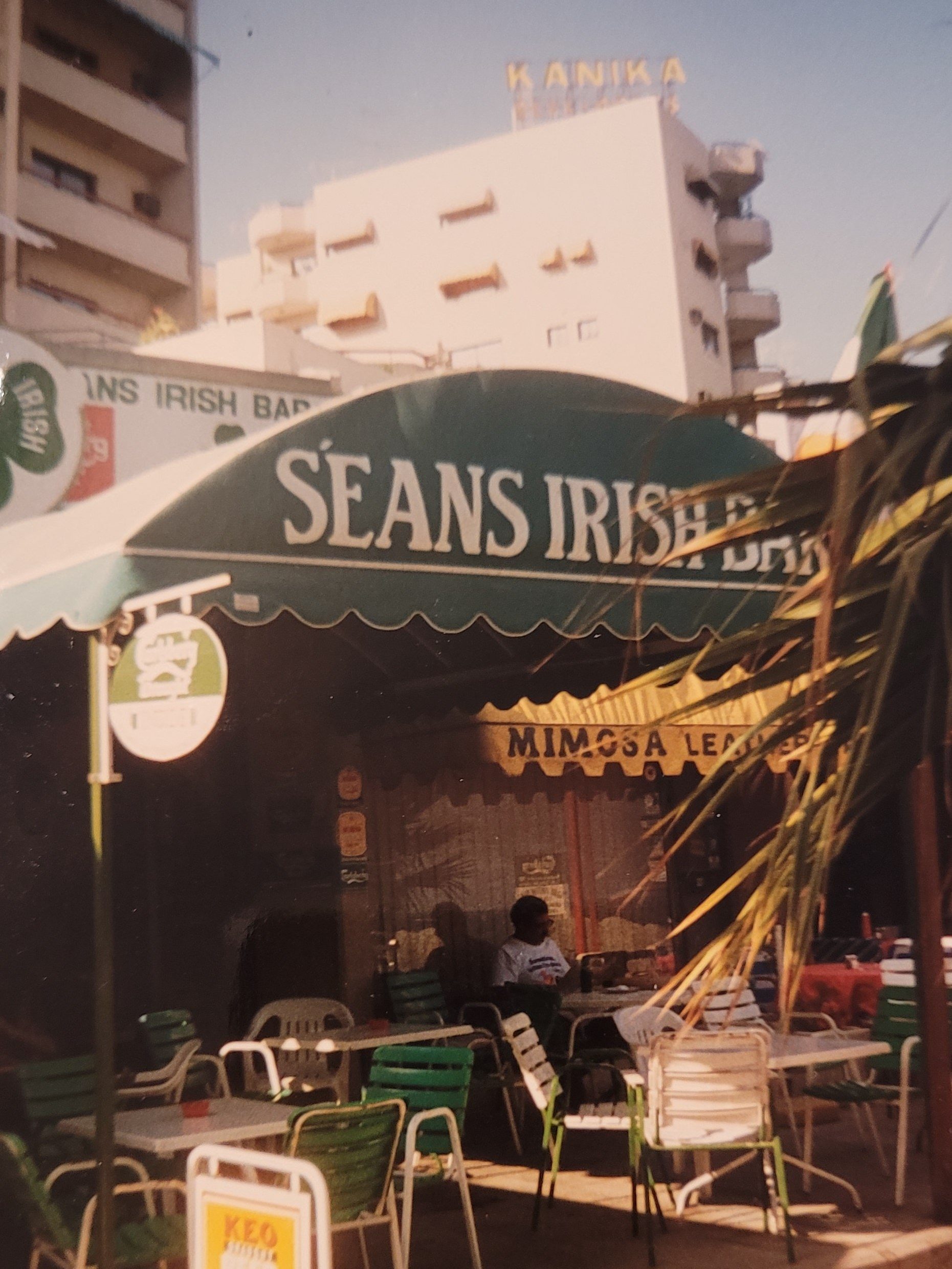


Sean’s Irish Pub was run by an Irishman and his daughter, serving both British and Irish beers and liquor. Talk about soccer teams was as peaceably divisive as with any sports fans in the USA. One of the patrons we chatted with was a Dublin businessman who amiably offered that Muammar Ghaddafi was a pleasant fellow he had business dealings (this was 1994, eight years after the US retaliated against him for sponsoring terrorism). It was best to let that slide. Being of Polish descent (dad) but Irish on my mother’s side (I neglected to mention they were Protestants), Sean made a couple of toasts over good Irish whiskey. We met and had a couple of drinks with one of the UN troops there – I forget whether he was Irish or British. The thing I do remember is that this pub catered to both the Irish and the Brits, but they came by at different hours. And the pub would either have a more “independent Ireland” or “welcome British” atmosphere (both Irish and UK flags displayed, ) depending on the clientele hosted.
Port o’ call: memories of Cartagena Spain
“JOIN THE NAVY AND SEE THE WORLD”
Navy recruiting slogan in the mid- 20th Century
Several years of High School Spanish, as well as years living in southern Arizona near the Mexican border, made travel in Latin America easier. Traveling to Spain, on the other hand, was a little more of a challenge. Though I had a Freshman year of castellano, Madrid-dialect Spanish, I soon found that they do not necessarily speak “Spanglish” or the Sonoran (Mexico) dialect there.

My second Mediterranean deployment on the USS PETERSON, a SPRUANCE-class guided-missile destroyer, began in October, 1994. One of the first ports we visited was Cartagena, Spain. Located in the state of Murcia, it is a port city that has seen sailors on its streets for a few thousand years. Having lived in or visited modern cities, from San Francisco to New York City, seeing a Roman-era coliseum and medieval architecture – much of it incorporated into modern structures- made some of the oldest American buildings practically new.

I ventured out on liberty alone, trusting that my Spanish would help me get around. Being adventurous and with an affinity for foreign languages, Europeans were more open and chatty to me (Except for a Northern Italian shopkeeper who must have assumed I was an arrogant German -but that’s for another story). A family-run cafe, Restaurante Casa Pepe, (a small lighter I kept all these years in trinket box, reminds me of that port visit), welcomed me. I learned that eggs and bacon are served a little differently there. Chatting with the family, the son who was about my age, offered to show me around his city. He enjoyed correcting my pronunciation, teasing my accent. I teased him that he didn’t speak Spanish either. Murcia has a distinct dialect from Castilian or other Latin dialects, where “c”s often are spoken pallatized (a “th” sound), e.g., “Mur’th’ia ” . One of the buildings in the older part of the city near the waterfront was elevated to display a site that I recall pre-dated the Roman times. It may have been Phoenician. I should plan to visit the places I saw while in the Navy. Now that I am thirty years older, I imagine my acquaintances have long forgotten one Spanish-speaking American sailor, but I still long to revisit these ports of call with my wife. Though I think I will upgrade our mode of travel to a cruise ship. With no intentional disrespect to the Navy, anything will be more luxurious than a destroyer.

Ed: this revised post was originally published here in August, 2021
A Navy career is what you make it
At age 17, I enlisted in the Delayed Entry Program, to pursue training in electronics and an accelerated advancement upon graduation. I had only some idea of what I was selecting from a few courses in my last year of high school. After completing a career in the Navy, the experiences and the training I earned have provided me security and satisfaction with the career I was afforded. Young men and women today have many more opportunities to learn life-changing skills and gain experience through military service. Yet, the career a young person embarks is still to a large degree dependent on the goals, aptitude and motivation of each individual. Though I know few who regretted their choice of career, with a well-reasoned, thoughtful approach to potential careers, the military does enable many to avoid the pitfalls of a loan-financed education with few real-world opportunities.
In 2023, the lure of a college education as a means to provide more security and career options to young people is recognized by many as failing to live up to the billing. Those whose aptitude and college credentials provide them access to biotech, engineering, computer programming and related careers will do well generally. Many of these students in the STEM (Science, Technology, Engineering and Math) fields have opportunity to intern with companies, and get real-world experiences prior to graduation. The Navy, as well as the other military services, as well as other government organizations offer internships to highly motivated young people, even before deciding to embark on an enlisted or commissioned career.
Here are some of the opportunities that exist today in the Navy:
- STEM internship for select high school or college students
- Warrant Officer (Aerial Vehicle Operator) program for current enlisted personnel to attend OCS and become advanced technical specialists
- For those students seeking post-graduate education in the medical or dental fields, a Navy scholarship program can pay those costs, so students can focus on their education and providing real-world experience in the Navy or Marine Corps
- Current college undergraduates whose career ambitions may be in the Active Duty or in the Reserve, seeking a Commission, or to pursue Nursing, Civil Engineering, or the nuclear power field have options
Ask the Chief: barter economy
Ask any Navy veteran about the barter economy, and most of us have engaged in it. We knew it as “comshaw”, which was anything we obtained outside of official channels, generally by bartering items we may have more abundantly, or obtained as something we might use to trade with another division, department, station or military branch for an item we needed. I experienced this firsthand when I was authorized by my department to shop at the DOD/ GSA store at the shipyard for items we needed before deploying. A fellow Petty Officer on a ship across the pier needed an item we were authorized to purchase, but his shopping manifest did not authorize it. We managed to do a little third party transfers with other shoppers to trade up to what he needed. And it came with a guarantee to provide me with something when needed in return. Sometimes, a supply Petty Officer must use forward thinking to anticipate what is a good trade and whom to count on to return a favor.
What brings this to mind many years later is the current state of our economy. It seems that just about everything that homeowners and entrepreneurs may find necessary (or effective) is either prohibited by the State, too costly, or comes with excessive taxes, permits or other fees. A solvent for a barbecue grill, legal in many states, was returned to the shipper, and my purchase rescinded (Amazon). Or another example, a preservative that is effective for concrete in extreme environments is not legal here; however, a less-effective preservative with many of the same “aerosols”, is legal, but requires double or triple applications during the same multi-year effectiveness of the former single application. Sometimes it is just a little difficult to obtain something – the toilet paper or meat and egg supply issues in recent years come to mind- while others may have a sufficiency. Perhaps they might be willing to trade these for another item or service of value? It was not all that long ago that I read about a champion of barter, who had started with an older but valuable item (I think it was a musical instrument) and successively traded up to obtain real estate.
Many years ago, our accommodations in the seaside Mexican town where my buddies and I went scuba diving were paid for with equipment and other goods from the United States that then were difficult to obtain in Mexico. Today, as the cost of maintenance and repair for household or mechanical items escalate, and the government continues to find additional ways to collect sales and income taxes from the middle class, I wonder whether a barter system that circumvents cash and credit transactions will become more popular.
Comshaw may be the way of the future.
on safari liberty
It does not take much to get old Salts, or two military veterans chatting like old friends. As a perk of his new job at the San DIego Zoo and Wild Animal Park, our son and his co-workers invited parents to go on a “safari” with them yesterday. Seeing giraffes, buffalo, zebras and gazelles in a more natural environment of several hundred acres, from the inside, was awesome.
In the course of getting to know our fellow travelers, I met Dave whom I instantly recognized shared a Navy connection with me. Though a submariner, a “bubblehead”, his quip “I could tell you what I did but I’d have to kill you,” is humorous code for those of us who performed duties that are still governed by national security regulations. As “spooks”, intelligence and cryptologist specialties, we just shared some laughs about those times over lunch after the tour.
Building boats in the desert and the Rillito river fleet
Long before the “sand Navy” was an actual thing – those Navy servicemembers who did a tour in Afghanistan or Iraq during the war- I remember a man who was building a boat in the Arizona desert in the 1980s. While the region is still subject to monsoon flooding (late summer thundershowers that over centuries carved riverbeds flowing west and north from Tucson and elsewhere), I think the builder was overly optimistic. Until I saw what I presume was the same boat launched from the bay in San Diego some twenty years ago. There are other latter-day Noahs still building boats in a parched land. Yet, owning a boat seems to be a short-lived experience for most would-be mariners. While there are many sailing and power boats moored in marina slips all along the San Diego bays, I have seen many hundreds high and dry in storage yards far from the sea. And I live the experience through others. One of my friends, a Navy veteran, invited me out on his boat. Though I enjoyed the experience, I have not had the urge to buy one myself. It would also be another frequent chore to master; between financial and maintenance needs of boats, or cars, or homes, there are rare times to enjoy one. Perhaps, it is why I remember movies where a boat owner was spending an afternoon drinking beer, in his boat while it was stored in his driveway. But having a boat sitting in my driveway in El Cajon most of the year would remind me of one of my running jokes from long ago.
What still causes me to chuckle forty years later is my years spent at the University of Arizona when I would frequently tease a former submariner and fellow student about his participation in the “Rillito River fleet”. The Rillito is, and has been for most of the last several decades, dry but for the previously mentioned “monsoons”. Also, it was the closest non-body of water near both of our homes during that period. That he was a drilling Navy Reservist at the center located on the Davis Monthan Air Force Base at the southern end of Tucson, was amusing to me then. However, the “bubblehead” may have had the last laugh, as I too, became a Reservist there. Within less than I year, I submitted a request to return to Active Duty and subsequently spent the next twenty-three years on ships, and shore sites, from Middle East desert to tropical jungle. From performing observation and interdiction of narco-traffickers in Latin American waters, seizing smuggler’s vessels during a Haitian revolution, supporting Allied efforts in the Serbian – Croatian war, supporting no-fly zones over Kurdish Iraq, I fulfilled my promise to get back out of Arizona and go to sea.
These days I do not make light of any veteran’s membership in the “sand Navy”. They have seen and done some stuff. Whether Reservist or Active Duty Sailor, female or male, if they would have me, I would be willing to crew with them even in the dry washes of southern Arizona.
Putting your heart where your crow used to be
Anybody who wears their feelings on their sleeve and has a harder, crusty shell – like I do – is definitely protecting an inner sensitivity.
Fred Durst, rapper, actor, musician (Limp Bizkit)
It has been more than twenty years since I was a crewman aboard a Navy ship putting to sea. With nearly eight and half years of sea time, all but several months of which was continually away from homeport, I relished having that connection to loved ones that the mail might bring. Where an actual package might take a month to be delivered, letters normally took half that time. And when email became possible, it seemed like those were almost instantaneous messages and response. Even during a busy OPTEMPO, Sailors need that connection to be reminded that what they are doing is important and that people back home have them in mind. We used to call articles shipped from home CARE packages. Moms or wives, or girlfriends (and now husbands, boyfriends and family) sent letters, cookies, magazines, and other mementos to their loved one afloat halfway around the world.
As former shipmates know, deployments and remote duty assignments can negatively influence marriages, relationships and personal conduct. Home life as a single parent is difficult without preplanning and a support network; many young marriages are tested by months of separation, and relocation every few years to different states or even countries. Sometimes poor decisions at home, or while on deployment causes emotional and financial distress. Away from one’s family or church, personal accountability is challenged. Working and living 24 hours a day among those who may believe playing “hard” is as important as working “hard”, personal accountability is tested (“poured into” one’s rack after drinking all day with your Liberty buddies, is overlooked once or twice by your leadership, but can be career-limiting as well as unhealthy). It is for that reason that connection with one of those families or young servicemembers, having walked myself in those boondockers, is so important to me.
The idea to continuing to serve our active duty men and women while they are away from home is not new. Legion and VFW halls, and USOs have done that for a century. But what eats at me is what am I doing to help encourage others? It is fairly easy to be someone who says they support such n such. And if someone says they are a supporter, do they provide some form of material support? A donor to a cause is needed, but asks little of that person. Putting additional “skin in the game”, is the one who participates in some activity, whether writing a letter, making a phone call, or taking a CARE package to the post office and mailing it. And then there is the one who is spurred to coordinate these efforts, obtaining the names of those service members your group or organization wants to help. Like the Chief, a job needs doing, and it is the Chief who sees it through. Sometimes your sweat, tears, and time makes it seem little is being accomplished. And yet there are those who will remember how there were people who helped make the separation – deployment – bearable. Being a Chief looking after the well-being of ‘your’ people never changes whether on Active Duty or retired for more than a decade. For the last couple decades, it is the members of my church family, neighbors, friends and former co-workers I have kept in my heart. Wearing my heart on my sleeve, though I no longer have khakis or dress uniform is still to help those serving today.
Ask the Chief: Mop-N-Glo memories
I do not recall Sailors or Marines scrubbing, polishing or sweeping (on hands and knees) featured in recruiting or Hollywood military movies. But cleaning living quarters with keen eye to removing specks of dust or a random human hair helped turned generations of civilians into military personnel. Being a just-promoted Navy seaman (or fireman or airman) apprentice (E-2) or seaman (E-3) attending a Navy “Class A” fundamentals school, the officer and enlisted managers of the schools and the barracks ran them as an extension of recruit training. These school managers were fastidious in weekly inspections of barracks rooms and our uniforms; we grumbled among ourselves to prefer being sent straight to the “Fleet”.
“A School” was just as much about learning Navy “life hacks” as it was about acquiring one’s trade fundamentals. And acquiring a perspective how to work “smarter, instead of harder”. After the first or second inspection, we would seek out the ‘skinny’ to obtain best result with the minimum output of effort. For dress uniform inspections, we learned of a local shop that specialized in neckerchief rolling, or ribbon-mounting (having only one, a National Defense ribbon as a recent enlistee, the shop catered primarily to senior military enlisted and officers). Though we had some who proudly shined their leather shoes to perfection, most of us purchased Corframs, patent-leather shoes as soon as we could.
It was some of our “Fleet returnees”, sailors and Marines returning for formal training, who gave us techniques to dazzle the inspectors. We learned quickly. Knowing that even a “spotless” room might receive an arbitrary review for “uneven” sheen using the Navy-standard floor wax and electric floor buffer, the secret these “salty” E-4s and E-5s passed us, involved the use of an acrylic liquid wax like Mop-N-Glo. Both techniques required ‘elbow grease’ and an absolutely clean, cleanser-free, surface. But the latter was applied with sponges. As the acrylic would be as easily marred by shoe scuffs, we all agreed to walk in our socks once inside the doorway.
Sometimes we might make two consecutive inspections before having to deep clean and reapply acrylic. As we learned later, many of the school staff would be more diligent when inspecting a barracks room that had a “Fleet returnee” in it. These were the first of many ‘life hacks’ I would acquire as a result of military experiences. Though I have not used a buffer nor Mop-N-Glo in 30 years, memories return when I visit a home where the resident has a sign requesting shoes to be left at the doorway. And if I have an appointment at an office building or military base, the sheen on the floor triggers silent appreciation for the “buffer technician”.
 Truths, Half-truths, and Sea Stories