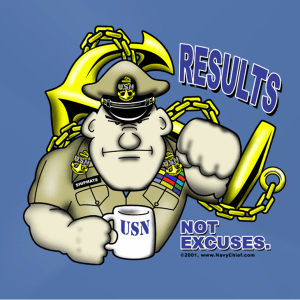
Veterans benefit

It is a long time in coming, but f you served, you may again be eligible for GI Bill Education benefits that you may have thought expired.

Sharing news from the Veterans Administration:

Dear Fellow Veterans and Colleagues,

As you know, the recent passage of the Harry W. Colmery Educational Assistance Act of 2017, also known as the “Forever GI Bill,” enacts several changes to the GI Bill that will positively impact Veterans and their families. Some of the changes became effective the day the law was signed, some next fall, and some in the future. In the months to come, I’ll be updating you on how this new law impacts VA education benefits and what actions Veterans may need to take.

Here’s a breakdown of some of the legislation that immediately went into effect with the President’s signature, and what it means for you.

The 15-year time limitation for using Post-9/11 GI Bill – The 15-year limitation to use benefits is removed for Veterans who left active duty on or after January 1, 2013, children who became eligible for the Marine Gunnery Sergeant John David Fry Scholarship (Fry Scholarship) on or after January 1, 2013, and all Fry Scholarship eligible spouses.

There is no action you need to take; if eligible, the limitation is simply removed for you.

Restoration of Benefits due to School Closure – We are now authorized to restore benefits and provide relief to Veterans affected by school closures or disapprovals.

If you attended courses or programs discontinued from January 1, 2015 to August 16, 2017, and attended an accredited institution of higher learning, and did not transfer any credits to a comparable program, entitlement will not be charged for the entire period of your enrollment. The law also provides separate criteria for partial benefit restoration for school closures after January 1, 2015.

To apply for restoration, we will develop a web page with instructions, information, and a form to complete and return. I will update you when this page is available, and we’ll post an announcement on our main GI Bill page and social media sites.

Independent study programs at career and technical education schools covered by GI Bill – This allows anyone eligible for GI Bill to use their benefits at an accredited independent study program at an area career and technical school, or a postsecondary vocational school providing postsecondary level education. A bit of background on this provision: before the passage of this law, most non-college degree programs weren’t approvable if any portion of it was online. This change allows those programs to be considered for approval even if some or all of the instruction is online/not in a classroom.

There is no action for you to take here, as these programs will go through the normal course of approval by the appropriate State Approving Agency. Any new programs will be added to our GI Bill Comparison Tool.

Reservists who had eligibility under the Reserve Educational Assistance Program (REAP) and lost it due to sunset of the program will have that service credited toward the Post-9/11 GI Bill program – We are in the process of identifying the approximately 2,800 Reservists affected by this and will send them letters with instructions.

I will update you when the letters go out, and what to do if you did not receive a letter but feel you may be eligible for this restoration. We will also post more information on the GI Bill web and Facebook pages.

These changes will greatly benefit our nation’s Veterans by providing expanded access and opportunity to access education benefits. I will continue to update you as we work out the details of this legislation.

As always, thank you for your service.

Regards,

Curtis L. Coy
Deputy Under Secretary for Economic Opportunity
Veterans Benefits Administration
U.S. Department of Veterans Affairs
Washington, DC 20420
VA Core Values: Integrity, Commitment, Advocacy, Respect, Excellence (“I CARE”)


the vibe

At the Starbucks today, I had a great chat with a police officer as we both were waiting on our orders.   He is probably ten years my junior, but  I had the sense,  a “vibe” Californians generally would call it,  that this man was formerly military.   The bearing of a military veteran is different; I’ve talked with religious leaders whom I got that same sense and  I then find confirmed they served in the military.  And having the acquaintance of cops from other backgrounds,  and cops who transitioned from the military,  I think there is subtle differences.  But I digress.  This officer acknowledged that he transitioned into blue uniform of a police officer.   However, his Army career and his public service had been in tandem:  while recently retired from the Army National Guard,  he was and is a 20-plus years veteran police officer civilian and military police.

In contrast, I got a different sort of vibe from a conversation I wandered into recently.  It suggested (to me) a child’s encounter with a member of law enforcement was either embellished by the storyteller’s negative opinion of civil authority and biases, or a child’s encounter with a greenhorn LEO;  the described first impression of flashing lights,  and a rehearsed, “politically-sensitive” introduction to a preteen would have been handled differently by my Starbuck’s patron LEO.   But in a time when it can be as hazardous for an officer – whether a conflict or a civil rights violation,  in a suburb in the Southwestern U.S. as in Southwest Asia (aka the Middle East),  tact might be a secondary concern.

In my childhood,  a police officer would see my bike run over in the middle of the street, check to see that I was unhurt, and then bring me home to my parents in the squad car.  Even a decade ago when my preteens were goofing off in the neighborhood and cops were called,  my wife came out to find my kid and his friends placed against a squad car. They all were “released to the custody” of  one really ticked-off Mom.   It was a different time.   But children of military veterans, and families where the military and law enforcement are family tradition, there is more respect given to those in authority.   I’ve generally only known times when the community relied on law enforcement as much as the other way around.

I would prefer to think that a poor impression made on this young man, would be the outcome of a lack of mentoring.  In the military, the best units have a reputation for building leaders and subject experts,  through the years of mentoring and feedback.  Such was my experience.   And several of my mentors, and those who came after me excelled militarily and professionally.    Several were law enforcement officers, federal marshals and agents.   I’ve known a few servicemen who were an ego in a uniform,    but most of the leaders I knew were humble.   Such was this professional I encountered today.

But I may be biased.   I support the fraternal orders of law enforcement.   I am a Life member of the Veterans of Foreign Wars.   I am grateful for these citizen-soldiers who continue to serve our communities.  Who serve our nation.   Who raise sons and daughters to be responsible, thinking adults.   Some choose other careers,  hold different views, but treasure the country,  respect its laws and order,  and respect people who respect others in return.  Among old warriors,   a recognition and  camaraderie, an appreciation of shared experience, discipline and service.   Thanks for serving.


original
Military Police, photo courtesy of http://www.army.mil


vets_3_pic
courtesy of http://www.vfw.org


Dunkirk, the movie

Watching the movie, Dunkirk, on Saturday was not a traditional rendering of the epic war-story.  The rescue of hundreds of thousands of British and French troops on the beach in May, 1940 was told in intersecting story lines.

But what I got out of it as a military veteran, was both the unspoken fear of many young soldiers who were looking at the empty sea for rescue, strafing, bombing and the ships they were able to find and board,  being sunk.    It had little dialogue- the courage of those who were defending the retreating soldiers, pilots and the naval personnel who were trying to protect these troops made the film even more desperate.   At one point, one of the characters makes the observation that England was not mobilizing a lot of their navy in order to preserve it for the expected invasion from Hitler.  But they were mobilizing a civilian fleet to sail for Dunkirk.   That early war period, when the Germans were rolling across Europe seemed hopeless.  There was courage, particularly in those who sailed across the English Channel in thousands of boats to rescue the men.

My mother grew up near Belfast in now Northern Ireland.  I never heard stories about living during the war and only learned how difficult it was from history and publications I obtained when we visited there.  Perhaps as she was quite young early in the war, but it might well have been that spirit the British exhibited.   You see, the Germans during the Battle of Britain, especially in 1940 -41,  were bombing the shipyards, factories and sinking merchant fleets to isolate Britain.   The heroism of the troops that eventually defeated Hitler’s armies was not the stuff of epic war movies, but courage expressed in action of ordinary people doing the extraordinary.   The scene in Dunkirk I appreciated was the young soldier riding in the train once back in Britain about Winston Churchill’s stirring words to rally the Britons.  And the people far from being negative about their rescued troops, were rallying and supportive and welcoming.

“field day” is not outdoors

I love the smell of Pine-oil cleanser.  Many years ago, I was taught, or should I say, I was indoctrinated, in  proper cleaning technique by the United States Navy.   One of the cleansers we used was Pine-oil, in water.   With a mop and a wringer bucket – known as a swab and a cadillac, respectively and a tremendous amount of elbow grease, we would render things sanitary.   One of the least sanitary places,the bathroom – head to the Navy and Marines, a latrine, to Army and  Air Force,  was subject to daily, or even twice-daily cleaning.  In boot camp, there are two primary skills impressed on the incoming rag-tag civilian to turn him into military personnel.  Behind all the barking orders, trash can tossing, marching, calisthenics, and of course, basic military training, is attention to detail, and instinctive obedience to orders.

cropped-2c1c4-picture1Cleaning is one of those “attention to detail” skills.  One of the favored techniques of boot camp instructors when our unit was housed in Korean War -era barracks, was to set us to performing “field day” (deep cleaning) the barracks.  These were a magnet for dust, flaking paint and generally the decks (floors) were yellowed or dull.  The reward for passing inspection was relief from a marching drill, calisthenics, or even a short recreation period.  The punishment for failing that inspection was enduring the former two choices and then, to field day all over again.   As a trainee at a military technical school, the same inspections and field days occur, though the “Fleet Sailor” is normally separated from the recent boot camp graduates at a training command.  pinesol

You see,  the “Fleet Sailor” has learned over years, that drills, inspections, and cleanliness are necessary, but she has developed a cynicism, a sarcastic response -mouth, and a few shortcuts to the cleaning process, particularly at a training command.  Enter Pine-Sol  and Future acrylic floor shine.  Pine-Sol cleans very thoroughly, and even a few drops will permeate the living quarters to smell “clean”.    Since waxing is a very time-consuming process to get applied properly and looking even,  Future, when the floor has been thoroughly stripped of wax and cleaned, and applied carefully, generally resulted in inspection grades of “OUTSTANDING”.   And that normally resulted in a duty-free day. That was,  relief from standing a watch.  Of course, the acrylic easily scratched, so occupants of those quarters would leave shoes by the door when entering the room for the next several days.

Some fifteen years later,  aboard ship,  our Executive Officer, “XO”, would periodically inspect areas of the ship to determine if the proper attention to detail was being paid.   One favorite memory involved him, in coveralls and gloves, flashlight in hand, prostrate on the deck in the head next to a urinal.  I was carrying a clipboard to note deficiencies.  Up came the XO with palm up glove “asking” the senior Petty Officer in the compartment,  “WHAT IS THIS, PETTY OFFICER?”

“PUBES, SIR”, he replied.

Pubic hairs on the deck behind the urinal and some dried pee were contributing factors to impending doom in armed conflict with an adversary.  It indicated a lack of attention to detail.   It was the XO’s job to see to it that everything on a ship was as near perfection as humanly possible.  Efficient machines and a capable crew, ready and able to fight catastrophe – fire, accidents, flooding, and the unexpected has saved lives.

FuturebottleAnd now twenty-five years later,  three boys now grown, and living in one of the dustiest environments I have experienced, with shed-prone dogs,  my home has only been subject to a ‘fairly good’ field day about once a month, and a decent sweep and swab each week before company comes over.    I am not complaining.   Were I to dare to get out the glove, flashlight and query about pubic hairs and pee, the “Admiral” would point me in the direction of a bucket and swab  and have me re-do it.
My former Commanding Officer and now, Rear Admiral, would probably be smiling, approving of an old Senior Chief getting re-acquainted with the swabbie skills.  She always like my wife, the Ombudsman as much if not more than me.

Where the heck is the Pine-oil?  I need to get to work.

NEVER clean a Chief’s coffee mug

One of the best and worst times of my young Navy Sailor life was performing as a “Mess Crank”.

While I have heard that the services now seem to employ civilians in the galleys or chow halls  – all recruits learned kitchen duties  in the recruit training commands’ cafeterias when I went through forty years ago.    I can only imagine what shipboard life is now  but it was a fact of sharing in responsibilities especially with the non-rated junior Sailors to help in all the Mess (kitchen) duties.    You might find a “Mess crank”  ( not a pejorative but a traditional term that none in my day might offer they were offended by)  at all hours scrubbing, putting away dishware, or running a buffer across the waxed decks.  For those assigned to the Officers Mess,  Commanding Officer’s or the Chiefs’ Mess,  duties came with varying levels of perks.  Basic duties included setting up the coffee urn. On military installations, the 24-hour nature of the job meant coffee should always be fresh and never run out.  This may have changed somewhat with the Millenials entering the ranks.  About the time I retired, many Sailors were drinking those Energy drinks – all highly caffeinated – so some may have not taken up the coffee habit.

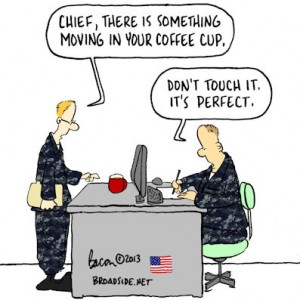
I might be old-fashioned, but woe to a Chief in the “Goat Locker” who disdains coffee!130715-28coffeemovingcolor397-300x300   A Chief and his coffee cup are fundamental to Navy lore.   Just as my predecessors, I was unable to function without my coffee cup.   Though some mugs might be now metal or some thermal metal/ plastic amalgam, the traditional one, a sturdy ceramic, that might be emblazoned with the Command logo,  a CPO anchor, or the rating and warfare designation.   Sometimes the outside of the cup was quite worn as might be any treasured possession through many years of service.
A retired Chief Petty Officer,  despite the passage of years, can still be identified by his or her crooked finger,  use of one favorite mug,  or the ongoing need to balance work with coffee – and usually a bit of advice that begins. “now this is a no-sh*t*er..”   On duty, the Navy Chief might otherwise be off-balance were it not for that crooked finger cradling a steaming mug.  It is a tool for supervision, training or correction.   The tell-tale hallmark of a “salty” Chief Petty Officer is the dark, some might say even crust-like, layer of black-brown coffee rings within a Chief’s coffee mug.   “Added flavor” we all say.

And under NO circumstances, be the one “Mess crank”, who takes it upon himself to wash out the “filthy” mugs in the Chief’s Mess.    The Chief’s Community has better information sharing than the latest satellite technology, and while you may eventually rise to become an initiate into the CPO community, someone might have been waiting 10 or 15 years to live down that sacrilege.   These days I keep one cup at work that never, ever gets washed.  Perhaps it is part of my charm.   I have been known to several for years by,  and still earn the respect of  co-workers, as the “Chief”

** Cartoons    Broadsides,   Jeff Bacon

** more interesting asides about coffee mugs and the Chief’s community –http://www.navyhistory.org/2013/11/dont-wash-that-coffee-mug/

Iron men and wooden ships

I think I should learn to sail before I die.  In a sailboat.  Perhaps on the ocean.  After all, I spent a seventh of my life on the ocean, in vessels that patrolled the world.  Of course, none of these used wind power and fabric for propulsion.   But as crew aboard a warship crossing the Pacific and at other times crossing the Atlantic,  I recall seeing adventurers on their tiny cork

For inspiration,  I was reading about a couple adventurers, beginning with Robin Knox-Johnson who was first to sail solo and non-stop around the world in 1968 ( it took him 10 months to complete)  and latest, Thomas Colville, whose fifth attempt at breaking the 2008 record of 57 days  accomplished circumnavigation in only 49 days.

Or maybe I will just take lessons this summer on a smallboy at the Navy MWR marina and sail in San Diego Bay.

the cradle of uncivil-ization

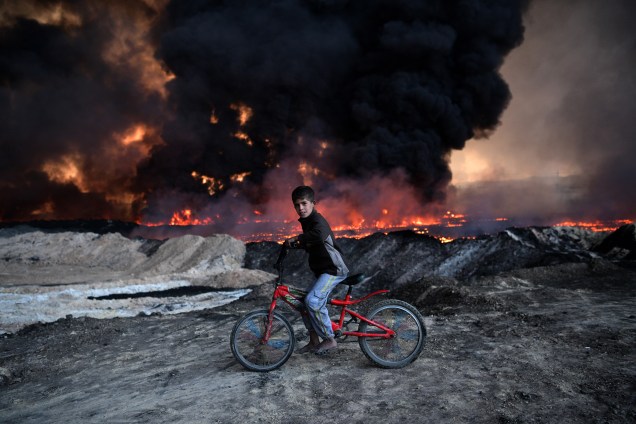
Opening this week’s edition of TIME magazine (June 26, 2017), my eye caught a pictorial article on the environmental battle that was waged last year in Iraq when ISIS set fire to oil fields to hinder the advance of the Iraqi and coalition force pushing them out from the territory they terrorized for years.

Joint Forces Battle To Retake Iraqi City Of Mosul From ISISIt is quite instructive that the world has become well-versed in the environmental  and human toll of oil spills and fires.  In that region, decades of poisoned water, poisoned wildlife,  and landscapes as a result of months of exposure to deliberate acts of evil men,   toxic fumes, oil -laden smoke and chemicals have been largely overlooked by the European and American “globalists”.   Twenty-five years ago,  while one American political party blamed another party,  the apolitical Government bureaucracy was ignoring the toll on forces of the first Gulf War;  I remember the “Gulf War Syndrome”  where U.S. veterans had to fight through the courts to obtain needed care and Government acknowledgement of responsibility for their ailments.
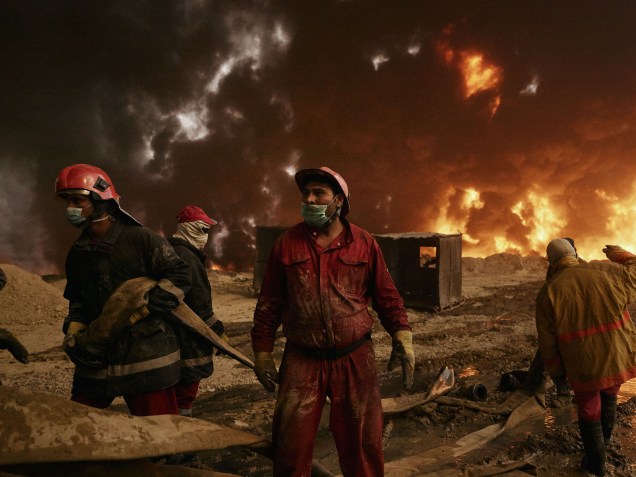
qayarrah_iraq_joey_l_photographer_11_resizingThe TIME article and other sources make the point that the Iraqi firefighting forces – petroleum engineers specialized in fighting these – have been doing so for years.   With ongoing battles against terrorists’  IEDs, bullets at the same time as fires hot enough to incinerate men and equipment,  Iraqi forces extinguished the fires the terrorists set along their retreat.   The Iraqi people who lived through a “scorched -earth” mandate from Saddam Hussein to his forces in 1991, are the same people who suffered again from an extremist army who once again set fires, IEDs, and booby-traps;  from the oil fires damage caused in the aftermath of the Gulf War,  those exposed suffer from cancer, skin diseases, birth defects,  mental issues and myriad other life-shortening illness.  And that terrorists set their world ablaze again, the effects will continue to plague people.   It is no wonder that the poor have risked dying in the attempt to flee to other countries.

While we wonder whether carbon dioxide in the air over the U.S. is a harmful pollutant,  perhaps the same “climate change” advocates can travel to Iraq to advise them that ending America’s reliance on hydrocarbons will end their suffering.

Further reading:

the Navy remains in good hands

Commuting home on a Monday, I knew that the traffic on the second leg of my drive would be better if I stopped by the cigar lounge for a little while.  Watching basketball (Golden State won the championship!) this evening at my favorite den of man-dom, it was also a chance meeting for this old Senior Chief to swap sea-stories with a 9th-year Sailor currently on training orders to San Diego.

Though he is an Operations Specialist (OS) on the USS STENNIS now in Washington state, and I was an Cryptologic Technician,  any Sailor I know would relate to the conversation; it was observations, opinions and swagger that a solidly capable, mentoring-focused, take-no-b***t career Sailor and I enjoyed that evening.  Even though I haven’t set foot, in uniform, on a ship or installation in eight years,  the conversation about current events,  deployment, camaraderie, and the social and political changes the Navy has undergone, invigorated me.  There’s something about watching the NBA Finals with a bunch of guys – some veterans, some civilians, and like this fellow, currently serving, that made a Monday great hangout time.  dont-tread-300

Sailors of fortune

Before the advent of  Cyber warfare,  when a ruler wanted to extend his (or her) sovereignty beyond the geographic boundaries of mountains or the sea, sailors were called upon.   Three thousand years BCE,  from their largest settlements on Crete, the Minoans had extensive trade with Egypt and the Syrian people of eastern shores of the Mediterranean.  They were wiped out from the sea– literally.   But the Philistines, whom Ramses III battled (his monuments bear witness to his Philistine captives) were likely either Minoan or proto- Roman Etruscan immigrants.  So once again sailors were prominent in history.

The Homeric tales of Greek mythology reflected actual battles of the Mycenaeans (Greeks) with the Trojans about 1100 years BCE in present-day Turkey.  Scholars think these wars were probably for access to the Black Sea through the Dardanelles.  Sailors as soldiers of fortune again made history.  Troy, whether or not fooled by a wooden horse at the time,  was laid waste, and likely sailors had some role.   About 500 years BCE,  the Mycenaeans battled and eventually repulsed invasion of the Persian Xerxes empire (attacking from the sea).   And as Greek seapower grew, sailors extended their reach and culture all through the eastern Mediterranean.

Alexander the Great, the Macedonian, about 300 BCE, created a Greek empire from Europe east to India and south into Egypt.  And the Romans about that time started to extend their reach by land and the sea.  For hundreds of years,  sailors extended the Roman influence from Britain to Egypt and North Africa.

Since the age of Christ,  European sailors have extended empires and trade to and from all corners of the globe. While squabbles between armies and navies are now over football games,  I think each is beholden to the other.   Sailors may have a tradition of rowdiness in ports around the world, but also gained a reputation for “girl in every port”.  FB_IMG_1491759647178From sailors, over the thousands of years of our known history,  we all potentially have some  DNA of people they encountered:  Assyrians, India,  Egyptians, Carthaginians,  Mongols, Polynesians, Chinese or aboriginal (native american or australian).  If not for Sailors of Fortune,  the dust of time would perhaps cover us.

heroes aren’t like in the movies

There are things that we remember from our youth ( or while I was still ‘under 30’) that should be left in those musty corners of our mental garage.  Just like the old cassette tape  I found during one ‘Spring Cleaning’ out there,  hearing the Split Endz again – or 38 Special  just doesn’t make me “feel” the same thirty years later.   Same thing tonight. A little casual dinner on the couch while watching the beginning of “Highlander” – the one with Sean Connery and Christopher Lambert.  (I recognized the villain, but I can’t remember his name.)   The effects are so rudimentary and the dialogue is rather lame – Sean Connery sounds a Scot but is supposed to be Spanish; however, Chris Lambert – he’s got one of those Kevin Costner-like non-accents due apparently to limited ability to speak English.

Even the swordplay and beheadings are cheesy.   I am trying to figure out why that movie spawned sequels and a television series.  Men in kilts?  Swords?  Perhaps it is the decades in the Navy that have colored my judgement.  I often let reality get in the way of plot on a lot of alien, superhero, or alien versus battleship dramas.   I should have read Mental Floss ‘s review here before I realized a few minutes in that watering the plants and picking up the dog poop was a better use of my time.

I offer a list of dropped must-have guy movies (or TV collections) of the last 30 years.    Some I don’t get why I liked them in the first place.  I don’t have either on DVD or nor recorded on the DVR:

  1. Top Gun (I still can watch Minority Report – for Max Von Sydow ) Cruise movies annoy me
  2. Die Hard (sequels)  ( the first was a classic, then they just kept coming)
  3. Highlander ( love Connery, but fast-forward 20 years to see how comic book-type movies are made WELL)
  4. Smokey and the Bandit ( Gleason’s last films, but such a dumb plot!)
  5. Battlestar Galactica (1978) (Lorne Greene still Cartwright for me !)
  6. Star Trek (only one of those movies I’ll watch again is Wrath of Khan with Monteban – I saw the original TV episode and loved the movie.)  However, the reboot movies with Chris Pine are great!
  7. Talledega Nights  ( now I wonder why I thought Ferrell was funny)
  8.  X-men after the first one.  I cannot keep up with the comic book plot jumps)
  9. Outlaw Josey Wales ( I prefer the Eastwood movies he’s made since 2000)
  10. Taken.  I liked Liam Neeson’s portrayals in Star Wars, the villain in Batman Begins, and Taken -even Love, Actually.  Then he just annoyed me with his Taken sequels   and his anti-gun off-screen preaching.

I think I need to watch Gladiator,  Lone Survivor,  and any of the movies that Sam Elliott was in. Testosterone, guts, courage and attitude.  What we need now more than ever are heroes: dads who want to raise their children responsibly,  people who recognize the effort and support the work of cops, volunteers to help our senior citizens  and young people who don’t want a hand out, or a “safe space”.

Pardon me while I gasp for air

“For, with a ship’s gear, as well as a sailor’s wardrobe, fine weather must be improved to get ready for the bad to come.”
Richard Henry Dana Jr., Two Years Before the Mast: A Sailor’s Life at Sea

Call me “somewhat concerned” with my deterioration during and after naval service.  Thirty years ago, I was prescribed steroids for some medical issues.  Twenty years ago, my appendix ruptured at the start of the Labor Day weekend holiday.  I was recuperating for a month.  I started to put on weight (happily-married weight) ten years ago.   And three  years ago, after getting too obsessed with cycling exercise, using clipless pedals  I fell and broke my wrist  in three places.  A year ago, I self-diagnosed that an annual or semi-annual trip to the ER  ( for ten years) was due to a food allergy to capsaicin.  Now that I have sworn off the spicy food or food containing bell peppers I ate for more than 30 years I am not poisoning myself.

This year I seem to have been crushed by flu and colds.  First year in three that I didn’t get a flu vaccine.   Congestion and nasal drip that chokes me at night will persist for a month, then off for a month or two and then come back just to be annoying.   With some of the crazy medical issues I’ve encountered over my life,  I don’t understand how I don’t have anemia like my late mother ( and low blood pressure)  Nor do I have high blood pressure or a  brain tumor like my late father (in his twenties).  Instead,  I find myself obsessed with breathing.

I always associated breathing problems with asthma, chain-smokers, or the people who live in horribly polluted environments.   I visited Samsun, Turkey one winter while in the Navy, and the coal smoke was literally down to waist-level height by the port . (And they were chain smokers as well.)    I only in the last couple years started smoking the occasional cigar figuring that after age 50,  would take twenty or thirty years to harm me. I probably now have only smoked a half dozen cigars in six months. In the next six months I will quit entirely.    I am very aware that my more sedentary life outside of the Navy renders me more susceptible to ills.   An article I read online tells me a healthier diet and exercise will counter the phlegm that is making breathing at night a chore.

Of course, I may have to cough up a lung or two exercising in my deteriorated state, to get healthier.