#2. If you’re gonna be stupid, you’re gonna be strong!
Flashback to 1977
My Navy career had a lot of great life, management, and leadership lessons. Many are undecipherable to those who have not been in military service but range from teamwork, testing physical and mental limits, courage, decision-making, and taking responsibility before being given authority. In Navy boot camp, the first thing learned is obedience to authority. Line up, no talking, do not move, and other commands. A second is quickly having situational awareness, introduced to recruits around 0400 (4 AM) on their first morning with a barracks wakeup. On my first morning, a metal trash can was hurled clattering across the floor. That, and a simultaneous yell of “Get your @#$ up!”, by the Company Commander.
For 9 weeks recruits are converted from civilians into military service men and women. Attention to detail was another lesson. A military uniform is worn is a precise manner and everything from stray threads to “gig lines” – proper alignment – and cleanliness are inspected. Deviations from the expectation often result in exercise – pushups, situps, 8-count body-builders. In addition, some “special attention” is paid, verbally, to the offender. However, everyone in the unit is afforded the same attention. To build cohesion, the expectation is for others in the unit to help their shipmate improve for the good of the unit as a whole. Making one’s bed, or rack, had to be done in an equally precise manner. Proper stowage of uniform items is also according to regulations. It was the proper folding and stowage of underwear that earned me “special attention”. I had reversed the left-right folds prescribed by the company commander. For that and other misunderstandings, I became the “Polack” – an endearing term – to the company commander until I graduated and became a “Shipmate”.
Thirty years later (2005)
Half a lifetime later, I was again in training. This time it was as a Navy Reservist selected for advancement to Chief Petty Officer (CPO). There is a century and a quarter of tradition in the Chief Petty Officer ranks, where these senior enlisted men and women train and mentor enlisted sailors and junior officers. Officers provide the mission and the direction. Chiefs take their direction and delegate the execution to sailors they place in charge of their division. Chiefs oversee their divisional petty officers, and they in turn, place more junior petty officers in charge of division Workcenters made up of several sailors. The purpose is to identify and mentor sailors to gain leadership skills and advance up through the ranks. To be a trusted member of the Chiefs’ Mess, a First Class Petty Officer, who may be technically proficient, has to be trained to think and act, not for self-promotion, but to delegate and mentor more junior sailors. Also, it is a Chief who deflects criticism, rebuke or conflicting directions given by a junior officer to an enlisted person in their division. It is the Chief who relies on advice from the years of expertise within the Chiefs’ Mess, to lead sailors, handle interpersonal conflicts, maintain discipline, and mentor junior officers to perform to the Commanding Officer’s expectation of warfighting proficiency.
As a Chief Petty Officer Selectee, prior to the promotion ceremony each September, each undergoes a period of training (exercise, team-building, lessons in leadership, traditions and CPO history) and builds camaraderie within the Mess. This formally begins when selection results are reported. And there are invitations to Chief Petty Officers, both on Active Duty and Retired to participate in the “Season” to build the sense of identity as a Mess.
To this very day, I still chuckle over the introduction of our trainer, a Chief Petty Officer who carried a bullhorn with a frequently-used siren. He combined exercise with Question and Answer sessions. We had “homework” every day, including Navy lore, songs, and so forth. We were supposed to share everything we learned and help our fellow Selectees with tasks and such. If we “failed” the answer or task, our trainer had a memorable response:
“If yer (sic) gonna be STUPID, yer gonna be STRONG!”
And then, “DOWN and give me twenty (push ups)!”
Everybody laughed, labored, and “suffered” together but everyone learned. And everyone got stronger, leaner and became a member of the Mess. But then, in the last ten years, politics, social pressures, and a lack of clear direction ( a military needs clear objectives), also affected the leadership at the deckplates. But being a member of the CPO Mess, “Chief Petty Officer, United States Navy”, is the recognition I will treasure for life.
I think a lot of the issues that were reported during the last ten or fifteen years within the leadership – the Chiefs and the Officer community – was due to abandonment or at least a minimalist approach, to training the Chief Petty Officers and mentoring junior officers. I hear it is returning to the tried and true.





 As for me, a new crewman on my first ship, my “salty” (experienced) maintenance supervisor sent me aloft to perform a maintenance check. While this was in port, I was to go about a hundred feet above the waterline, so I paid very close attention to the proper safety procedures. He got me outfitted in climbing gear, lanyards, helmet, bucket of tools and sent me aloft to verify operation of the aircraft warning lamp atop our receiving antenna. Once aloft, white-knuckled, I found there was actually no physical maintenance involved. But the experience cured my fear of heights forever.
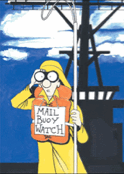 Some time later, it was one young seaman being prepared for a most-important mission that was most amusing to me. His mission: Capturing the mail buoy. It was one of the harmless but amusing initiations for a young Seaman’s first time at sea. The build up was important. The crew was expecting mail, letters from home, Care packages, and so on. A plane flew ahead on the course that the ship was following, dropping the mail buoy. It had to be retrieved. In hardhat, foul weather gear, sound-powered headphones, life jacket, lifeline and a gaff, the Seaman was posted to the forecastle and was instructed to keep his eyes peeled for the buoy. Twenty or thirty minutes in the cold breeze and sea spray later, of course, one of the Boatswains Mates, lookout or bridge watch would then cuss him out (over the headphones) for missing it. Of course, both the Deck Officer, the Bridge OIC and the Chief Boats were in on the joke.
 Another practical joke was played on new seaman on the Low-Visibility Detail. These are lookouts posted to the forecastle during foggy conditions in busy sea lanes. “Boats”, an experienced junior Petty Officer, requested the new seaman on the detail, to signal to the bridge to report whether the Ship’s Whistle (a truly thunderous horn) was working properly. He straight-faced told the seaman, the bridge watch could not hear it. After protecting his ears with each blast, he turned to wave up to the bridge. “It works”. The fun lasted only a few minutes. The Skipper came onto the bridge, demanded to know what that fellow was doing, and after a brief chuckle, put an end to it. He gave us all sorts of oral navigation quizzes to torture us, since we tortured that poor seaman.
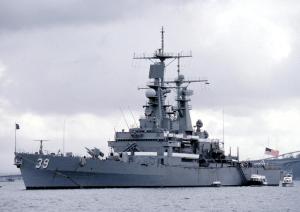
 On a warship there are few times that anything without a strict mission-related purpose is permitted aboard ship. Of course, this does not necessarily mean trinkets the crew buys in a foreign port of call have to be shipped home. After a visit to Turkey, there were many nooks and crannies aboard the Proud Pete that were stuffed with oriental carpets, leather goods and other swag. Another time, after a port visit in the Caribbean, many crewmen had Cuban cigars. And all sorts of goods from stops in the Mediterranean.
 “It” was a park bench the my Commanding Officer, CAPT. Edward Zurey authorized to be installed (welded) in the athwartships passageway near the Ship’s Store. A corner that during his tenure became known as “Broadway and Main” (for the Main Deck).

 Truths, Half-truths, and Sea Stories